CBSE Class 5  >  Class 5 Test  >  Mathematics  >  Test: Measurement of Length, Mass and Capacity - 1 - Class 5 MCQ

Measurement of Length, Mass and Capacity - 1 - Free MCQ Practice Test


MCQ Practice Test & Solutions: Test: Measurement of Length, Mass and Capacity - 1 (10 Questions)

You can prepare effectively for Class 5 Mathematics for Class 5 with this dedicated MCQ Practice Test (available with solutions) on the important topic of "Test: Measurement of Length, Mass and Capacity - 1". These 10 questions have been designed by the experts with the latest curriculum of Class 5 2026, to help you master the concept.

Test Highlights:

  • - Format: Multiple Choice Questions (MCQ)
  • - Duration: 10 minutes
  • - Number of Questions: 10

Sign up on EduRev for free to attempt this test and track your preparation progress.

Test: Measurement of Length, Mass and Capacity - 1 - Question 1

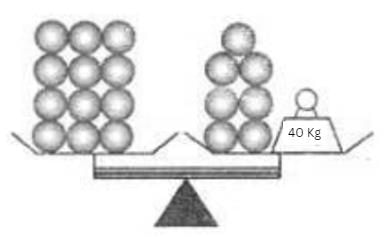
What is the mass of 20 such ?

Detailed Solution: Question 1

From the balance scale diagram:

  • Left side has 12 identical balls (arranged 3 × 4).
  • Right side has 7 identical balls plus a 40 kg weight.

Since the scale is balanced:

12 balls = 7 balls + 40 kg

Subtract 7 balls from both sides:

5 balls = 40 kg

So, mass of 1 ball = 40 ÷ 5 = 8 kg

Now, mass of 20 such balls:

20 × 8 = 160 kg

Answer: 160 kg

Test: Measurement of Length, Mass and Capacity - 1 - Question 2


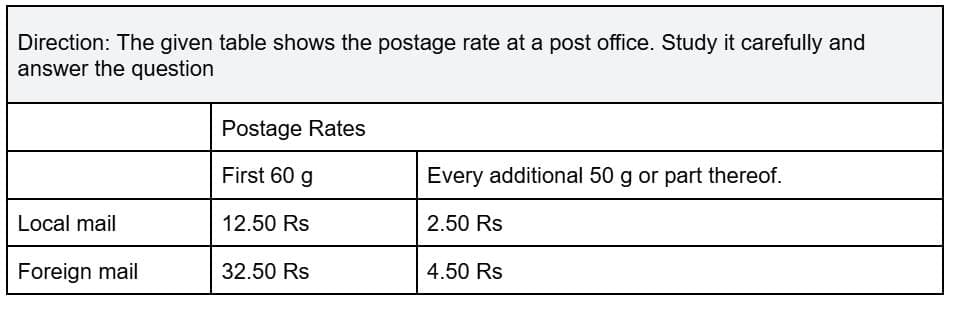
The postage for sending a parcel by foreign mail is Rs.136. What is the maximum possible weight of the parcel?

Detailed Solution: Question 2
To solve this problem, we need to calculate the maximum possible weight of the parcel that can be sent using foreign mail with a postage of Rs. 136.

The postage rates for foreign mail are:

  • First 60 g: Rs. 32.50
  • Every additional 50 g or part thereof: Rs. 4.50

Step 1: Calculate the remaining postage after the first 60 g.

Given that the first 60 g costs Rs. 32.50, subtract this from the total postage:

136 − 32.50 = 103.50 Rs.

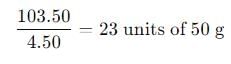
Step 2: Determine how many additional 50 g units can be covered by Rs. 103.50.

Each additional 50 g costs Rs. 4.50, so divide the remaining postage by this amount:

Step 3: Calculate the total weight.

Add the weight for the first 60 g and the additional weight:

60 g+ (23×50 g) = 60 g +1150 g=1210 g

So, the maximum possible weight of the parcel is 1210 g. = 1.210 kgs

Test: Measurement of Length, Mass and Capacity - 1 - Question 3

Soni can cycle from point A to point B and return to point A in 10 minutes. She can cycle and walk back in 18 minutes. It will take ___ mins for her to walk there and walk back.

Detailed Solution: Question 3

Let one-way distance be d, cycling speed be c and walking speed be w.

From cycling both ways: 2d/c = 10 ⇒ d/c = 5 minutes.

From cycling there and walking back: d/c + d/w = 18. Substituting d/c = 5 gives 5 + d/w = 18 ⇒ d/w = 13 minutes.

Time to walk there and back = 2d/w = 2 × 13 = 26 minutes.

Test: Measurement of Length, Mass and Capacity - 1 - Question 4

A rope is 6.45 m long. If 2.80 m of the rope is cut off, what length of rope remains?

Detailed Solution: Question 4

Subtract the cut length from the original length aligning decimal places.

6.45 − 2.80 = 3.65

Remaining length = 3.65 m

Test: Measurement of Length, Mass and Capacity - 1 - Question 5

3 pieces of pastries cost Rs. 345. What is the cost of one dozen pastries?

Detailed Solution: Question 5

Given: 3 pieces cost Rs. 345.

Price of 1 piece = 345 ÷ 3 = 115.

Price of 12 pieces = 115 × 12 = 1380.

Hence, cost of one dozen pastries = Rs. 1380 (Option D).

Test: Measurement of Length, Mass and Capacity - 1 - Question 6

Mrs. Reeta had 17.85 m of ribbon. She cut 11 smaller pieces each of length 0.45 m from it. How many metres of ribbon were left?

Detailed Solution: Question 6

Ribbon used = 11 × 0.45 = 4.95 m.

Ribbon left = 17.85 − 4.95 = 12.90 m.

Therefore, the remaining ribbon is 12.90 m; option B is correct.

Test: Measurement of Length, Mass and Capacity - 1 - Question 7

A shopkeeper mixed 4.75 kg of hazelnuts with 0.75 kg of raisins. He packed the mixture equally into 5 boxes. What is the weight of each box?

Detailed Solution: Question 7

Total weight = 4.75 kg + 0.75 kg = 5.5 kg.

Each box gets an equal share: 5.5 kg ÷ 5 = 1.1 kg per box.

Test: Measurement of Length, Mass and Capacity - 1 - Question 8

It takes 30 minutes to walk __________.

Detailed Solution: Question 8

Only option C is a unit of distance; the others are units of mass (gram, kg) or volume (litre).

Walking is measured by distance, so One kilometre is the appropriate choice.

Test: Measurement of Length, Mass and Capacity - 1 - Question 9

Aman's bag is 2.14 kg lighter than Ajay's bag. The weight of Ajay's bag is 4.72 kg. What is the weight of Aman's bag?

Detailed Solution: Question 9

Given: Ajay's bag = 4.72 kg; Aman is 2.14 kg lighter.

Weight of Aman = 4.72 kg − 2.14 kg = 2.58 kg.

Answer: 2.58 kg.

Test: Measurement of Length, Mass and Capacity - 1 - Question 10

Convert into centimetres: 26 m 6 cm

Detailed Solution: Question 10

Use 1 m = 100 cm.

26 m = 26 × 100 = 2600 cm.

Add the 6 cm: 2600 cm + 6 cm = 2606 cm.

76 videos|469 docs|47 tests
Information about Test: Measurement of Length, Mass and Capacity - 1 Page
In this test you can find the Exam questions for Test: Measurement of Length, Mass and Capacity - 1 solved & explained in the simplest way possible. Besides giving Questions and answers for Test: Measurement of Length, Mass and Capacity - 1, EduRev gives you an ample number of Online tests for practice
76 videos|469 docs|47 tests
Download as PDF