CBSE Class 5  >  Class 5 Test  >  Mathematics  >  Test: Patterns - 2 - Class 5 MCQ

Patterns - 2 - Free MCQ Practice Test with solutions, Class 5 Mathematics


MCQ Practice Test & Solutions: Test: Patterns - 2 (10 Questions)

You can prepare effectively for Class 5 Mathematics for Class 5 with this dedicated MCQ Practice Test (available with solutions) on the important topic of "Test: Patterns - 2". These 10 questions have been designed by the experts with the latest curriculum of Class 5 2026, to help you master the concept.

Test Highlights:

  • - Format: Multiple Choice Questions (MCQ)
  • - Duration: 10 minutes
  • - Number of Questions: 10

Sign up on EduRev for free to attempt this test and track your preparation progress.

Test: Patterns - 2 - Question 1

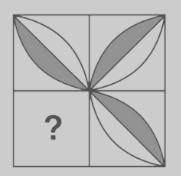
Observe the below figure and identify the missing part.

Detailed Solution: Question 1

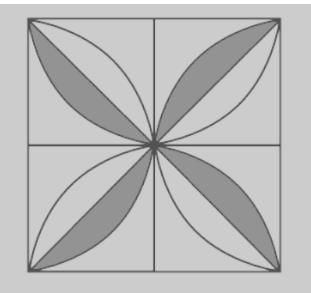
Consider the question figure, where the design in each part will be obtained by rotating the previous design by 90 degrees in the clockwise direction.

So, the missing part will be option (b).

Hence, the complete figure is:

Test: Patterns - 2 - Question 2

What smallest number should be added to 136 to make it a square number?

Detailed Solution: Question 2

Step 1: Find the nearest perfect squares around 136
Perfect squares 
112 = 121
122 = 144

Step 2: Check how far 136 is from the next perfect square
136 is between 121 and 144.
To make 136 a perfect square, we move to the next perfect square, which is:
144 − 136 = 8

Smallest number to be added = 8

Correct Option: C

Test: Patterns - 2 - Question 3

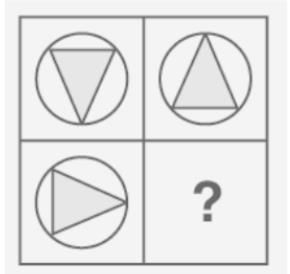
Observe the following figure and choose the correct option.

Detailed Solution: Question 3

Each part of the square box contains a triangle inscribed in the circle in the given figure. Also, the triangle in the next circle is the vertical image of the previous one.

Similarly, in the second row, the triangle in the missing part will be an image of the previous one.

Thus, the missing part is option (a).

Test: Patterns - 2 - Question 4

The next triangular number after 28 is:

Detailed Solution: Question 4

The next triangular number after 28 can be found using the formula for triangular numbers: n(n + 1) / 2.

  • Triangular numbers are formed by adding consecutive whole numbers.
  • The 7th triangular number is 28, so the next is the 8th.
  • Calculate using 8(8 + 1) / 2:
  • 8 × 9 / 2 = 36
  • Therefore, the next triangular number is 36.

Test: Patterns - 2 - Question 5

What is the next number of the series 1, 2, 4, 8, 16, ____________ is

Detailed Solution: Question 5
This series doubles each number to get the next. Starting from 1, the pattern is as follows:

1 x 2 = 2
2 x 2 = 4
4 x 2 = 8
8 x 2 = 16
16 x 2 = 32
The next number is 32.

Test: Patterns - 2 - Question 6

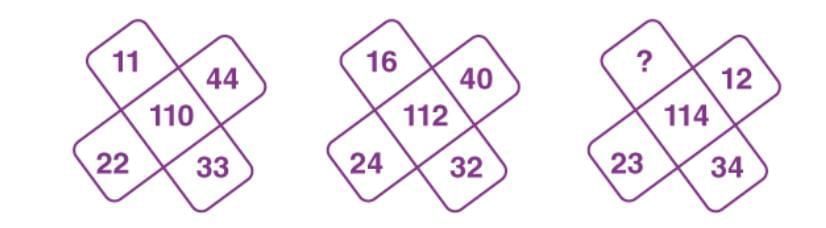
Observe the pattern given below. Find the missing number.

Detailed Solution: Question 6

In the given figure, we can observe that the sum of the four numbers is equal to the number written in the middle of the shape.

That means,

11 + 22 + 33 + 44 = 110

16 + 24 + 32 + 40 = 112

? + 23 + 34 + 12 = 114

? = 114 – 23 – 34 – 12 = 45

Therefore, the missing number is 45.

Test: Patterns - 2 - Question 7

The square number which is just greater than 100 is:

Detailed Solution: Question 7

The square numbers are the products of an integer multiplied by itself. The square of 10 is 100, and the next integer is 11, which squared is 121. Therefore, the square number just greater than 100 is 121.

Test: Patterns - 2 - Question 8

Which of the following is a square number between 80 and 90?

Detailed Solution: Question 8

81 is the square of 9 (9 x 9), and it is the only square number between 80 and 90.

Test: Patterns - 2 - Question 9

The square number just after 200 is

Detailed Solution: Question 9

225 is the next square number after 200 because it is 15 squared (15 x 15).

Test: Patterns - 2 - Question 10

Which of the following is a square number?

Detailed Solution: Question 10

A square number is an integer that is the square of an integer; in other words, it is the product of some integer with itself. Here, 121 is 11 times 11, so it's a square number.

76 videos|469 docs|47 tests
Information about Test: Patterns - 2 Page
In this test you can find the Exam questions for Test: Patterns - 2 solved & explained in the simplest way possible. Besides giving Questions and answers for Test: Patterns - 2, EduRev gives you an ample number of Online tests for practice
76 videos|469 docs|47 tests
Download as PDF