CBSE Class 4  >  Class 4 Test  >  Science  >  Test: Solids, Liquids & Gases- 2 - Class 4 MCQ

Solids, Liquids & Gases- 2 - Free MCQ Practice Test with solutions,


MCQ Practice Test & Solutions: Test: Solids, Liquids & Gases- 2 (10 Questions)

You can prepare effectively for Class 4 Science for Class 4 with this dedicated MCQ Practice Test (available with solutions) on the important topic of "Test: Solids, Liquids & Gases- 2". These 10 questions have been designed by the experts with the latest curriculum of Class 4 2026, to help you master the concept.

Test Highlights:

  • - Format: Multiple Choice Questions (MCQ)
  • - Duration: 15 minutes
  • - Number of Questions: 10

Sign up on EduRev for free to attempt this test and track your preparation progress.

Test: Solids, Liquids & Gases- 2 - Question 1

Which of these is a characteristic property of gases?

Detailed Solution: Question 1
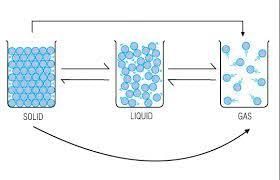
  • Gases have no fixed shape or volume, as their particles are widely spaced and move freely in all directions.
  • This property allows them to expand and fill the shape of the container they are in.
  • Additionally, gases are compressible due to the large spaces between particles, have low density compared to solids and liquids, and do not have tightly packed particles.

Test: Solids, Liquids & Gases- 2 - Question 2

The conversion of matter from solid state to liquid state is called ________.

Detailed Solution: Question 2

The process of conversion of solid state to liquid state is called melting.

What are some examples of melting? - Quora

Test: Solids, Liquids & Gases- 2 - Question 3

Read the statements carefully and choose the correct option.     
Statement A: In solids the molecules are packed the closest together.
Statement B: In gases the molecules are spread out the most.

Detailed Solution: Question 3
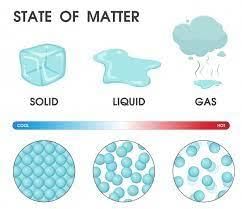
Solid > Liquid > Gas. Solids have the most tightly packed molecules and gases have the least packed molecules.

Test: Solids, Liquids & Gases- 2 - Question 4

Water is known as a universal ____.

Detailed Solution: Question 4

Water is known as a universal solvent because it can dissolve many substances like salt, sugar, coffee, and more. A solvent is what dissolves other substances in a solution.

Test: Solids, Liquids & Gases- 2 - Question 5

Air has _____ and takes up _____.

Detailed Solution: Question 5

Air has weight and takes up space. This means that even though we can't see air, it still has some weight and fills the space around us. Imagine blowing up a balloon, the air you blow into it gives the balloon weight and fills it up just like how air fills the space around us.

Test: Solids, Liquids & Gases- 2 - Question 6

Which process would be used to separate sugar from a sugar-water solution?

Detailed Solution: Question 6

Evaporation is used to separate sugar from a sugar-water solution. By heating the solution, the water evaporates, leaving behind the sugar crystals. This method works because sugar dissolves in water but does not evaporate with it.

Test: Solids, Liquids & Gases- 2 - Question 7

What happens to the rate of diffusion when a substance changes from a solid to a liquid?

Detailed Solution: Question 7

The rate of diffusion increases when a substance changes from a solid to a liquid. In liquids, particles are less tightly packed and can move more freely compared to solids, allowing for faster diffusion.

Test: Solids, Liquids & Gases- 2 - Question 8

What is the outcome when a substance undergoes condensation?

Detailed Solution: Question 8

Condensation involves a substance changing from a gas to a liquid. For example, water vapor in the air condenses into liquid water when cooled, such as when steam forms droplets on a cold surface.

Test: Solids, Liquids & Gases- 2 - Question 9

Which of the following is an example of an insoluble substance in water?

Detailed Solution: Question 9

Tea leaves are an example of an insoluble substance in water. Unlike sugar and salt, which dissolve, tea leaves do not dissolve in water. They remain separate and can be filtered out from the liquid.

Test: Solids, Liquids & Gases- 2 - Question 10

What is the role of a solute in a solution?

Detailed Solution: Question 10

A solute is a substance that dissolves in a solvent to form a solution. For example, when sugar is added to water, it dissolves (solutes) to form a sweet solution. The solute integrates into the solvent to create a uniform mixture.

48 videos|193 docs|34 tests
Information about Test: Solids, Liquids & Gases- 2 Page
In this test you can find the Exam questions for Test: Solids, Liquids & Gases- 2 solved & explained in the simplest way possible. Besides giving Questions and answers for Test: Solids, Liquids & Gases- 2, EduRev gives you an ample number of Online tests for practice
48 videos|193 docs|34 tests
Download as PDF