CBSE Class 9  >  Class 9 Test  >  : Additional Practice  >  Test: The Fundamental Unit of Life- Case Based Type Questions- 2 - Class 9 MCQ

The Fundamental Unit of Life- Case Based Type Questions- 2 - Free Questions


MCQ Practice Test & Solutions: Test: The Fundamental Unit of Life- Case Based Type Questions- 2 (10 Questions)

You can prepare effectively for Class 9 Class 9: Additional Practice with this dedicated MCQ Practice Test (available with solutions) on the important topic of "Test: The Fundamental Unit of Life- Case Based Type Questions- 2". These 10 questions have been designed by the experts with the latest curriculum of Class 9 2026, to help you master the concept.

Test Highlights:

  • - Format: Multiple Choice Questions (MCQ)
  • - Duration: 20 minutes
  • - Number of Questions: 10

Sign up on EduRev for free to attempt this test and track your preparation progress.

Test: The Fundamental Unit of Life- Case Based Type Questions- 2 - Question 1

Direction: All living Organisms are made up of cells and these cells perform all the functions essential for the survival of the Organism eg. respiration, digestion, excretion etc. In Unicellular organisms, a single cell carries out all these functions and in multicellular organisms different group of cells carry out different functions.

Q. Cell was discovered by

Detailed Solution: Question 1

Initially discovered by Robert Hooke in 1665, the cell has a rich and interesting history that has ultimately given way to many of today's scientific advancements.

Test: The Fundamental Unit of Life- Case Based Type Questions- 2 - Question 2

Direction: All living Organisms are made up of cells and these cells perform all the functions essential for the survival of the Organism eg. respiration, digestion, excretion etc. In Unicellular organisms, a single cell carries out all these functions and in multicellular organisms different group of cells carry out different functions.

Q. Select the Prokaryotic cell

Detailed Solution: Question 2

Bacteria do not have a true nucleus or well developed nucleus. So, it is a Prokaryotic cell.

Test: The Fundamental Unit of Life- Case Based Type Questions- 2 - Question 3

Direction: Study the given diagram and answer the following questions.
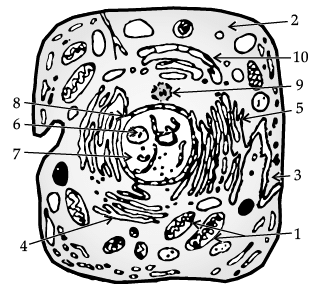
Q. The Organelle responsible for intracellular transport is

Detailed Solution: Question 3

Endoplasmic Reticulum is an extensive, interconnected, membrane bound network of tubes and sheet which provide a pathway for intracellular transport of materials.

Test: The Fundamental Unit of Life- Case Based Type Questions- 2 - Question 4

The only cell organelle seen in prokaryotic cell is       

Detailed Solution: Question 4

 Unlike eukaryotic cell, a prokaryotic cell lacks membrane-bound organelles like plastids, mitochondria and endoplasmic reticulum, but smaller and randomly scattered ribosomes are seen.

Test: The Fundamental Unit of Life- Case Based Type Questions- 2 - Question 5

Direction: Study the given diagram and answer the following questions.
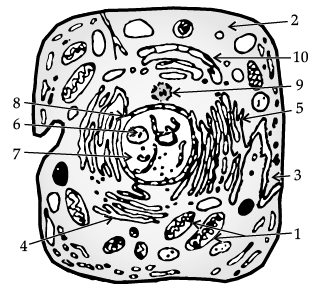
Q. Identify the diagram

Detailed Solution: Question 5

Animal cells do not have cell walls because they do not need them. Cell walls, which are found in plant cells, maintain cell shape, almost as if each cell has its own exoskeleton. This rigidity allows plants to stand upright without the need for bones.

Test: The Fundamental Unit of Life- Case Based Type Questions- 2 - Question 6

Direction: Study the given diagram and answer the following questions.
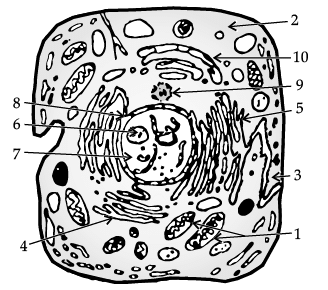
Q. Which part in the cell help in protein synthesis

Detailed Solution: Question 6

Ribosomes are called protein factories because proteins are manufactured in the Ribosomes.

Test: The Fundamental Unit of Life- Case Based Type Questions- 2 - Question 7

Direction: Two beakers A and B contain plain water and concentrated sugar solution respectively. Equal number of dry raisins are kept in them for a few hours and then taken out.

Q. Shrinkage of protoplasm is known as

Detailed Solution: Question 7

Shrinkage of protoplast from the cell wall in the presence of hypertonic solution due to Exosmosis is known as Plasmolysis.

Test: The Fundamental Unit of Life- Case Based Type Questions- 2 - Question 8

Direction: Two beakers A and B contain plain water and concentrated sugar solution respectively. Equal number of dry raisins are kept in them for a few hours and then taken out.

Q. In beaker B, the raisins will_____

Detailed Solution: Question 8

In beaker B, raisins will Shrink because water concentration is less outside the cell membrane, so more water comes out of the membrane than enters.

Test: The Fundamental Unit of Life- Case Based Type Questions- 2 - Question 9

Direction: Two beakers A and B contain plain water and concentrated sugar solution respectively. Equal number of dry raisins are kept in them for a few hours and then taken out.

Q. In beaker A, the Raisins would________

Detailed Solution: Question 9

In beaker A, the raisins would swell because water concentration is higher outside the cell membrane, so more water enters the membrane than leaves it.

Test: The Fundamental Unit of Life- Case Based Type Questions- 2 - Question 10

Direction: Two beakers A and B contain plain water and concentrated sugar solution respectively. Equal number of dry raisins are kept in them for a few hours and then taken out.

Q. Category of the solution A is

Detailed Solution: Question 10

In beaker A, the raisins would swell because water concentration is higher outside the cell membrane. So more water enters the membrane than leaves it.

In beaker B, raisins will shrink because water concentration is less outside the cell membrane. So more water comes out of the membrane than enters.

4 docs|108 tests
Information about Test: The Fundamental Unit of Life- Case Based Type Questions- 2 Page
In this test you can find the Exam questions for Test: The Fundamental Unit of Life- Case Based Type Questions- 2 solved & explained in the simplest way possible. Besides giving Questions and answers for Test: The Fundamental Unit of Life- Case Based Type Questions- 2, EduRev gives you an ample number of Online tests for practice
Download as PDF