
Tissues- Case Based Type Questions- 2 - Free Questions with solutions
MCQ Practice Test & Solutions: Test: Tissues- Case Based Type Questions- 2 (10 Questions)
You can prepare effectively for Class 9 Class 9: Additional Practice with this dedicated MCQ Practice Test (available with solutions) on the important topic of "Test: Tissues- Case Based Type Questions- 2". These 10 questions have been designed by the experts with the latest curriculum of Class 9 2026, to help you master the concept.
Test Highlights:
- - Format: Multiple Choice Questions (MCQ)
- - Duration: 20 minutes
- - Number of Questions: 10
Sign up on EduRev for free to attempt this test and track your preparation progress.

Direction: Sunil while playing football with his friends got injured suddenly. His friends took him to the hospital and the doctor told that he was suffering from a sprain and advised bed rest. Every afternoon, his friends visited him to enquire about his health.
Q. During a sprain, which type of tissue are stresses?
Detailed Solution: Question 1
Direction: Sunil while playing football with his friends got injured suddenly. His friends took him to the hospital and the doctor told that he was suffering from a sprain and advised bed rest. Every afternoon, his friends visited him to enquire about his health.
Q. Dislocation of bones is due to ________
Detailed Solution: Question 2

Direction: Study the given diagram and answer the following questions.
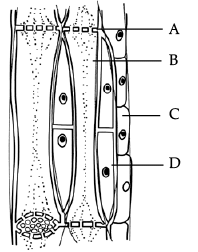
Q. Vascular bundles are :
Detailed Solution: Question 3
Direction: Study the given diagram and answer the following questions.
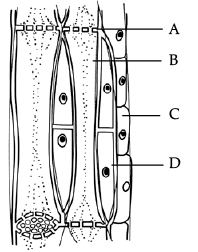
Q. What will happen if Phloem at the base of the branch is removed?
Detailed Solution: Question 4
Direction: Study the given diagram and answer the following questions.
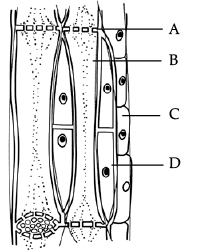
Q. Name the tissue shown in the diagram.
Detailed Solution: Question 5
Direction: Study the given diagram and answer the following questions.
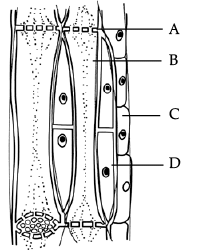
Q. Identify the parts A,B,C and D.
Detailed Solution: Question 6
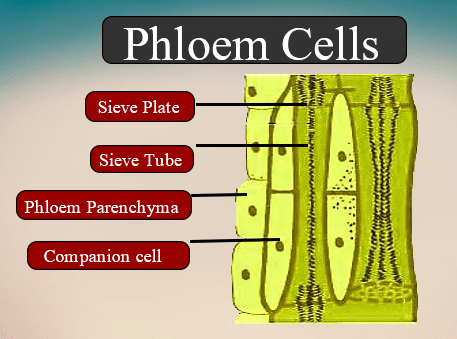
Direction: Study the given descriptions and answer the following questions.
Tissue ‘A’–Repairs the injured tissues and fills spaces within organs.
Tissue ‘B’–Serves as a fat reservoir and also carries out the function of insulator.
Q. Muscular tissues that functions throughout life without fatigue :
Detailed Solution: Question 7
Direction: Study the given descriptions and answer the following questions.
Tissue ‘A’–Repairs the injured tissues and fills spaces within organs.
Tissue ‘B’–Serves as a fat reservoir and also carries out the function of insulator.
Q. Specialised connective tissue consist of lipid rich cells ______
Detailed Solution: Question 8
Direction: Study the given descriptions and answer the following questions.
Tissue ‘A’–Repairs the injured tissues and fills spaces within organs.
Tissue ‘B’–Serves as a fat reservoir and also carries out the function of insulator.
Q. Identify the animal tissue from the given description :
Detailed Solution: Question 9
Direction: Study the given descriptions and answer the following questions.
Tissue ‘A’–Repairs the injured tissues and fills spaces within organs.
Tissue ‘B’–Serves as a fat reservoir and also carries out the function of insulator.
Q. The fibres present in areolar tissue are :
Detailed Solution: Question 10
4 docs|108 tests |
