
Carbon & Its compounds - 2 - Free Case Based Type Questions with solutions
MCQ Practice Test & Solutions: Case Based Questions Test: Carbon & Its compounds - 2 (15 Questions)
You can prepare effectively for Year 11 Chemistry for Year 11 with this dedicated MCQ Practice Test (available with solutions) on the important topic of "Case Based Questions Test: Carbon & Its compounds - 2". These 15 questions have been designed by the experts with the latest curriculum of Year 11 2026, to help you master the concept.
Test Highlights:
- - Format: Multiple Choice Questions (MCQ)
- - Duration: 30 minutes
- - Number of Questions: 15
Sign up on EduRev for free to attempt this test and track your preparation progress.

Read the passage and answer the question :
A homologous series is a series of organic compounds which belong to the same family (i.e. possess the same functional group) and show similar chemical properties. The members of this series are called homologous and differ from each other by the number of CH2 units in the main carbon chain.
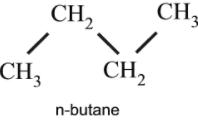
Q. The chemical properties of which of the following compounds is similar to butane ?
Detailed Solution: Question 1
Read the passage and answer the question :
A homologous series is a series of organic compounds which belong to the same family (i.e. possess the same functional group) and show similar chemical properties. The members of this series are called homologous and differ from each other by the number of CH2 units in the main carbon chain.
Q. Which of the following is not the property of a homologous series ?
Detailed Solution: Question 2

Read the passage and answer the question :
A homologous series is a series of organic compounds which belong to the same family (i.e. possess the same functional group) and show similar chemical properties. The members of this series are called homologous and differ from each other by the number of CH2 units in the main carbon chain.
Q. What is the difference between two consecutive members in a homologous series in alkanes in terms of molecular mass and number of atoms of elements is:
Detailed Solution: Question 3
Read the passage and answer the question :
A homologous series is a series of organic compounds which belong to the same family (i.e. possess the same functional group) and show similar chemical properties. The members of this series are called homologous and differ from each other by the number of CH2 units in the main carbon chain.
Q. Which of the following represent the name and formula of the 2nd member of homologous series having the general formula CnH2n + 2 ?
Detailed Solution: Question 4
Read the passage and answer the question :
A homologous series is a series of organic compounds which belong to the same family (i.e. possess the same functional group) and show similar chemical properties. The members of this series are called homologous and differ from each other by the number of CH2 units in the main carbon chain.
Q. The compound CH3 CH (OH) CH3 belongs to which of the following homologous series ?
Detailed Solution: Question 5
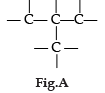
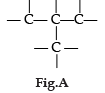
Carbon has the unique property to form bonds with other atoms of carbon. Answer the question :
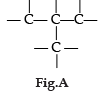
Name the characteristic property of carbon as depicted in the fig. A
Detailed Solution: Question 6
Carbon has the unique property to form bonds with other atoms of carbon. Answer the question :
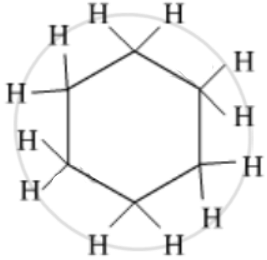
Give the number of single bonds present in the Cyclohexane compound.
Detailed Solution: Question 7
Carbon has the unique property to form bonds with other atoms of carbon. Answer the question :
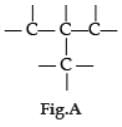
Q. Carbon forms large number of compounds due to :
Detailed Solution: Question 8
Carbon has the unique property to form bonds with other atoms of carbon. Answer the question :
Carbon is :
Carbon has the unique property to form bonds with other atoms of carbon. Answer the question :
Q. Write the name and structure of a saturated compound in which 6 carbon atoms are arranged in a ring.
Read the passage and answer the questions :
An organic compound A of molecular formula C2H4 on reduction gives another compound B of molecular formula C2H6. B on reaction with chlorine in the presence of sunlight gives C of molecular formula C2H5Cl.
Q. Name the compounds A, B and C.
Detailed Solution: Question 11
Read the passage and answer the questions :
An organic compound A of molecular formula C2H4 on reduction gives another compound B of molecular formula C2H6. B on reaction with chlorine in the presence of sunlight gives C of molecular formula C2H5Cl.
Q. The general formula for alkene is :
Detailed Solution: Question 12
Read the passage and answer the questions :
An organic compound A of molecular formula C2H4 on reduction gives another compound B of molecular formula C2H6. B on reaction with chlorine in the presence of sunlight gives C of molecular formula C2H5Cl.
Q. Name the type of reaction.
Detailed Solution: Question 13
Read the passage and answer the questions :
An organic compound A of molecular formula C2H4 on reduction gives another compound B of molecular formula C2H6. B on reaction with chlorine in the presence of sunlight gives C of molecular formula C2H5Cl.
Q. Choose the correct condition for conversion of ethene to ethane:
Detailed Solution: Question 14
Read the passage and answer the questions :
An organic compound A of molecular formula C2H4 on reduction gives another compound B of molecular formula C2H6. B on reaction with chlorine in the presence of sunlight gives C of molecular formula C2H5Cl.
Q. Essential conditions required for the addition reaction to occur :
Detailed Solution: Question 15
1 videos|51 docs|20 tests |
