
Quadratic Equation - Free Assertion & Reason Questions with Solutions
MCQ Practice Test & Solutions: Assertion & Reason Test: Quadratic Equation (10 Questions)
You can prepare effectively for Class 10 Mathematics (Maths) Class 10 with this dedicated MCQ Practice Test (available with solutions) on the important topic of "Assertion & Reason Test: Quadratic Equation". These 10 questions have been designed by the experts with the latest curriculum of Class 10 2026, to help you master the concept.
Test Highlights:
- - Format: Multiple Choice Questions (MCQ)
- - Duration: 20 minutes
- - Number of Questions: 10
Sign up on EduRev for free to attempt this test and track your preparation progress.

Directions: In the following questions, A statement of Assertion (A) is followed by a statement of Reason (R). Mark the correct choice as.
Assertion (A): The degree of quadratic equation is always 2. Hence, x2 – 1 = 0 is pure quadratic equation.
Reason (R): An equation of the form ax2 + c = 0 is known as pure quadratic equation.
Detailed Solution: Question 1
Directions: In the following questions, A statement of Assertion (A) is followed by a statement of Reason (R). Mark the correct choice as.
Assertion (A): The product of two successive positive integral multiples of 5 is 300, then the two numbers are 15 and 20.
Reason (R): The product of two consecutive integrals is a multiple of 2.
Detailed Solution: Question 2

Directions: In the following questions, A statement of Assertion (A) is followed by a statement of Reason (R). Mark the correct choice as.
Assertion (A): In the expression: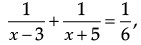 x can’t have values 3 and – 5
Reason (R): If discriminant D = b2 – 4ac > 0 then the roots of the quadratic equation ax2 + bx + c = 0 are real and unequal.
x can’t have values 3 and – 5Detailed Solution: Question 3
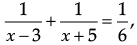
 forms in the expression which has no solution.
 Directions: In the following questions, A statement of Assertion (A) is followed by a statement of Reason (R). Mark the correct choice as.
Assertion (A): The equation 8x2 + 3kx + 2 = 0 has equal roots than the value of k is ± 
Reason (R): The equation ax2 + bx + c = 0 has equal roots if D = b2 – 4ac = 0.
Detailed Solution: Question 4

Directions: In the following questions, a statement of Assertion (A) is followed by a statement of Reason (R). Mark the correct choice as.
Assertion (A): Values of x are a for the quadratic equation 2x2 + ax – a2 = 0.
Reason (R): For a quadratic equation ax2 + bx + c = 0, the roots are given by
x = (-b ± √(b2 - 4ac)) / 2a.
x = (-b ± √(b2 - 4ac)) / 2a.
Detailed Solution: Question 5
Directions: In the following questions, A statement of Assertion (A) is followed by a statement of Reason (R). Mark the correct choice as.
Assertion (A): Sum of ages of two friends is 20 years. Four years ago, the product of their ages in years was 48. Then the difference between their ages is 16.
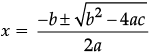
Reason (R): For quadratic equation ax2 + bx + c = 0,
Detailed Solution: Question 6
Directions: In the following questions, A statement of Assertion (A) is followed by a statement of Reason (R). Mark the correct choice as.
Assertion (A): The roots of the quadratic equation x2 + 2x + 2 = 0 are imaginary.
Reason (B): If discriminant D = b2 – 4ac < 0 then the roots of the quadratic equation ax2 + bx + c = 0 are imaginary.
Detailed Solution: Question 7
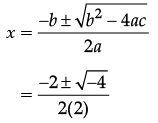
 is unreal.
 Directions: In the following questions, A statement of Assertion (A) is followed by a statement of Reason (R). Mark the correct choice as.
Assertion (A): If we solve the equation of the form 9(x+2) – 6.(3)(x+1) + 1 = 0, then x = – 2.
Reason (R): The equation of the form x2a + xb + b = 0 can’t be solved by quadratic formula.
Detailed Solution: Question 8
Directions: In the following questions, A statement of Assertion (A) is followed by a statement of Reason (R). Mark the correct choice as.
Assertion (A): The equation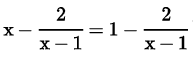 has no root.
Reason (R): x - 1 ≠ 0, then only above equation is defined.
has no root.Detailed Solution: Question 9
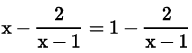
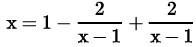
 is not defined.
 DIRECTION : In the following questions, a statement of assertion (A) is followed by a statement of reason (R). Mark the correct choice as:
Assertion : The equation x2 + 3x+1 = (x - 2)2 is a quadratic equation.
Reason : Any equation of the form ax2 + bx + c = 0 where a ≠ 0 , is called a quadratic equation.
Detailed Solution: Question 10
|
118 videos|526 docs|45 tests
|
