NEET Exam  >  NEET Test  >  Biology Class 11  >  15 Minute Test: Kingdom Monera (NCERT) - NEET MCQ

Kingdom Monera (NCERT) - Free MCQ Practice Test with solutions, NEET Biology


MCQ Practice Test & Solutions: 15 Minute Test: Kingdom Monera (NCERT) (15 Questions)

You can prepare effectively for NEET Biology Class 11 with this dedicated MCQ Practice Test (available with solutions) on the important topic of "15 Minute Test: Kingdom Monera (NCERT)". These 15 questions have been designed by the experts with the latest curriculum of NEET 2026, to help you master the concept.

Test Highlights:

  • - Format: Multiple Choice Questions (MCQ)
  • - Duration: 15 minutes
  • - Number of Questions: 15

Sign up on EduRev for free to attempt this test and track your preparation progress.

15 Minute Test: Kingdom Monera (NCERT) - Question 1

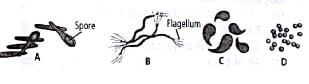
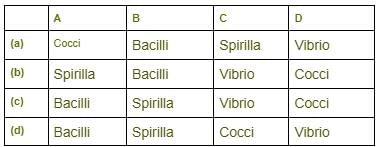
Bacteria are grouped under four categories according to their shape. Study the given figures and select the correct option regarding this.
Detailed Solution: Question 1

Bacteria are grouped under four categories based on their shapes: the spherical coccus (pl.: coccl), the rod-shaped bacillus (pi.: bacilli), the comma-shaped vibrium (pl.: vibrio) and the spiral spirillum (pl.: spirilla).

Topic in NCERT: KINGDOM MONERA

Line in NCERT: "Bacteria are grouped under four categories based on their shape: the spherical Coccus (pl.: cocci), the rod-shaped Bacillus (pl.: bacilli), the comma-shaped Vibrium (pl.: vibrio) and the spiral Spirillum (pl.: spirilla)"

15 Minute Test: Kingdom Monera (NCERT) - Question 2

Which one of the following is an incorrect statement regarding mycoplasma?

Detailed Solution: Question 2

The Mycoplasma are organisms that completely lack a cell wall. They are the smallest living cells known and can survive without oxygen. Many mycoplasma are pathogenic in animals and plants.

Topic in NCERT: KINGDOM MONERA

Line in NCERT: "The Mycoplasma are organisms that completely lack a cell wall. They are the smallest living cells known and can survive without oxygen. Many mycoplasma are pathogenic in animals and plants."

15 Minute Test: Kingdom Monera (NCERT) - Question 3

Read the following statements regarding methanogens and select the correct option.

(i) They are included in the group Archaebacteria.

(ii) They are responsible for the production of biogas in gobar gas plants.

(iii) They live in hot sulphur springs.

(iv) They are present in the gut of several ruminant animals such as cows and buffaloes.

Detailed Solution: Question 3

Correct option: B.

(i) Correct. Methanogens belong to the group Archaebacteria (Archaea) and are biochemically distinct from true bacteria.

(ii) Correct. Methanogens carry out anaerobic decomposition of organic matter and produce methane, which is the principal component of biogas produced in gobar gas plants and similar anaerobic digesters.

(iii) Incorrect. Hot sulphur springs are typical habitats of thermoacidophiles (a different group of archaea). Methanogens are usually found in anaerobic, marshy or gut environments, not as typical inhabitants of hot sulphur springs.

(iv) Correct. Methanogens are present in the gut of ruminants (for example cows and buffaloes) and contribute to methane production there.

Therefore, statements (i), (ii) and (iv) are correct while (iii) is not; the correct choice is B.

15 Minute Test: Kingdom Monera (NCERT) - Question 4

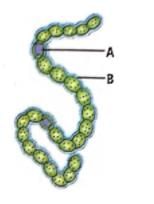
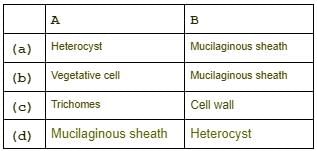
Given figure is of filamentous blue green alga Nostoc Identify the parts marked as A and B and select the correct option.
Detailed Solution: Question 4
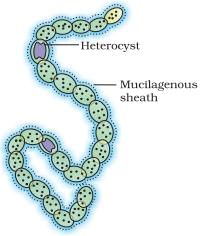
The cyanobacteria are unicellular, colonial or filamentous, freshwater/marine or terrestrial algae. The colonies are generally surrounded by gelatinous sheath. They often form blooms in polluted water bodies. Some of these organisms can fix atmospheric nitrogen in specialised cells called heterocysts, e.g., Nostoc and Anabaena

It is filamentous blue green algae- Nostoc

15 Minute Test: Kingdom Monera (NCERT) - Question 5

How do cyanobacteria perform photosynthesis?

Detailed Solution: Question 5

Cyanobacteria have chlorophyll-a, similar to green plants, which allows them to perform photosynthesis. They are photosynthetic autotrophs and can be unicellular, colonial, or filamentous algae.

Topic in NCERT: Eubacteria

Line in NCERT: "The cyanobacteria (also referred to as blue-green algae) have chlorophyll a similar to green plants and are photosynthetic autotrophs."

15 Minute Test: Kingdom Monera (NCERT) - Question 6

Cyanobacteria are used in agricultural fields for improvement because they cause

Detailed Solution: Question 6

A. N2 fixation is the correct answer.

Cyanobacteria have specialised cells called heterocysts that convert atmospheric N2 into nitrogenous compounds usable by plants; examples include Nostoc and Anabaena.

The nitrogen fixed by these organisms increases soil fertility and supplies plants with an essential nutrient, which is why they are deliberately used to improve agricultural fields-particularly in wetland crops like paddy.

Although cyanobacteria perform photosynthesis, this trait is not the primary reason for their use in soil improvement.

Algal blooms are typically harmful (they can cause oxygen depletion and ecological imbalance) and are not a beneficial reason for using cyanobacteria in agriculture.

Therefore, option A is the correct choice.

15 Minute Test: Kingdom Monera (NCERT) - Question 7

Identify the incorrect statements -

Detailed Solution: Question 7

Correct answer: B

Bacteria do not produce gametes. Reproduction in bacteria is normally asexual, and gamete formation does not occur.

Most bacteria reproduce by binary fission, in which a single cell divides into two daughter cells with similar genetic material.

Many bacteria form endospores under unfavourable conditions; endospore formation is a survival strategy seen in genera such as Bacillus and Clostridium.

Bacteria can exchange genetic material by mechanisms such as conjugation, transformation and transduction. These processes involve transfer and recombination of DNA and are described as a primitive or "sort of" sexual reproduction, but they do not involve gamete formation.

Therefore only option B is incorrect; options A, C and D are correct in the intended sense.

15 Minute Test: Kingdom Monera (NCERT) - Question 8

Select the correct statement regarding Eubacteria.

Detailed Solution: Question 8

The cyanobacteria are unicellular, colonial or filamentous, freshwater/marine or terrestrial algae. The colonies are generally surrounded by gelatinous sheath. They often form blooms in polluted water bodies. Some of these organisms can fix atmospheric nitrogen in specialised cells called heterocysts, e.g., Nostoc and Anabaena. Chemosynthetic autotrophic bacteria oxidise various inorganic substances such as nitrates, nitrites and ammonia and use the released energy for their ATP production. They play a great role in recycling nutrients like nitrogen, phosphorous, iron and sulphur.

Topic in NCERT: Eubacteria

Line in NCERT: "Some of these organisms can fix atmospheric nitrogen in specialised cells called heterocysts, e.g., Nostoc and Anabaena."

15 Minute Test: Kingdom Monera (NCERT) - Question 9

Identify the incorrect statement regarding bacteria:

Detailed Solution: Question 9

To identify the incorrect statement regarding bacteria:

- A: Bacteria are the most abundant microorganisms.
- B: Bacteria live in extreme habitats where very few other life forms can survive.
- C: Bacteria as a group show the most extensive metabolic diversity.
- D: They are obligate intracellular parasites.

The incorrect statement is: D: They are obligate intracellular parasites.

Explanation: Bacteria can be classified as intracellular or extracellular, with many living freely outside cells. While some bacteria can be obligate intracellular parasites, not all bacteria exhibit this behavior.

Topic in NCERT: KINGDOM MONERA

Line in NCERT: "Many of them live in or on other organisms as parasites."

15 Minute Test: Kingdom Monera (NCERT) - Question 10

Which feature differentiates archaebacteria from other bacteria and contributes to their survival in extreme environments?

Detailed Solution: Question 10

Archaebacteria have a different cell wall structure compared to other bacteria, which allows them to survive in extreme environments such as salty areas, hot springs, and marshy areas. This unique feature is crucial for their survival in harsh conditions.

15 Minute Test: Kingdom Monera (NCERT) - Question 11

Assertion (A): Cyanobacteria are capable of photosynthesis and nitrogen fixation due to the presence of chlorophyll and specialized cells called heterocysts.

Reason (R): Cyanobacteria can only perform photosynthesis in aquatic environments due to the absence of light in terrestrial environments.

Detailed Solution: Question 11

Assertion (A) is correct because cyanobacteria can perform photosynthesis using chlorophyll a and can fix nitrogen in specialized cells called heterocysts. These abilities help them thrive in various environments, including freshwater and marine ecosystems.

However, Reason (R) is incorrect because cyanobacteria can perform photosynthesis in both aquatic and terrestrial environments, as long as there is sufficient light. The assertion is correct, but the reasoning given is false, so the correct answer is Option C.

15 Minute Test: Kingdom Monera (NCERT) - Question 12

Halophiles, thermoacidophiles, and methanogens are grouped under which category of bacteria?

Detailed Solution: Question 12

Archaebacteria are special bacteria that live in some of the most harsh habitats. Halophiles live in extreme salty areas, thermoacidophiles live in hot springs, and methanogens live in marshy areas. These bacteria differ from other bacteria in having a different cell wall structure, which is responsible for their survival in extreme conditions. Methanogens are also present in the gut of ruminant animals like cows and buffaloes, where they are responsible for the production of methane (biogas) from the dung of these animals.

15 Minute Test: Kingdom Monera (NCERT) - Question 13

Which of the following bacterial diseases are correctly matched?

Detailed Solution: Question 13

Cholera, typhoid, tetanus, and citrus canker are well-known diseases caused by different bacteria. Some bacteria are pathogens causing damage to human beings, crops, farm animals, and pets. Option B is incorrect because malaria and dengue are caused by protozoans and viruses respectively, not bacteria. Option C is incorrect because AIDS is caused by a virus. Option D is incorrect because wheat rust and potato blight are caused by fungi, not bacteria.

15 Minute Test: Kingdom Monera (NCERT) - Question 14

Chemosynthetic autotrophic bacteria play an important role in

Detailed Solution: Question 14

Chemosynthetic autotrophic bacteria oxidise various inorganic substances such as nitrates, nitrites and ammonia and use the released energy for their ATP production. They play a great role in recycling nutrients like nitrogen, phosphorous, iron and sulphur. Option A refers to certain heterotrophic bacteria, Option C refers to cyanobacteria like Nostoc and Anabaena, and Option D refers to methanogens, which are archaebacteria.

15 Minute Test: Kingdom Monera (NCERT) - Question 15

Which of the following is a beneficial role of heterotrophic bacteria?

Detailed Solution: Question 15

Heterotrophic bacteria are most abundant in nature and the majority are important decomposers. Many of them have a significant impact on human affairs. They are helpful in making curd from milk, production of antibiotics, fixing nitrogen in legume roots, etc. Options A, C, and D all describe harmful effects of bacteria. Option A and D describe pathogenic bacteria, while Option C describes the negative environmental impact of cyanobacteria forming blooms in polluted water bodies.

142 videos|410 docs|135 tests
Information about 15 Minute Test: Kingdom Monera (NCERT) Page
In this test you can find the Exam questions for 15 Minute Test: Kingdom Monera (NCERT) solved & explained in the simplest way possible. Besides giving Questions and answers for 15 Minute Test: Kingdom Monera (NCERT), EduRev gives you an ample number of Online tests for practice
142 videos|410 docs|135 tests
Download as PDF