
Kingdom Protista (NCERT) - NEET Biology Class 11 Free MCQ Test with solutions
MCQ Practice Test & Solutions: Test: Kingdom Protista (NCERT) (15 Questions)
You can prepare effectively for NEET Biology Class 11 with this dedicated MCQ Practice Test (available with solutions) on the important topic of "Test: Kingdom Protista (NCERT)". These 15 questions have been designed by the experts with the latest curriculum of NEET 2026, to help you master the concept.
Test Highlights:
- - Format: Multiple Choice Questions (MCQ)
- - Duration: 15 minutes
- - Number of Questions: 15
Sign up on EduRev for free to attempt this test and track your preparation progress.

Detailed Solution: Question 1
Topic in NCERT: Slime MouldsLine in NCERT: "Slime moulds are saprophytic protists."
How do slime moulds typically behave under favorable conditions?
Detailed Solution: Question 2

Detailed Solution: Question 3
Topic in NCERT: Kingdom ProtistaLine in NCERT: "Members of Protista are primarily aquatic."
Which of the following organisms have been placed under kingdom Protista?
Detailed Solution: Question 4
Topic in NCERT: ProtistaLine in NCERT: "we include Chrysophytes, Dinoflagellates, Euglenoids, Slime moulds and Protozoans under Protista."
Which out of the following is a ciliated protozoan?
Detailed Solution: Question 5
Topic in NCERT: Ciliated protozoansLine in NCERT: "Ciliated protozoans: These are aquatic, actively moving organisms because of the presence of thousands of cilia. Example: Paramoecium (Figure 2.4d)."
Detailed Solution: Question 6
Topic in NCERT: ChrysophytesLine in NCERT: "Being gritty this soil is used in polishing, filtration of oils and syrups."
Match each item in Column I with one in Column II and select your answer from the codes given below:
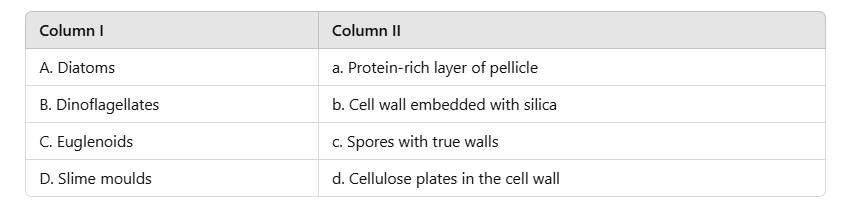
Detailed Solution: Question 7
Detailed Solution: Question 8
Topic in NCERT: Kingdom ProtistaLine in NCERT: "Being eukaryotes, the protistan cell body contains a well defined nucleus and other membrane-bound organelles."
The cell wall is composed of two thin overlapping shells which fit together like a soap case, in
Detailed Solution: Question 9
Topic in NCERT: ChrysophytesLine in NCERT: "In diatoms the cell walls form two thin overlapping shells, which fit together as in a soap box."
Causal organisms of sleeping sickness belong to which of the following groups of protozoan protists?
Detailed Solution: Question 10
Topic in NCERT: Flagellated protozoansLine in NCERT: "Flagellated protozoans: The members of this group are either free-living or parasitic. They have flagella. The parasitic forms cause diseases such as sleeping sickness. Example: Trypanosoma."
