NEET Exam  >  NEET Test  >  Biology Class 11  >  15 Minute Test: Bryophytes (NCERT) - NEET MCQ

Bryophytes (NCERT) - NEET Biology Class 11 Free MCQ Practice Test


MCQ Practice Test & Solutions: 15 Minute Test: Bryophytes (NCERT) (15 Questions)

You can prepare effectively for NEET Biology Class 11 with this dedicated MCQ Practice Test (available with solutions) on the important topic of "15 Minute Test: Bryophytes (NCERT)". These 15 questions have been designed by the experts with the latest curriculum of NEET 2026, to help you master the concept.

Test Highlights:

  • - Format: Multiple Choice Questions (MCQ)
  • - Duration: 15 minutes
  • - Number of Questions: 15

Sign up on EduRev for free to attempt this test and track your preparation progress.

15 Minute Test: Bryophytes (NCERT) - Question 1

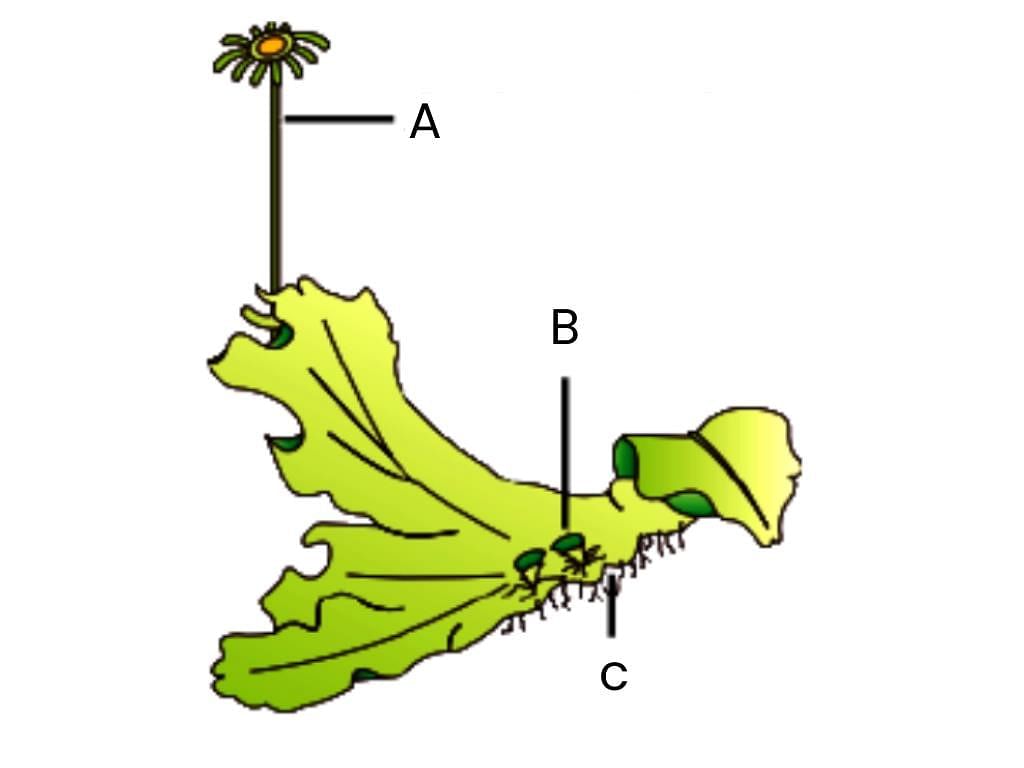
Select the option that correctly identifies A, B and C in the given figure of female thallus of Marchantia.
Detailed Solution: Question 1
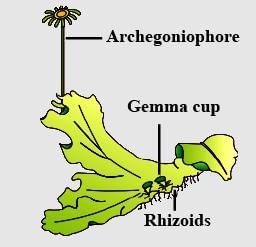
Based on the given figure, the correct option is C: A - Archegoniophore, B-Gemma cup, C-Rhizoids as it correctly identifies the labeled parts.

Fig: Female thallus of Merchantia

15 Minute Test: Bryophytes (NCERT) - Question 2

What is the predominant stage of the moss life cycle?

Detailed Solution: Question 2

In the life cycle of a moss, the predominant stage is the gametophyte stage. This stage consists of two main stages: the protonema stage and the leafy stage. The protonema stage is the first stage, developing directly from a spore, while the leafy stage develops from the secondary protonema as a lateral bud. The gametophyte stage bears the sex organs and is crucial for the reproductive cycle of mosses.

Topic in NCERT: Mosses

Line in NCERT: "the predominant stage of the life cycle of a moss is the gametophyte which consists of two stages."

15 Minute Test: Bryophytes (NCERT) - Question 3

Consider the following statements regarding bryophytes:

I. Bryophytes are also called amphibians of the plant kingdom because they are dependent on water for sexual reproduction.

II. They play an important role in plant succession on bare rocks.

III. They lack true roots, stem or leaves.

IV. The sex organs in bryophytes are multicelluar.

V. They produce biflagellate zoospores.

VI. Archegonium is flask-shaped and produces a single egg.

The number of corrected statements is

Detailed Solution: Question 3

- Statement I: Bryophytes are indeed referred to as the amphibians of the plant kingdom because they rely on water for sexual reproduction, needing moisture for the sperm to swim to the egg.
- Statement II: Bryophytes do contribute significantly to plant succession on barren rocks by initiating soil formation and providing a habitat for other plant species.
- Statement III: Bryophytes lack true roots, stems, and leaves. Instead, they have structures that serve similar functions but are not as complex.
- Statement IV: The sex organs in bryophytes are indeed multicellular, aiding in the reproductive process.
- Statement VI: The archegonium in bryophytes is flask-shaped and produces a single egg, crucial for sexual reproduction.To determine the correct statements about bryophytes:


- Bryophytes produce biflagellate antherozoids not zoospores.


Correct statements:

- I. Bryophytes are also called amphibians of the plant kingdom because they are dependent on water for sexual reproduction.
- II. They play an important role in plant succession on bare rocks.
- III. They lack true roots, stem or leaves.
- IV. The sex organs in bryophytes are multicellular.
- VI. Archegonium is flask-shaped and produces a single egg.

Therefore, the number of correct statements is 5 (option C).

Topic in NCERT: Bryophytes

Line in NCERT: "bryophytes are also called amphibians of the plant kingdom because these plants can live in soil but are dependent on water for sexual reproduction. they play an important role in plant succession on bare rocks/soil. they lack true roots, stem or leaves. the sex organs in bryophytes are multicellular. they produce biflagellate antherozoids. the female sex organ called archegonium is flask-shaped and produces a single egg."

15 Minute Test: Bryophytes (NCERT) - Question 4

Peat, obtained from Sphagnum moss, is used as

Detailed Solution: Question 4

Species of Sphagnum, a moss, provide peat that have long been used as fuel, and as packing material for trans-shipment of living material because of their capacity to hold water

Topic in NCERT: Bryophytes

Line in NCERT: "species of sphagnum, a moss, provide peat that have long been used as fuel, and as packing material for trans-shipment of living material because of their capacity to hold water."

15 Minute Test: Bryophytes (NCERT) - Question 5

How do mosses primarily reproduce vegetatively?

Detailed Solution: Question 5

Mosses primarily reproduce vegetatively by fragmentation and budding in the secondary protonema stage. This method of reproduction allows mosses to propagate asexually and colonize new areas. Fragmentation involves the breaking off of segments of the plant body to grow into new individuals, while budding involves the formation of new growths from existing structures.

Topic in NCERT: Mosses

Line in NCERT: "vegetative reproduction in mosses is by fragmentation and budding in the secondary protonema."

15 Minute Test: Bryophytes (NCERT) - Question 6

Question: Identify the incorrect statement regarding liverworts

Detailed Solution: Question 6

Solution: Incorrect statement: 4. The sporophyte in liverworts is differentiated into a foot, seta, and rhizoid.

Explanation: The correct differentiation of the sporophyte in liverworts includes a foot, seta, and capsule, not a rhizoid.

Topic in NCERT: Mosses

Line in NCERT: "the sporophyte is differentiated into a foot, seta and capsule."

15 Minute Test: Bryophytes (NCERT) - Question 7

Why are bryophytes referred to as "amphibians of the plant kingdom"?

Detailed Solution: Question 7

Bryophytes are also called amphibians of the plant kingdom because these plants can live in soil but are dependent on water for sexual reproduction

Topic in NCERT: Bryophytes

Line in NCERT: "bryophytes are also called amphibians of the plant kingdom because these plants can live in soil but are dependent on water for sexual reproduction."

15 Minute Test: Bryophytes (NCERT) - Question 8

Read the following statements about liverworts and identify the number of incorrect statements:

  1. The plant body of liverworts is leafy with tiny leaf-like appendages arranged in three rows on the stem-like structures.
  2. Liverworts are typically found growing on bark of trees and deep in the woods.
  3. Gemmae are green, multicellular, asexual buds that develop in gemma cups located on the thalli.
  4. During sexual reproduction, male and female sex organs are produced only on different thalli in liverworts.

How many of the above statements are incorrect?

Detailed Solution: Question 8


Correct answer: Two

Explanation:

  • Statement 1 is incorrect because the tiny leaf-like appendages are arranged in two rows, not three.
  • Statement 4 is incorrect because male and female sex organs can be produced either on the same or on different thalli in liverworts.

Topic in NCERT: Bryophytes

Line in NCERT: "the plant body of liverworts is thalloid and dorsiventral whereas mosses have upright, slender axes bearing spirally arranged leaves."
15 Minute Test: Bryophytes (NCERT) - Question 9

Read the given statements and select the correct options.
Statement 1: Each sperm of moss has two flagella.
Statement 2: Water is essential for fertilization is mosses.

Detailed Solution: Question 9

Statement 1: Each sperm of moss has two flagella.

  • This statement is correct. The sperm of mosses are biflagellate, meaning they have two flagella that they use to swim towards the egg in the presence of water.

Statement 2: Water is essential for fertilization in mosses.

  • This statement is also correct. Mosses require water for fertilization because the sperm must swim through water to reach the egg for fertilization to occur.

Both statements are correct; however, Statement 2 is not the explanation for Statement 1. They are simply two facts about the reproductive requirements of mosses.

Topic in NCERT: Bryophytes

Line in NCERT: "the male sex organ is called antheridium. they produce biflagellate antherozoids. the female sex organ called archegonium is flask-shaped and produces a single egg. the antherozoids are released into water where they come in contact with archegonium."

15 Minute Test: Bryophytes (NCERT) - Question 10

Question:
Read the following statements about the life cycle of a moss and identify the number of incorrect statements:

  1. The predominant stage of the life cycle of a moss is the gametophyte.
  2. The protonema stage is the second stage of the gametophyte, which develops from the leafy stage.
  3. The leafy stage develops from the secondary protonema as a lateral bud.
  4. The leafy stage is attached to the soil through multicellular and branched rhizoids.

How many of the above statements are incorrect?

    Detailed Solution: Question 10

    Correct answer:  one

    Explanation:

    • Statement 1 is correct. In mosses, the gametophyte stage is indeed the dominant stage of the life cycle.
    • Statement 2 is incorrect because the protonema stage is the first stage of the gametophyte, not the second.
    • Statement 3 is correct as it accurately describes the development of the leafy stage from the secondary protonema.
    • Statement 4 is correct and describes the attachment of the leafy stage to the soil through rhizoids.

    Topic in NCERT: Mosses

    Line in NCERT: "the predominant stage of the life cycle of a moss is the gametophyte which consists of two stages. the first stage is the protonema stage, which develops directly from a spore. it is a creeping, green, branched and frequently filamentous stage. the second stage is the leafy stage, which develops from the secondary protonema as a lateral bud. they consist of upright, slender axes bearing spirally arranged leaves. they are attached to the soil through multicellular and branched rhizoids."

    15 Minute Test: Bryophytes (NCERT) - Question 11

    Detailed Solution: Question 11

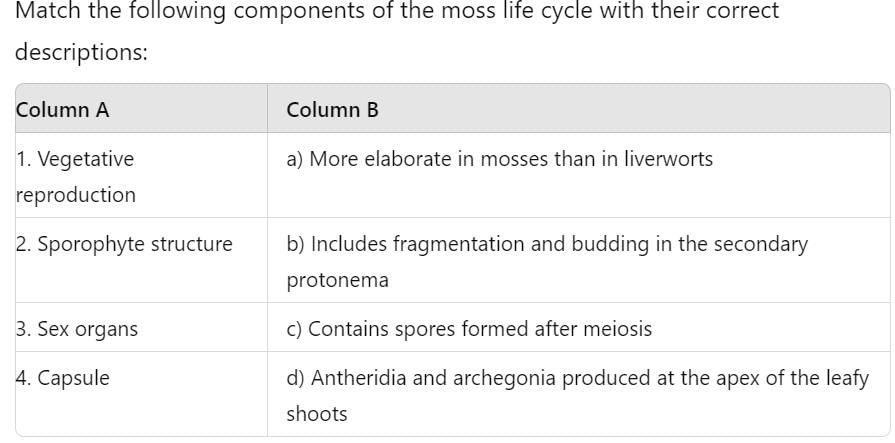
    Correct Matching:

    1. Vegetative reproduction - b) Includes fragmentation and budding in the secondary protonema
    2. Sporophyte structure - a) More elaborate in mosses than in liverworts
    3. Sex organs - d) Antheridia and archegonia produced at the apex of the leafy shoots
    4. Capsule - c) Contains spores formed after meiosis

    Explanation:

    • Vegetative reproduction in mosses occurs by fragmentation and budding in the secondary protonema.
    • The sporophyte in mosses is more complex compared to liverworts, consisting of a foot, seta, and capsule.
    • Sex organs (antheridia and archegonia) are located at the apex of the leafy shoots.
    • The capsule of the sporophyte contains spores, which are released through an elaborate dispersal mechanism.

    15 Minute Test: Bryophytes (NCERT) - Question 12

    Read the following statements and select the incorrect ones:

    (a) Mosses have an elaborate mechanism of spore dispersal.
    (b) In liverworts, the haploid free-living sporophyte is formed by spore germination.
    (c) Vegetative reproduction in Polytrichum occurs by budding in the secondary protonema.
    (d) Marchantia is a heterosporous bryophyte.
    (e) Growth of bog moss ultimately fills ponds and lakes with soil

      Detailed Solution: Question 12

      Correct answer: 3. (b) and (d) only

      Explanation:

      • Statement (b) is incorrect because liverworts have a haploid gametophyte and a diploid sporophyte. The sporophyte is not free-living and does not form by spore germination.
      • Statement (d) is incorrect because Marchantia is not a heterosporous bryophyte; it is a homosporous liverwort.
      • Statement (a) is correct; mosses do have an elaborate mechanism of spore dispersal.
      • Statement (c) is correct; vegetative reproduction in Polytrichum occurs by budding in the secondary protonema.
      • Statement (e) is correct; bog moss growth can contribute to the formation of peatlands by filling ponds and lakes with soil.

      Topic in NCERT: Sporophyte development and spore dispersal in mosses

      Line in NCERT: "the mosses have an elaborate mechanism of spore dispersal."

      15 Minute Test: Bryophytes (NCERT) - Question 13

      Vegetative reproduction in mosses is by:

      Detailed Solution: Question 13

      Vegetative reproduction in mosses is by fragmentation and budding in the secondary protonema.

      Topic in NCERT: Mosses

      Line in NCERT: "vegetative reproduction in mosses is by fragmentation and budding in the secondary protonema."

      15 Minute Test: Bryophytes (NCERT) - Question 14

      The embryonic development in bryophytes takes place in the

      Detailed Solution: Question 14

      Like other plants, the embryonic development in bryophytes begins with the process of fertilization. This involves the fusion of male and female gametes, which are produced in the antheridium and archegonium respectively.
       

      Role of Archegonium

      • The archegonium is the female sex organ in bryophytes, and it is where the female gametes or eggs are produced.
      • After fertilization, the zygote remains in the archegonium and begins to divide and grow into an embryo.
      • This process takes place within the protective structure of the archegonium, which provides a suitable environment for the developing embryo.

      Topic in NCERT: Bryophytes

      Line in NCERT: "the female sex organ called archegonium is flask-shaped and produces a single egg."

      15 Minute Test: Bryophytes (NCERT) - Question 15

      Read the given statements and select the correct options. 

      Statement 1: Bryophytes play a significant role in plant succession on bare rocks and soil.

      Statement 2: They contribute to the breakdown of rocks and enrich the soil, making it more suitable for higher plants.

      Detailed Solution: Question 15

      The assertion is correct. Bryophytes, including mosses and liverworts, indeed play a significant role in plant succession on barren surfaces like rocks and nutrient-poor soil. They are often the first plants to colonize these environments.

      The reason is also correct and provides an explanation for why bryophytes contribute to plant succession. Bryophytes can slowly break down rocks through their growth and the release of organic acids. As they decompose rocks, they release minerals and organic matter into the soil, which enriches it. This enriched soil becomes more hospitable for the growth of higher plants, facilitating the establishment of a more complex plant community.

      In summary, bryophytes help initiate plant succession by breaking down rocks and improving soil quality, thereby creating suitable conditions for the growth of higher plants.

      Topic in NCERT: Bryophytes

      Line in NCERT: "bryophytes play an important role in plant succession on bare rocks/soil. they decompose rocks making the substrate suitable for the growth of higher plants."

      142 videos|410 docs|135 tests
      Information about 15 Minute Test: Bryophytes (NCERT) Page
      In this test you can find the Exam questions for 15 Minute Test: Bryophytes (NCERT) solved & explained in the simplest way possible. Besides giving Questions and answers for 15 Minute Test: Bryophytes (NCERT), EduRev gives you an ample number of Online tests for practice
      142 videos|410 docs|135 tests
      Download as PDF