NEET Exam  >  NEET Test  >  Biology Class 11  >  Test: Biomacromolecules (NCERT) - NEET MCQ

Biomacromolecules (NCERT) - Free MCQ Practice Test with solutions, NEET


MCQ Practice Test & Solutions: Test: Biomacromolecules (NCERT) (5 Questions)

You can prepare effectively for NEET Biology Class 11 with this dedicated MCQ Practice Test (available with solutions) on the important topic of "Test: Biomacromolecules (NCERT)". These 5 questions have been designed by the experts with the latest curriculum of NEET 2026, to help you master the concept.

Test Highlights:

  • - Format: Multiple Choice Questions (MCQ)
  • - Duration: 5 minutes
  • - Number of Questions: 5

Sign up on EduRev for free to attempt this test and track your preparation progress.

Test: Biomacromolecules (NCERT) - Question 1

Why are lipids categorized under the acid insoluble fraction despite not having high molecular weights like other macromolecules?

Detailed Solution: Question 1

Lipids, though they do not have high molecular weights like other macromolecules, are part of the acid insoluble fraction because they arrange into structures like cell membranes. When tissues are ground up, these membranes break into vesicles that are not water-soluble, leading to their categorization as part of the acid insoluble fraction despite their smaller size.

Topic in NCERT: Biomolecules

Line in NCERT: "therefore, these membrane fragments in the form of vesicles get separated along with the acid insoluble pool and hence in the macromolecular fraction."

Test: Biomacromolecules (NCERT) - Question 2

What is the primary role of the acid soluble pool within cells?

Detailed Solution: Question 2

The acid soluble pool within cells primarily represents the cytoplasmic composition, comprising various small molecules that play roles in cellular metabolism and function. This includes metabolites, ions, and other small biomolecules that are crucial for cellular processes.

Topic in NCERT: Biomolecules

Line in NCERT: "the acid soluble pool represents roughly the cytoplasmic composition."

Test: Biomacromolecules (NCERT) - Question 3

What percentage of the total cellular mass is made up of proteins?

Detailed Solution: Question 3
Proteins constitute a significant portion of the cellular mass, making up about 10-15% of it. This makes them vital for numerous cellular functions, including acting as enzymes, structural components, and signaling molecules.

Topic in NCERT: Proteins

Line in NCERT: "proteins\n% of the total\ncellular mass\n10-15"

Test: Biomacromolecules (NCERT) - Question 4

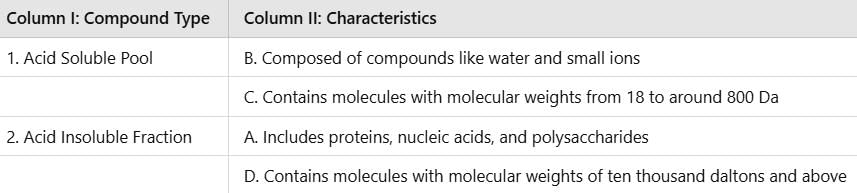
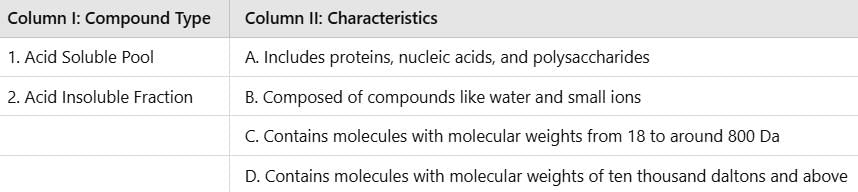
Match the Following

Detailed Solution: Question 4


The acid soluble pool is characterized by having lower molecular weight compounds ranging from 18 to around 800 daltons and typically includes water and small ions, matching with Option B in Column II. The acid insoluble fraction includes macromolecules such as proteins, nucleic acids, and polysaccharides, which generally have molecular weights above ten thousand daltons, aligning with Option A in Column II. Thus, the correct match is 1-B, 2-A.

Topic in NCERT: Nature of enzyme action

Line in NCERT: Error occcured while getting response from embedding

Test: Biomacromolecules (NCERT) - Question 5

Assertion (A): Lipids, despite their smaller molecular weights, are part of the acid insoluble fraction.
Reason (R): Lipids form structures like cell membranes that are not water soluble, leading to their inclusion in the macromolecular fraction.

Detailed Solution: Question 5

The assertion is true as lipids, though typically having molecular weights not exceeding 800 Da, are found in the acid insoluble fraction. The reason correctly explains this by stating that lipids are involved in forming cell membrane structures that are not water-soluble. When tissues are disrupted, these membrane structures break into vesicles that end up in the macromolecular fraction due to their insolubility in water. Thus, Reason R provides the correct explanation for Assertion A.

Topic in NCERT: Biomolecules

Line in NCERT: "therefore, these membrane fragments in the form of vesicles get separated along with the acid insoluble pool and hence in the macromolecular fraction."

142 videos|410 docs|135 tests
Information about Test: Biomacromolecules (NCERT) Page
In this test you can find the Exam questions for Test: Biomacromolecules (NCERT) solved & explained in the simplest way possible. Besides giving Questions and answers for Test: Biomacromolecules (NCERT), EduRev gives you an ample number of Online tests for practice
142 videos|410 docs|135 tests
Download as PDF