
Secondary Growth (NCERT) - Free MCQ Practice Test with solutions, NEET
MCQ Practice Test & Solutions: Test: Secondary Growth (NCERT) (20 Questions)
You can prepare effectively for NEET NCERT Based Tests for NEET with this dedicated MCQ Practice Test (available with solutions) on the important topic of "Test: Secondary Growth (NCERT)". These 20 questions have been designed by the experts with the latest curriculum of NEET 2026, to help you master the concept.
Test Highlights:
- - Format: Multiple Choice Questions (MCQ)
- - Duration: 20 minutes
- - Number of Questions: 20
Sign up on EduRev for free to attempt this test and track your preparation progress.

Identify the given figure and select the correct labels for A, B and C.
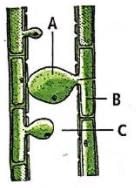
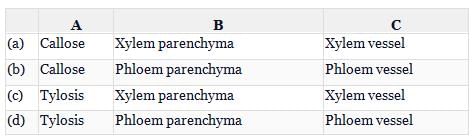
Detailed Solution: Question 1
In dicot stems, cambium present between primary xylem and primary phloem is
Detailed Solution: Question 2

Which of the following statements is correct about a woody dicot stem which shows extensive secondary growth?
Detailed Solution: Question 3
In old trees, central dark coloured, non-conducting part of secondary xylem is referred to as
Detailed Solution: Question 4
Which of the following options correctly shows the sequence of different tissues of the periderm starting from periphery?
Detailed Solution: Question 5
Match Column-I with Column-II and select the correct answer from the codes given below.
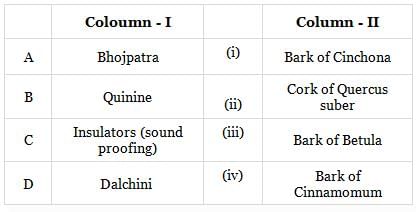
Detailed Solution: Question 6
Detailed Solution: Question 7
Detailed Solution: Question 8
Match Column-I with Column-II and select the correct answer from the codes given below.
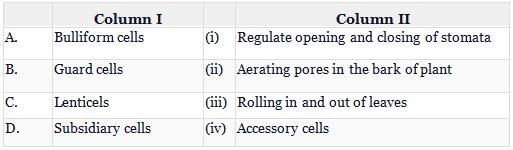
Detailed Solution: Question 9
During the secondary growth in a dicotyledonous stem, the fusiform initials of vascular cambium give rise to
Detailed Solution: Question 10
Detailed Solution: Question 11
Cork is impervious to water due to the presence of _______ in its cell wall.
Detailed Solution: Question 12
Bark formed early in the season is called as________ bark and bark formed towards the end of the season is called as _________bark.
Detailed Solution: Question 13
During secondary growth in a dicot root, cork cambium is formed by the activity of
Detailed Solution: Question 14
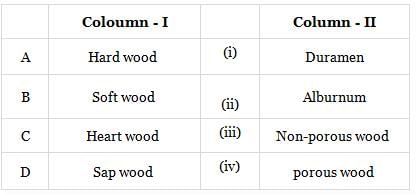
Match Column-I with Column-II and select the correct answer from the codes given below.
Detailed Solution: Question 15
Detailed Solution: Question 16
Bark of which of the following plants yields a drug for the treatment of malaria?
Detailed Solution: Question 17
Detailed Solution: Question 18
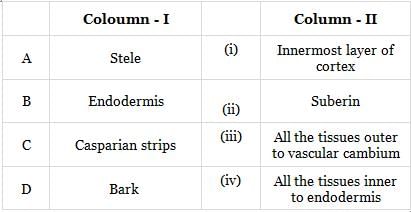
Match Column-I with Column-II and select the correct answer from the codes given below.
Detailed Solution: Question 19
What is the function of the pericycle in plant roots?
Detailed Solution: Question 20
