Mitosis (NCERT) - Free MCQ Practice Test with solutions, NEET Biology
MCQ Practice Test & Solutions: 20-Minute Test: Mitosis (NCERT) (20 Questions)
You can prepare effectively for NEET Biology Class 11 with this dedicated MCQ Practice Test (available with solutions) on the important topic of "20-Minute Test: Mitosis (NCERT)". These 20 questions have been designed by the experts with the latest curriculum of NEET 2026, to help you master the concept.
Test Highlights:
- - Format: Multiple Choice Questions (MCQ)
- - Duration: 20 minutes
- - Number of Questions: 20
Sign up on EduRev for free to attempt this test and track your preparation progress.

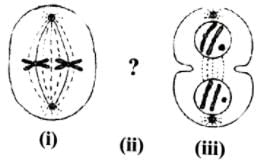
Select the correct option:Centrioles undergo duplication during _______(i) of ________(ii), and begin to move towards opposite poles of the cell during ________(iii) stage of _________(iv).
Detailed Solution: Question 1
______ is the best stage to count the number and study the morphology of chromosomes.
Detailed Solution: Question 2
Line in NCERT: "This then, is the stage at which morphology of chromosomes is most easily studied."

At which stage of mitosis, the two daughter chromatids separate from each other, migrate towards the opposite poles and are now referred to as chromosomes of the future daughter nuclei?
Detailed Solution: Question 3
Line in NCERT: "At the onset of anaphase, each chromosome arranged at the metaphase plate is split simultaneously and the two daughter chromatids, now referred to as daughter chromosomes of the future daughter nuclei, begin their migration towards the two opposite poles."
During anaphasic movements of chromosomes, ______ of each chromosome is/are towards the pole and _____ of the chromosome trail(s) behind.
Detailed Solution: Question 4
Line in NCERT: "the centromere of each chromosome remains directed towards the pole and hence at the leading edge, with the arms of the chromosome trailing behind."
Detailed Solution: Question 5
Line in NCERT: "At the beginning of the final stage of karyokinesis, i.e., telophase, the chromosomes that have reached their respective poles decondense and lose their individuality. The individual chromosomes can no longer be seen and each set of chromatin material tends to collect at each of the two poles. This is the stage which shows the following key events: Chromosomes cluster at opposite spindle poles and their identity is lost as discrete elements. Nuclear envelope develops around the chromosome clusters at each pole forming two daughter nuclei. Nucleolus, golgi complex and ER reform."
Mitotic spindle is mainly composed of _________ protein.
Detailed Solution: Question 6
Line in NCERT: "The two asters together with spindle fibres forms mitotic apparatus."
Detailed Solution: Question 7
During cell division, the spindle fibres get attached to condensing chromosome at a highly differentiated region. This region is called as
Detailed Solution: Question 8
Line in NCERT: "Small disc-shaped structures at the surface of the centromeres are called kinetochores. These structures serve as the sites of attachment of spindle fibres (formed by the spindle fibres) to the chromosomes that are moved into position at the centre of the cell."
If the tissue has at a given time 1024 cells, how many cycles of mitosis had the original parental single-cell undergone?
Detailed Solution: Question 9
Which phase of mitosis is essentially the reverse of prophase in terms of nuclear changes?
Detailed Solution: Question 10
Line in NCERT: "At the beginning of the final stage of karyokinesis, i.e., telophase, the chromosomes that have reached their respective poles decondense and lose their individuality."
The given graph shows the change in DNA content during various phases (A to D) in a typical mitotic cell cycle. Identify the phases and select the correct option.
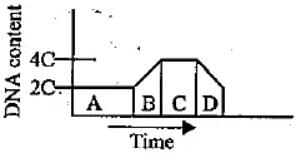
Detailed Solution: Question 11
Line in NCERT: "The interphase is divided into three further phases: G1 phase (Gap 1), S phase (Synthesis), G2 phase (Gap 2)."