NEET Exam  >  NEET Test  >  Biology Class 12  >  Test: Sex Determination (NCERT) - NEET MCQ

Sex Determination (NCERT) - Free MCQ Practice Test with solutions, NEET


MCQ Practice Test & Solutions: Test: Sex Determination (NCERT) (5 Questions)

You can prepare effectively for NEET Biology Class 12 with this dedicated MCQ Practice Test (available with solutions) on the important topic of "Test: Sex Determination (NCERT)". These 5 questions have been designed by the experts with the latest curriculum of NEET 2026, to help you master the concept.

Test Highlights:

  • - Format: Multiple Choice Questions (MCQ)
  • - Duration: 5 minutes
  • - Number of Questions: 5

Sign up on EduRev for free to attempt this test and track your preparation progress.

Test: Sex Determination (NCERT) - Question 1

XO type of sex determination and XY type of sex determination are the examples of

Detailed Solution: Question 1

In XO type and XY type sex determining mechanisms, males produce two different types of gametes, (a) either with or without X-chromosome (XO type), (b) some gametes with X-chromosome and some with Y-chromosome (XY type). Such type of sex determination mechanism is designated to be the example of male heterogamety. In both, females are homogametic and produce X type of gametes in both the cases and have XX genotype.

Test: Sex Determination (NCERT) - Question 2

Which of the following is incorrect regarding ZW-ZZ type of sex determination?

Detailed Solution: Question 2

In ZW - ZZ type of sex determination, the male has two homomorphic sex chromosomes (ZZ) and is homogametic, and the female has two heteromorphic sex chromosomes (ZW) and is heterogametic. There are, thus, two types of eggs : with Z and with W, and only one type of sperms, i.e., each with Z. Fertilisation of an egg with Z chromosome by a sperm with Z chromosome gives a zygote with ZZ chromosomes (male). Fertilisation of an egg with W chromosome by a sperm with Z chromosome yields a zygote with ZW chromosomes (female). This mechanism operates in some vertebrates (fishes, reptiles and birds).

Test: Sex Determination (NCERT) - Question 3

A couple has six daughters. What is the possibility of their having a girl next time?

Detailed Solution: Question 3

The possibility of having a girl or boy child is equal i.e., 50% as 50% male gametes are Y type and 50% are X type. Fusion of egg with X type sperm will produce a girl child.

Test: Sex Determination (NCERT) - Question 4

Number of autosomes present in liver cells of a human female is

Detailed Solution: Question 4

In humans, number of autosomes are 2n = 44 or 22 pairs regardless of the sex.

Test: Sex Determination (NCERT) - Question 5

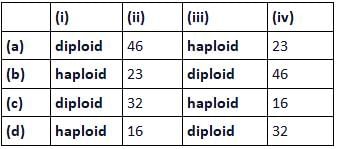
In honeybees, females are ___(i)_____ having ___(ii)_____ chromosomes and males are ___(iii)_____ having ___(iv)_____ chromosomes.
Detailed Solution: Question 5

Honeybees have a haplodiploid sex-determination system, which means that females develop from fertilized eggs and are therefore diploid, while males develop from unfertilized eggs and are therefore haploid. This system is different from the XY sex-determination system found in humans and many other animals, where males have one X and one Y chromosome and females have two X chromosomes. In honeybees, fertilized eggs give rise to females, which have two sets of chromosomes (16 chromosomes from the queen and 16 chromosomes from the drone), while unfertilized eggs give rise to males, which have only one set of chromosomes (16 chromosomes from the queen).

69 videos|305 docs|161 tests
Information about Test: Sex Determination (NCERT) Page
In this test you can find the Exam questions for Test: Sex Determination (NCERT) solved & explained in the simplest way possible. Besides giving Questions and answers for Test: Sex Determination (NCERT), EduRev gives you an ample number of Online tests for practice
69 videos|305 docs|161 tests
Download as PDF