NEET Exam  >  NEET Test  >  Biology Class 12  >  Test: Principles of Biotechnology (NCERT) - NEET MCQ

Principles of Biotechnology (NCERT) - Free MCQ Practice Test with solutions,


MCQ Practice Test & Solutions: Test: Principles of Biotechnology (NCERT) (10 Questions)

You can prepare effectively for NEET Biology Class 12 with this dedicated MCQ Practice Test (available with solutions) on the important topic of "Test: Principles of Biotechnology (NCERT)". These 10 questions have been designed by the experts with the latest curriculum of NEET 2026, to help you master the concept.

Test Highlights:

  • - Format: Multiple Choice Questions (MCQ)
  • - Duration: 10 minutes
  • - Number of Questions: 10

Sign up on EduRev for free to attempt this test and track your preparation progress.

Test: Principles of Biotechnology (NCERT) - Question 1

Plasmid used to construct the first recombinant DNA was isolated from which bacterium species?

Detailed Solution: Question 1

The first recombinant DNA was constructed by Stanley Cohen and Herbert Boyer in 1972. They cut the piece of DNA from a plasmid carrying antibiotic resistance gene in the bacterium Salmonella typhimurium and linked it to the plasmid of Escherichia coil.

NCERT Topic: Plasmid used to construct recombinant DNA

NCERT Line: "DNA emerged from the possibility of linking a gene encoding antibiotic resistance with a native plasmid (autonomously replicating circular extra-chromosomal DNA) of Salmonella typhimurium."

Test: Principles of Biotechnology (NCERT) - Question 2

The term 'molecular scissors' refers to

Detailed Solution: Question 2

The restriction endonuclease enzyme inspects the length of a DNA sequence. Once it recongnises specific sequence, it binds to the DNA and cuts each of the two strands of the double helix at specific points in their sugar phosphate back bone. Special sequence in the DNA recongnised by restriction endonuclease is called palindromic nucleotide sequence. Restriction endonuclease enzymes are also known as molecular scissors or biological scissors or chemical knives or chemical scalpels.

NCERT Topic: Restriction enzymes

NCERT Line: "Restriction enzymes belong to a larger class of enzymes called nucleases."

Test: Principles of Biotechnology (NCERT) - Question 3

The term 'recombinant DNA' refers to

Detailed Solution: Question 3

After cutting the source DNA and the vector DNA with a specific restriction enzyme, the cut out 'gene of interest' from the source DNA and the cut vector with space are mixed and ligase enzyme is added. This results in the formation of rDNA or hybrid DNA or chimeric DNA.

NCERT Topic: Recombinant DNA technology

NCERT Line: "Recombinant DNA can then be forced into such cells by incubating the cells with recombinant DNA on ice, followed by placing them briefly at 42°C (heat shock), and then putting them back on ice."

Test: Principles of Biotechnology (NCERT) - Question 4

Which of the following statements is not correct?

Detailed Solution: Question 4

Correct option: C

The statement in option C is false because it reverses the definitions of the lag and log (exponential) phases of microbial growth.

Log (exponential) phase is characterised by active cell division at a constant maximum rate, so the number of cells increases rapidly and the population grows exponentially.

Lag phase is the initial adaptation period after inoculation; cells are metabolically active but show little or no increase in number while they adjust to the new environment.

Therefore, option C is the incorrect statement and the correct answer is C.

The user feedback claiming option D should read 'Rosie cow not Dolly' is not correct. Dolly was a sheep and is known as the first mammal cloned from an adult somatic cell; she was born on 5 July 1996 and the cloning work was publicly reported in 1997. This factual clarification does not change that option C is the wrong statement.

Test: Principles of Biotechnology (NCERT) - Question 5

Who is the father of genetic engineering?

Detailed Solution: Question 5

In 1972, genetic engineering was started by Paul Berg. He was able to introduce a gene of the SV-40 virus into a bacterium with the help of lambda phage. Berg is often considered as "Father of genetic engineering". He was awarded Nobel Prize in 1980.

Test: Principles of Biotechnology (NCERT) - Question 6

The term 'chemical knife' refers to

Detailed Solution: Question 6

The restriction endonuclease enzyme inspects the length of a DNA sequence. Once it recognises specific sequence, it binds to the DNA and cuts each of the two strands of the double helix at specific points in their sugar phosphate back bone. Special sequence in the DNA recognised by restriction endonuclease is called palindromic nucleotide sequence. Restriction endonuclease enzymes are also known as molecular scissors or biological scissors or chemical knives or chemical scalpels.

NCERT Topic: Restriction enzymes

NCERT Line: "Restriction enzymes belong to a larger class of enzymes called nucleases. These are of two kinds; exonucleases and endonucleases."

Test: Principles of Biotechnology (NCERT) - Question 7

One of the key factors, which makes the plasmid the vector in genetic engineering is

Detailed Solution: Question 7

Plasmids are extra-chromosomal, self-replicating, usually circular, double-stranded DNA molecules found naturally in many bacteria and also in some yeasts. Plasmids are usually not essential for normal cell growth and division, they often confer some traits to the host organism e.g., resistance to certain antibiotics. The plasmid that is used as a carrier for transferring a fragment of foreign DNA into a suitable host is called vehicle DNA or cloning vector or gene carrier.

NCERT Topic: Plasmid as a vector

NCERT Line: "In the same way, a plasmid can be used as vector to deliver an alien piece of DNA into the host organism."

Test: Principles of Biotechnology (NCERT) - Question 8

Genetic engineering is possible, because

Detailed Solution: Question 8

Genetic engineering is the artificail synthesis, isolation modification, cimbination, addition and repaor of the genetic material (DNA) to alter the phenotype of the host organism to suit human needs. It is the manipulation of genes by man in vitro. Restriction endonucleases play major role in gentic engineering as they can cut DNA at specific sites.

NCERT Topic: Cutting of DNA at specific locations

NCERT Line: "Restriction endonucleases are used in genetic engineering to form 'recombinant' molecules of DNA, which are composed of DNA from different sources/genomes."

Test: Principles of Biotechnology (NCERT) - Question 9

Which of the following processes/techniques can be included under biotechnology?
(i) In vitro fertilisation
(ii) Synthesis of a gene
(iii) Correcting a defective gene
(iv) Developing a DNA vaccine

Detailed Solution: Question 9

Biotechnology deals with techniques of using live micro-organisms, plant or animal cells or their components or enzymes from organisms to produce products and processes (service) useful to human beings. In vitro fertilisation, synthesis of recombinant gene, correcting a defective gene and developing a DNA vaccine are all parts of biotechnology.

NCERT Topic: Processes included under biotechnology

NCERT Line: "Further, many other processes/techniques are also included under biotechnology. For example, in vitro fertilisation leading to a 'test-tube' baby, synthesising a gene and using it, developing a DNA vaccine or correcting a defective gene, are all part of biotechnology."

Test: Principles of Biotechnology (NCERT) - Question 10

Match the scientists in column I with their related discoveries in column II and select the correct option from the given codes.
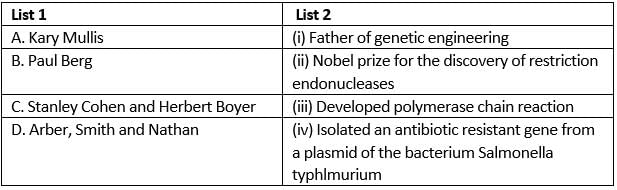
Detailed Solution: Question 10

  • The father of genetic engineering is Paul Berg. He creates the recombinant DNA technology in 1972.
  • Kary Mullis invents the polymerase chain reaction in 1993. Arber, Smith and Nathan discovered the restriction endonuclease enzymes in 1978.
  • Stanley Cohen and Herbert Boyer constructed artificial recombinant DNA for the first time. They got the idea of linking a gene encoding for antibiotic resistance with a native plasmid of Salmonella typhinurium.

69 videos|305 docs|161 tests
Information about Test: Principles of Biotechnology (NCERT) Page
In this test you can find the Exam questions for Test: Principles of Biotechnology (NCERT) solved & explained in the simplest way possible. Besides giving Questions and answers for Test: Principles of Biotechnology (NCERT), EduRev gives you an ample number of Online tests for practice
69 videos|305 docs|161 tests
Download as PDF