NEET Exam  >  NEET Test  >  Biology Class 12  >  Test: Microbes as Biocontrol Agents (NCERT) - NEET MCQ

Microbes as Biocontrol Agents (NCERT) - Free MCQ Practice Test with solutions,


MCQ Practice Test & Solutions: Test: Microbes as Biocontrol Agents (NCERT) (10 Questions)

You can prepare effectively for NEET Biology Class 12 with this dedicated MCQ Practice Test (available with solutions) on the important topic of "Test: Microbes as Biocontrol Agents (NCERT)". These 10 questions have been designed by the experts with the latest curriculum of NEET 2026, to help you master the concept.

Test Highlights:

  • - Format: Multiple Choice Questions (MCQ)
  • - Duration: 10 minutes
  • - Number of Questions: 10

Sign up on EduRev for free to attempt this test and track your preparation progress.

Test: Microbes as Biocontrol Agents (NCERT) - Question 1

Bacillus thuringiensis (Bt) strains have been used for designing novel

Detailed Solution: Question 1

Bioinsecticides are those biological agents that are used to control harmful insects. Because of development of methods of genetic enginerring, B-Thuringiensis toxic genes are introduced into plants. Such plants are resistant to attack by insect pests. Bt cotton is one such example.

Test: Microbes as Biocontrol Agents (NCERT) - Question 2

Which of the following is not used as a biopesticide?

Detailed Solution: Question 2

Xanthomonas campestris is not used as a biopesticide. Bacillus thuringiensis is used as a microbial biocontrol agent. Trichoderma harzianum is a free-living fungi, common in soil and root ecosystems. It is an effective biocontrol agent of several plant pathogens. viruses of the family Baculoviruses are pathogens that attack insecs and other arthropods. The majority of baculoviruses used as biological control agents belong to genus Nucleopolyhedrovirus.

Test: Microbes as Biocontrol Agents (NCERT) - Question 3

Which of the following statements regarding baculoviruses as biocontrol agents is/are correct?

Detailed Solution: Question 3

Baculoviruses are pathogens that attack insects and other arthropods. The majority of them used as a biological control agents are in the genus Nucleopolyhedrovirus.These viruses are excellent candidates for species-specific, narrow spectrum insecticidal applications. Infection with baculoviruses occurs when susceptible hosts eat virus particle present on foliage and dies. These are important in organic farming because of their specific action on harmful insects without causing any damage to beneficial insects as well as to the environment.

Test: Microbes as Biocontrol Agents (NCERT) - Question 4

A microbial biocontrol agent that can be used to control butterfly caterpillars is:

Detailed Solution: Question 4

An example of microbial biocontrol agent is bacteria Bacillus thuringiensis (Bt).
It can be introduced in order to control butterfly caterpillars.
These are available in sachets as dried spores that are mixed with water and sprayed onto vulnerable plants such as Brassica and fruit trees, where these are eaten by the insect larvae. In the gut of larvae, the toxin is released and the larvae get killed. The bacterial disease will kill the caterpillars, but leaves other insect uharmed. 

Test: Microbes as Biocontrol Agents (NCERT) - Question 5

Baculoviruses (Nucleopolyhedrovirus) do not show

Detailed Solution: Question 5

Nucleopolyhedrovirus are excellent candidates for species-specific, narrow spectrum insecticidal applications. They have been shown to have no negative impacts on plants, mammals, birds, fish or even on non-target insects. This is especially desirable when beneficial insects are being conserved to aid in an overall integrated pest management (IPM) programme, or when an ecologically sensitive area is being treated.

Test: Microbes as Biocontrol Agents (NCERT) - Question 6

Match column I with column II and select the correct answer from the codes given below.
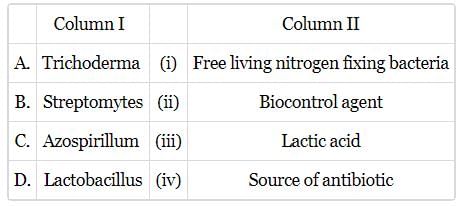
 

Detailed Solution: Question 6

  • Tricoderma is a biocontrol agent.
  • Streptomyces is the source of antibiotic streptomycin.
  • Azospirillum is a free-living nitrogen fixing bacteria.
  • Lactobacillus produces lactic acid.

Test: Microbes as Biocontrol Agents (NCERT) - Question 7

Which of the following statements is correct with regard to biocontrol agents?

Detailed Solution: Question 7

Ladybird and dragonflies are used to get rid of aphids and mosquitoes respectively. Bacillus thuringiensis bacteria are used to control utterfly caterpillars. Trichoderma species are used to control several plant pathogen.. 

Test: Microbes as Biocontrol Agents (NCERT) - Question 8

Consider the following statements regarding microbial biocontrol:
A. Biocontrol aims at complete eradication of pests.
B. Bt toxin genes can be introduced into plants for pest resistance.
C. Baculoviruses are narrow-spectrum insecticides.
D. Chemical pesticides are always preferred over biocontrol in organic farming.
Which of the statements are correct?

Detailed Solution: Question 8

Statement A is incorrect (biocontrol maintains balance, not eradication).
Statement B is correct (Bt genes used in transgenic plants).
Statement C is correct (baculoviruses are species-specific).
Statement D is incorrect (organic farming avoids chemicals).

Test: Microbes as Biocontrol Agents (NCERT) - Question 9

Assertion (A): Baculoviruses are considered ideal biocontrol agents in integrated pest management (IPM).
Reason (R): They affect a wide range of organisms including beneficial insects.

Detailed Solution: Question 9

Assertion is true because baculoviruses are species-specific and safe for non-target organisms.
Reason is false because they do not affect a wide range; they are highly specific.

Test: Microbes as Biocontrol Agents (NCERT) - Question 10

Assertion (A): Bacillus thuringiensis is widely used as a biocontrol agent in agriculture.
Reason (R): It produces protein toxins that become active in the alkaline gut of insect larvae, leading to their death.

Detailed Solution: Question 10

Bacillus thuringiensis produces crystalline protein toxins which are activated in the alkaline gut of insect larvae, causing cell lysis and death. This property makes it an effective biocontrol agent. Hence, both A and R are true and R correctly explains A.

69 videos|305 docs|161 tests
Information about Test: Microbes as Biocontrol Agents (NCERT) Page
In this test you can find the Exam questions for Test: Microbes as Biocontrol Agents (NCERT) solved & explained in the simplest way possible. Besides giving Questions and answers for Test: Microbes as Biocontrol Agents (NCERT), EduRev gives you an ample number of Online tests for practice
69 videos|305 docs|161 tests
Download as PDF