NEET Exam  >  NEET Test  >  Chemistry Class 11  >  Test: Nomenclature of Organic Compounds (NCERT) - NEET MCQ

Nomenclature of Organic Compounds (NCERT) - Free MCQ Practice Test


MCQ Practice Test & Solutions: Test: Nomenclature of Organic Compounds (NCERT) (20 Questions)

You can prepare effectively for NEET Chemistry Class 11 with this dedicated MCQ Practice Test (available with solutions) on the important topic of "Test: Nomenclature of Organic Compounds (NCERT)". These 20 questions have been designed by the experts with the latest curriculum of NEET 2026, to help you master the concept.

Test Highlights:

  • - Format: Multiple Choice Questions (MCQ)
  • - Duration: 20 minutes
  • - Number of Questions: 20

Sign up on EduRev for free to attempt this test and track your preparation progress.

Test: Nomenclature of Organic Compounds (NCERT) - Question 1

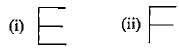
lUPAC names of the given structures are​

Detailed Solution: Question 1

Option D is correct.

For structure (i), identify the longest continuous carbon chain: it contains 5 carbon atoms, so the parent hydrocarbon is pentane.

Number the carbon chain from the end nearer the substituent so the substituent receives the lowest possible locant. A methyl substituent lies on carbon 3, giving the correct IUPAC name 3-methylpentane.

For structure (ii), the longest continuous carbon chain contains 4 carbon atoms, so the parent hydrocarbon is butane.

Number the chain to assign the lowest locant to the substituent. The methyl group is on carbon 2, giving the correct IUPAC name 2-methylbutane.

Therefore the pair of IUPAC names is 3-methylpentane and 2-methylbutane, matching option D.

Test: Nomenclature of Organic Compounds (NCERT) - Question 2

Correct name for the given compound,​

Detailed Solution: Question 2

Test: Nomenclature of Organic Compounds (NCERT) - Question 3

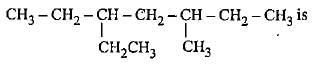
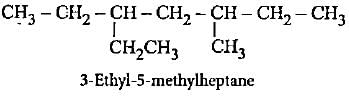
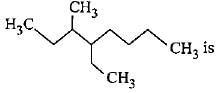
lUPAC name of the compound

Detailed Solution: Question 3

To determine the IUPAC name of the given compound, follow these steps:

  1. Identify the longest carbon chain: The longest continuous chain has 8 carbon atoms, so the base name is octane.
  2. Number the chain: Number the carbon chain from the end nearest to the first substituent to give the substituents the lowest possible numbers.
  3. Identify substituents and their positions:
    • At carbon 3, there is a methyl (-CH3) group.
    • At carbon 4, there is an ethyl (-CH2CH3) group.
  4. Write the name: Substituents are listed alphabetically regardless of their position numbers.
    • Ethyl comes before methyl alphabetically.
    • Therefore, the name is 4-ethyl-3-methyloctane.

Hence, the correct IUPAC name of the compound is 4-ethyl-3-methyloctane.

Answer: D. 4-ethyl-3-methyloctane

Test: Nomenclature of Organic Compounds (NCERT) - Question 4

How many primary, secondary, tertiary and quaternary carbon atoms are present in the following compound?
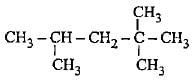
Detailed Solution: Question 4
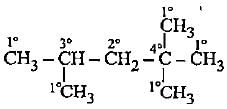

1° - 5, 2° - 1, 3° - 1, 4° - 1

Test: Nomenclature of Organic Compounds (NCERT) - Question 5

The lUPAC name of the compound having formula
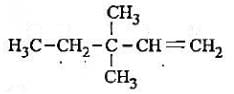
Detailed Solution: Question 5
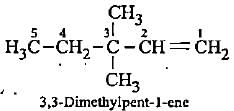
Test: Nomenclature of Organic Compounds (NCERT) - Question 6

lUPAC name of (CH3)3C - CH = CH2 is

Detailed Solution: Question 6
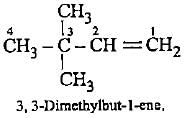
Test: Nomenclature of Organic Compounds (NCERT) - Question 7

Which of the following represents 3-methylpenta-1, 3-diene?

Detailed Solution: Question 7
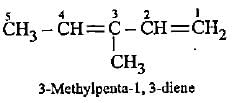
Test: Nomenclature of Organic Compounds (NCERT) - Question 8

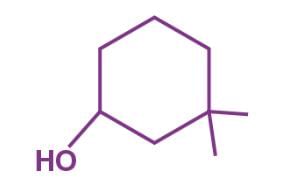
Select the correct IUPAC name for

Detailed Solution: Question 8

Answer: (b), The IUPAC name of aforementioned compound is 3,3 –dimethyl -1-cyclohexanol.

Test: Nomenclature of Organic Compounds (NCERT) - Question 9

The correct decreasing order of priority for the functional groups of organic compounds In the lUPAC system of nomenclature Is

Detailed Solution: Question 9
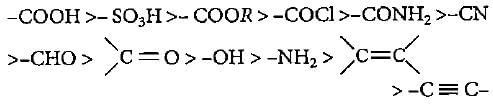
The order of preference of functional groups is as follows;

Test: Nomenclature of Organic Compounds (NCERT) - Question 10

Which of the following compounds Is not correctly matched with Its lUPAC name?

Detailed Solution: Question 10
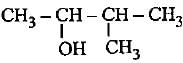

The correct name is 3-methylbutan-2-ol since functional group should get lowest number.

Test: Nomenclature of Organic Compounds (NCERT) - Question 11

The correct representation of 4-hydroxy-2-methylpent-2-en-1 -al Is

Detailed Solution: Question 11
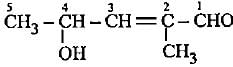

4-Hydroxy-2-methylpent-2-en-l-al

Test: Nomenclature of Organic Compounds (NCERT) - Question 12

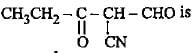
The correct name of 

Detailed Solution: Question 12

2-formyl-3-oxopentanenitrile

Why:

  • Treat the –C≡N carbon as C-1 (nitrile = parent suffix -nitrile).

  • That gives a five-carbon parent chain (pentanenitrile).

  • The terminal aldehyde (original –CHO) is now a formyl substituent at C-2 → 2-formyl.

  • The carbonyl (=O) in the chain is a 3-oxo substituent.

  • Assemble substituents alphabetically: formyl before oxo → 2-formyl-3-oxopentanenitrile.

For comparison (non-preferred/older style): the same structure can be called 2-cyano-3-oxopentanal (aldehyde as parent), but that is not the preferred IUPAC name under the modern rules.

Test: Nomenclature of Organic Compounds (NCERT) - Question 13

The lUPAC name of 

Detailed Solution: Question 13

Test: Nomenclature of Organic Compounds (NCERT) - Question 14

Correct representation of 3-methylpent-3-en-2-ol is

Detailed Solution: Question 14
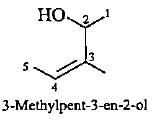
Test: Nomenclature of Organic Compounds (NCERT) - Question 15

Which of the following lUPAC names is not correctly matched?

Detailed Solution: Question 15

Option C is not correctly matched.

The name 1,1-dimethylcyclohexane indicates two methyl groups bonded directly to the same ring carbon (a geminal dimethyl substitution on the cyclohexane ring).

The drawn structure, however, corresponds to a single carbon attached to the ring that itself carries two methyl groups; that carbon is an alkyl substituent (the propan-2-yl group, commonly called isopropyl), not two separate methyl substituents on the ring carbon.

By selecting the larger group as parent, the ring is chosen as parent. The correct systematic name is therefore 1-(propan-2-yl)cyclohexane (equivalently propan-2-ylcyclohexane or isopropylcyclohexane), so the given name 1,1-dimethylcyclohexane is incorrect.

Hence the incorrectly matched option is C.

Test: Nomenclature of Organic Compounds (NCERT) - Question 16

The correct lUPAC name of the compound
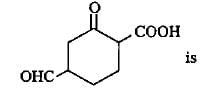
Detailed Solution: Question 16

Priority of functional groups is
- COOH > - CHO >>C = O.
Hence, the lUPAC name is 4-formyl-2-oxocyclohexane carboxylicacid.

Test: Nomenclature of Organic Compounds (NCERT) - Question 17

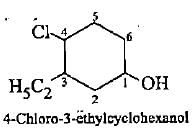
The correct IUPAC name of the following compound is
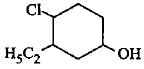
Detailed Solution: Question 17
Test: Nomenclature of Organic Compounds (NCERT) - Question 18

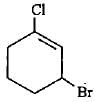
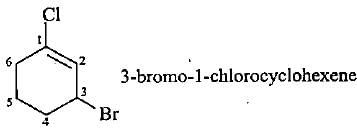
The lUPAC name of the compound shown below is
Detailed Solution: Question 18
Test: Nomenclature of Organic Compounds (NCERT) - Question 19

Which ofthe following names of substituted benzene compounds is not correct?

Detailed Solution: Question 19
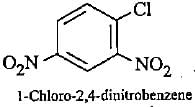
1-chloro-2,4-dinitrobenzene is the correct iupac name of this compound 

  • Chlorine (Cl) is assigned position 1 because it comes first alphabetically.
  • Nitro groups (NO₂) are numbered 2 and 4 to give the lowest possible locants.
  • The name follows the order: 1-chloro-2,4-dinitrobenzene, listing substituents alphabetically and indicating their positions.

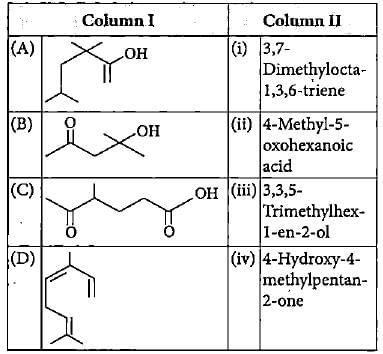
Test: Nomenclature of Organic Compounds (NCERT) - Question 20

Match the compounds given in column I with the TUPAC names given in column II and mark the appropriate choice.
98 videos|243 docs|71 tests
Information about Test: Nomenclature of Organic Compounds (NCERT) Page
In this test you can find the Exam questions for Test: Nomenclature of Organic Compounds (NCERT) solved & explained in the simplest way possible. Besides giving Questions and answers for Test: Nomenclature of Organic Compounds (NCERT), EduRev gives you an ample number of Online tests for practice
98 videos|243 docs|71 tests
Download as PDF