NEET Exam  >  NEET Test  >  Physics Class 11  >  Test: The International System of Units (NCERT) - NEET MCQ

The International System of Units (NCERT) - Free MCQ Practice Test


MCQ Practice Test & Solutions: Test: The International System of Units (NCERT) (16 Questions)

You can prepare effectively for NEET Physics Class 11 with this dedicated MCQ Practice Test (available with solutions) on the important topic of "Test: The International System of Units (NCERT)". These 16 questions have been designed by the experts with the latest curriculum of NEET 2026, to help you master the concept.

Test Highlights:

  • - Format: Multiple Choice Questions (MCQ)
  • - Duration: 16 minutes
  • - Number of Questions: 16

Sign up on EduRev for free to attempt this test and track your preparation progress.

Test: The International System of Units (NCERT) - Question 1

In International System of units, there are seven base quantities whose units are defined. Which physical quantity has a prefix with its unit?

Detailed Solution: Question 1

  • The International System of Units (SI) has seven base quantities.
  • Among these, the unit for mass is the kilogram (kg).
  • The prefix "kilo-" in kilogram indicates a factor of 1,000.
  • Other quantities like thermodynamic temperature (kelvin), luminous intensity (candela), and amount of substance (mole) do not have prefixes in their base units.
  • Thus, mass is unique as it includes a prefix in its unit.

Test: The International System of Units (NCERT) - Question 2

The wrong unit conversion among the following is

Detailed Solution: Question 2

I astronomical unit = 1.496 x 10¹¹ m
All the other unit conversation are correct.

Test: The International System of Units (NCERT) - Question 3

Which of the following is not the name of a fundamental physical quantity?

Detailed Solution: Question 3

- Fundamental physical quantities are basic measurements that cannot be defined in terms of other quantities.
- Examples include time, temperature, and mass, which are essential for describing physical phenomena.
- Impulse, however, is derived from other quantities; it is the product of force and time, making it a derived quantity.
- Therefore, impulse is not considered a fundamental physical quantity, as it relies on the fundamental concepts of force and time.

Test: The International System of Units (NCERT) - Question 4

Which one of the following physical quantities is not a fundamental quantity?

Detailed Solution: Question 4

Among the given physical quantities work is not a fundamental quantity whereas all other three physical quantities are fundamental quantities.

Test: The International System of Units (NCERT) - Question 5

Which one of the following statements is incorrect?

Detailed Solution: Question 5

Incorrect Statement:

  • 4. The SI units are based on six base units.

The SI system actually relies on seven base units:

  1. Meter (m) for length
  2. Kilogram (kg) for mass
  3. Second (s) for time
  4. Ampere (A) for electric current
  5. Kelvin (K) for thermodynamic temperature
  6. Mole (mol) for amount of substance
  7. Candela (cd) for luminous intensity

Correct Statements:

  • 1. Direct and indirect methods are used for the measurement of physical quantities. (True - We can measure directly or use indirect methods like displacement for volume.)
  • 2. Scientific notation and the prefixes are used to simplify numerical computation. (True - They help express large/small numbers conveniently.)
  • 3. A dimensionally correct equation need not be a correct equation. (True - Matching units doesn't guarantee a factual equation.)

Test: The International System of Units (NCERT) - Question 6

Which one of the following is not a derived unit?

Detailed Solution: Question 6

Among the given units kilogram is the fundamental or base unit whereas others are the derived units.

Test: The International System of Units (NCERT) - Question 7

Which of the following units is not a base unit?

Detailed Solution: Question 7

Among the given units pascal is the derived unit whereas other are the fundamental or base units.

Test: The International System of Units (NCERT) - Question 8

Which of the following system of units is not based on unit of mass, length and time?

Detailed Solution: Question 8

SI is not based on units of mass, length and time alone.

Test: The International System of Units (NCERT) - Question 9

Spot out the odd one.

Detailed Solution: Question 9

Calorie, kilowatt hour, joule all are the units of energy whereas watt is the unit of power.

Test: The International System of Units (NCERT) - Question 10

Which of the following is unitless quantity?

Detailed Solution: Question 10

Among the given quantities displacement gradient is a unitless quantity.

Test: The International System of Units (NCERT) - Question 11

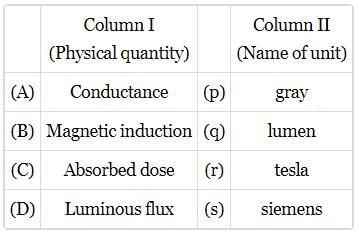
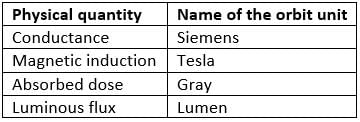
Match the Column I with Column II.

Detailed Solution: Question 11
Test: The International System of Units (NCERT) - Question 12

The SI unit of pressure gradient is

Detailed Solution: Question 12

Pressure gradient = Pressure/Distance
∵ The SI unit of pressure is N m-2 and distance is m.
∴ The SI unit of pressure gradient is N m-3.

Test: The International System of Units (NCERT) - Question 13

The relative density of lead is 11.3. Its density in SI unit is 

Detailed Solution: Question 13

∴ Density of lead = 11.3 × 1 × 103 kg m−3
(∵ Density of water = 1 × 10kg m−3)
= 11.3 × 10³ kg m−3 = 1.13 × 10⁴ kg m−3

Test: The International System of Units (NCERT) - Question 14

The value of universal gravitational constant G = 6.67 × 10⁻¹¹ N m2 kg−2. The value of G in units of g−1 cm3 s−2 is

Detailed Solution: Question 14

G = 6.67 × 10⁻¹¹ N mkg−2
= 6.67 × 10⁻¹¹ × (kg m s−2)(m2)(kg)−2
= 6.67 × 10⁻¹¹ × [(1000 g) × (100 cm) × s−2] × (100 cm)× (1000 g)−2
= 6.67 × 10⁻⁸ g−1 cm3 s−2

Test: The International System of Units (NCERT) - Question 15

If the value of atmospheric pressure is 106 dyne cm−2, its value in SI units is

Detailed Solution: Question 15

Pressure = F/A
∴ 106 dyne cm−2 = 105 N m−2.

Test: The International System of Units (NCERT) - Question 16

The solid angle subtended by the periphery of an area 1 cm2 at a point situated symmetrically at a distance of 5 cm from the area is

Detailed Solution: Question 16
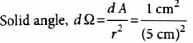

= 4 × 10⁻² steradian

97 videos|376 docs|98 tests
Information about Test: The International System of Units (NCERT) Page
In this test you can find the Exam questions for Test: The International System of Units (NCERT) solved & explained in the simplest way possible. Besides giving Questions and answers for Test: The International System of Units (NCERT), EduRev gives you an ample number of Online tests for practice
97 videos|376 docs|98 tests
Download as PDF