NEET Exam  >  NEET Test  >  Physics Class 11  >  Test: Accuracy, Precision of Instruments & Errors in Measurement (NCERT) - NEET MCQ

Accuracy, Precision of Instruments & Errors in Measurement (NCERT) - NEET


MCQ Practice Test & Solutions: Test: Accuracy, Precision of Instruments & Errors in Measurement (NCERT) (10 Questions)

You can prepare effectively for NEET Physics Class 11 with this dedicated MCQ Practice Test (available with solutions) on the important topic of "Test: Accuracy, Precision of Instruments & Errors in Measurement (NCERT)". These 10 questions have been designed by the experts with the latest curriculum of NEET 2026, to help you master the concept.

Test Highlights:

  • - Format: Multiple Choice Questions (MCQ)
  • - Duration: 10 minutes
  • - Number of Questions: 10

Sign up on EduRev for free to attempt this test and track your preparation progress.

Test: Accuracy, Precision of Instruments & Errors in Measurement (NCERT) - Question 1

If the error in measuring the radius of the sphere is 2% and that in measuring its mass is 3%, then the error in measuring the density of material of the sphere is
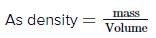
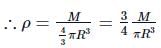
Detailed Solution: Question 1


∴ The percentage error in density is

= 3% + 3(2%) = 3% + 6% = 9%

Test: Accuracy, Precision of Instruments & Errors in Measurement (NCERT) - Question 2

Which of the following is the most precise instrument for measuring length?

Detailed Solution: Question 2

Screw gauge has minimum least count of 0.001cm. Hence, it is most precise instrument.

Test: Accuracy, Precision of Instruments & Errors in Measurement (NCERT) - Question 3

Which of the following time measuring devices is most precise?

Detailed Solution: Question 3

An atomic clock is the most precise time measuring device because atomic oscillations are repeated with a precision of 1s in 1013s.

Test: Accuracy, Precision of Instruments & Errors in Measurement (NCERT) - Question 4

Which of the following statements is incorrect?

Detailed Solution: Question 4

The magnitude of the difference between the true value of the quantity and the individual measurement value is called the absolute error of the measurement. Hence, option (d) is an incorrect statement while all other statements are correct.

Test: Accuracy, Precision of Instruments & Errors in Measurement (NCERT) - Question 5

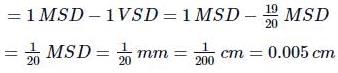
Which of the following instruments has minimum least count?
Detailed Solution: Question 5

(a) Least count of vernier callipers

(∵ 1MSD = 1mm)
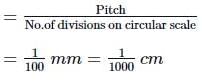
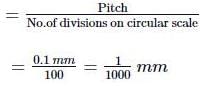
(b) Least count of screw gauge

(c) Least count of spherometer

= 0.0001cm
(d) Wavelength of light, λ = 10−5 cm = 0.00001cm
Clearly the optical instrument is the most precise.

Test: Accuracy, Precision of Instruments & Errors in Measurement (NCERT) - Question 6

The vernier scale of a travelling microscope has 50 divisions which coincide with 49 main scale divisions. If each main scale division is 0.5 mm, then the least count of the microscope is

Detailed Solution: Question 6

1 MSD = 0.5mm
50VSD = 49MSD
1 VSD = 49/50 MSD
Least Count = 1 MSD - 1 VSD

Test: Accuracy, Precision of Instruments & Errors in Measurement (NCERT) - Question 7

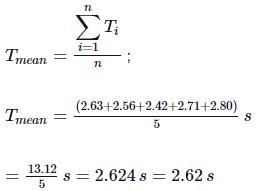
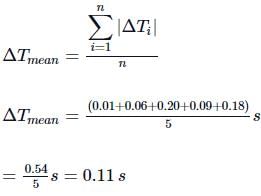
In an experiment, the period of oscillation of a simple pendulum was observed to be 2.63s, 2.56s, 2.42s, 2.71s and 2.80s. The mean absolute error is
Detailed Solution: Question 7

The mean period of oscillation of the pendulum is

(Rounded off to two decimal places)
The absolute errors in the measurement are
ΔT1 = 2.62s − 2.63s = −0.01s
ΔT2 = 2.62s − 2.56s = 0.06s
ΔT3 = 2.62s − 2.42s = 0.20s
ΔT4 = 2.62s − 2.71s = −0.09s
ΔT5 = 2.62s − 2.80s = −0.18s
Mean absolute error is

Test: Accuracy, Precision of Instruments & Errors in Measurement (NCERT) - Question 8

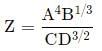
If  and ΔA, ΔB, ΔC, and ΔD are their absolute errors in A, B, C and D respectively. The relative error in Z is then

Detailed Solution: Question 8


The relative error in Z is given by

Test: Accuracy, Precision of Instruments & Errors in Measurement (NCERT) - Question 9

The temperatures of two bodies measured by a thermometer are t1 = 20 °C ± 0.5 °C and t2 = 50 °C ± 0.5 °C. The temperature difference and the error there is

Detailed Solution: Question 9

Here, t1 = 20 °C ± 0.5 °C; t2 = 50 °C ± 0.5 °C
The temperature difference of two bodies is
t = t2 - t1 = 50 °C - 20 °C = 30 °C
The error in temperature difference is given by
Δt = (Δt1, + Δt2) = (0.5 °C + 0.5 °C) = 1 °C
∴ The temperature difference is 30 °C ± 1 °C.

Test: Accuracy, Precision of Instruments & Errors in Measurement (NCERT) - Question 10

Two resistors of resistances R1 = (300 ± 3)Ω and R2 = (500 ± 4)Ω are connected in series. The equivalent resistance of the series combination is

Detailed Solution: Question 10

The equivalent resistance of series combination is
Rs = R1 + R= 300Ω + 500Ω = 800Ω
The error in equivalent resistance is given by
ΔR = (ΔR1 + ΔR2) = (3 + 4)Ω = 7Ω
Hence, the equivalent resistance along with error is (800 ± 7)Ω.

97 videos|376 docs|102 tests
Information about Test: Accuracy, Precision of Instruments & Errors in Measurement (NCERT) Page
In this test you can find the Exam questions for Test: Accuracy, Precision of Instruments & Errors in Measurement (NCERT) solved & explained in the simplest way possible. Besides giving Questions and answers for Test: Accuracy, Precision of Instruments & Errors in Measurement (NCERT), EduRev gives you an ample number of Online tests for practice
97 videos|376 docs|102 tests
Download as PDF