Coulomb's Law (NCERT) - Free MCQ Practice Test with solutions, NEET NCERT
MCQ Practice Test & Solutions: Test: Coulomb's Law (NCERT) (10 Questions)
You can prepare effectively for NEET NCERT Based Tests for NEET with this dedicated MCQ Practice Test (available with solutions) on the important topic of "Test: Coulomb's Law (NCERT)". These 10 questions have been designed by the experts with the latest curriculum of NEET 2026, to help you master the concept.
Test Highlights:
- - Format: Multiple Choice Questions (MCQ)
- - Duration: 10 minutes
- - Number of Questions: 10
Sign up on EduRev for free to attempt this test and track your preparation progress.

Detailed Solution: Question 1
Which of the following statement is not a similarity between electrostatic and gravitational forces?
Detailed Solution: Question 2

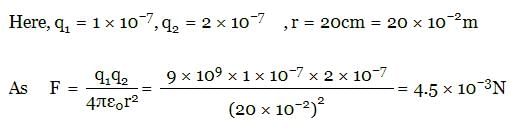
The force between two small charged spheres having charges of 1 x 10⁻⁷ C and 2 x 10⁻⁷ C placed 20 cm apart in air is
Detailed Solution: Question 4
The nucleus of helium atom contains two proton that are separated by distance 3.0 x 10⁻¹⁵ m. The magnitude of the electrostatic force that each proton exerts on the other is
Detailed Solution: Question 5

Two insulated charged metallic spheres P and Q have their centres separated by a distance of 60 cm. The radii of P and Q are negligible compared to the distance of separation. The mutual force of electrostatic repulsion if the charge on each is 3.2 x 10⁻⁷ C is
Detailed Solution: Question 6

Two point charges of +3 μC and +4 μC repel each other with a force of 10 N. If each is given an additional charge of -6 μC, the new force is
Detailed Solution: Question 7
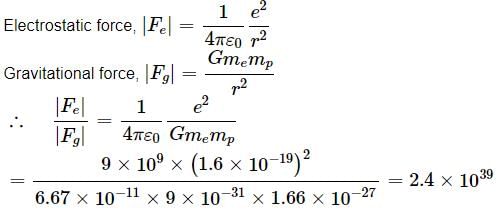
The ratio of magnitude of electrostatic force and gravitational force for an electron and proton is
Detailed Solution: Question 8
The electrostatic attracting force on a small sphere of charge 0.2μC due to another small sphere of charge -0.4μC in air is 0.4N. The distance between the two spheres is
Detailed Solution: Question 9


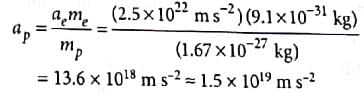
Under the action of a given coulombic force the acceleration of an electron is 2.5 x 10²² ms-2. Then the magnitude of the acceleration of a proton under the action of same force is nearly
Detailed Solution: Question 10
 where mc and mp are masses of electron and proton respectively