NEET Exam  >  NEET Test  >  NCERT Based Tests  >  Test: Electric Flux & Electric Dipole (NCERT) - NEET MCQ

Electric Flux & Dipole (NCERT) - Free MCQ Practice Test with solutions,


MCQ Practice Test & Solutions: Test: Electric Flux & Electric Dipole (NCERT) (10 Questions)

You can prepare effectively for NEET NCERT Based Tests for NEET with this dedicated MCQ Practice Test (available with solutions) on the important topic of "Test: Electric Flux & Electric Dipole (NCERT)". These 10 questions have been designed by the experts with the latest curriculum of NEET 2026, to help you master the concept.

Test Highlights:

  • - Format: Multiple Choice Questions (MCQ)
  • - Duration: 10 minutes
  • - Number of Questions: 10

Sign up on EduRev for free to attempt this test and track your preparation progress.

Test: Electric Flux & Electric Dipole (NCERT) - Question 1

The SI unit of electric flux is

Detailed Solution: Question 1

 As electric flux, φ = E.Δs
∴ unit of φ is N C-1 m2

Test: Electric Flux & Electric Dipole (NCERT) - Question 2

The dimensional formula of electric flux is

Detailed Solution: Question 2

 Electric flux, φ= 
The dimension of φ = Dimension of E x dimension of s
[φ] = [M1L1T-2][AT]-1[L2] = [M1L3T-3A-1]

Test: Electric Flux & Electric Dipole (NCERT) - Question 3

A circular plane sheet of radius 10 cm is placed in a uniform electric field of 5 x 10⁵N C-1, making an angle of 600 with the field. The electric flux through the sheet is

Detailed Solution: Question 3

Here, r = 10 cm 0.1 m, E = 5 x 10⁵ N C-1
As the angle between the plane sheet and the electric field is 600, angle made by the normal to the plane sheet and the electric field is θ = 900 - 600 = 300
φE = ES cos θ = E x πr2 cos θ
= 5 x 105 x 3.14 x (0.1)2 cos 300 = 1.36 x 10⁴ N m2C-1

Test: Electric Flux & Electric Dipole (NCERT) - Question 4

A uniform electric field E = 2 x 10³ N C-1 is acting along the positive x-axis. The flux of this field through a square of 10cm on a side whose plane is paralled to the yz plane is 

Detailed Solution: Question 4

Here, E = 2 x 10³ N C-1 is along + x-axis
Surface area, s = (10 cm)2 = 10x 10-4 m2 = 10-2 m2
When plane is parallel to yz plane, θ = 0°
So φ = E s cosθ = 2 x 103 x 10-2 cos 0° = 20N C-1 m2

Test: Electric Flux & Electric Dipole (NCERT) - Question 5

In the above question , the flux through the same square if the line normal to its plane makes a 60° angle with the x-axis is

Detailed Solution: Question 5

When normal to the plane makes an angle of 60° with x-axis, then θ = 60°
φ = Es cosθ = 2 x 103 x 10-2 cos 60° = 10 N C-1m2

Test: Electric Flux & Electric Dipole (NCERT) - Question 6

Which of the following statements about dipole moment is not true?

Detailed Solution: Question 6

Dipole moment is a vector quantity and has magnitude of 2qa and it is in the direction of the dipole axis from -q to q.

Test: Electric Flux & Electric Dipole (NCERT) - Question 7

The unit of electric dipole moment is

Detailed Solution: Question 7

The unit of electric dipole moment is: 2ql =  C − m = Debye

Test: Electric Flux & Electric Dipole (NCERT) - Question 8

Two charges + 20 μC and -20 μC are placed 10 mm apart. The electric field at point P, on the axis of the dipole 10 cm away from  its centre O on the side of the positive charge is

Detailed Solution: Question 8
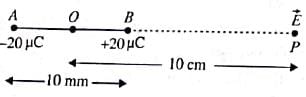

Here, q = ±20μC = ±20 x 10-6C, 2a = 10 mm = 10 x 10-3m
r = OP = 10 cm = 10 x 10-2 m
= q x 2a = 20 x 10-6 x 10 x 10-3 m = 2 x 10⁻⁷ m
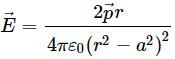

The electric field along BP, 
As a < < r,

Test: Electric Flux & Electric Dipole (NCERT) - Question 9

Consider a region inside which, there are various types of charges but the total charge is zero. At points outside the region

Detailed Solution: Question 9

When there are various types of charges in a region, but the total charge is zero, the region can be supposed to contain a number of electric dipoles. Therefore, at points outside the region, the dominant electric field ∝ (1/r3) for large r.

Test: Electric Flux & Electric Dipole (NCERT) - Question 10

Two point charges of 1μC and -1μC are separated by a distance of 100 Å. A point P is at a distance of 10 cm from the midpoint and on the perpendicular bisector of the line joining the two charges. The electric field at P will be 

Detailed Solution: Question 10

The Point lies on equatorial line of a short dipole,  

677 tests
Information about Test: Electric Flux & Electric Dipole (NCERT) Page
In this test you can find the Exam questions for Test: Electric Flux & Electric Dipole (NCERT) solved & explained in the simplest way possible. Besides giving Questions and answers for Test: Electric Flux & Electric Dipole (NCERT), EduRev gives you an ample number of Online tests for practice
Download as PDF