NEET Exam  >  NEET Test  >  Physics Class 12  >  Test: The Parallel Plate Capacitor (NCERT) - NEET MCQ

The Parallel Plate Capacitor (NCERT) - NEET Physics Class 12 Free MCQ Test


MCQ Practice Test & Solutions: Test: The Parallel Plate Capacitor (NCERT) (5 Questions)

You can prepare effectively for NEET Physics Class 12 with this dedicated MCQ Practice Test (available with solutions) on the important topic of "Test: The Parallel Plate Capacitor (NCERT)". These 5 questions have been designed by the experts with the latest curriculum of NEET 2026, to help you master the concept.

Test Highlights:

  • - Format: Multiple Choice Questions (MCQ)
  • - Duration: 5 minutes
  • - Number of Questions: 5

Sign up on EduRev for free to attempt this test and track your preparation progress.

Test: The Parallel Plate Capacitor (NCERT) - Question 1

In a parallel plate capacitor, the capacity increases if
Detailed Solution: Question 1

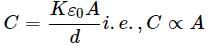
In a parallel plate capacitor the capacity of capacitor.

The capacity of capacitor increases if area of the plate is increased.

Test: The Parallel Plate Capacitor (NCERT) - Question 2

A parallel plate capacitor has two square plates with equal and opposite charges. The surface charge densities on the plate are +σ and −σ respectively. In the region between the plates the magnitude of electric field is:

Detailed Solution: Question 2

The magnitude of the electric field between the plates is F = σ/2ε0 - (- σ/2ε0) - σ/ε0

Test: The Parallel Plate Capacitor (NCERT) - Question 3

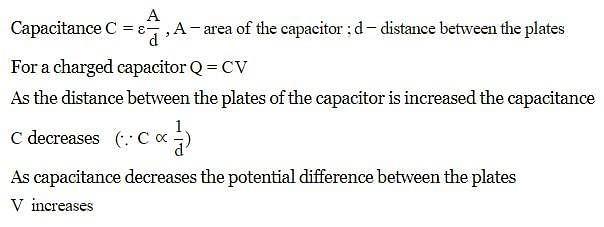
A parallel plate air capacitor is charged to a potential difference of V volts. After disconnecting the charging battery the distance between the plates of the capacitor is increased using an insulating handle. As a result the potential difference between the plates
Detailed Solution: Question 3

Correct answer is A.

Test: The Parallel Plate Capacitor (NCERT) - Question 4

A parallel plate capacitor is charged and then isolated. What is the effect of increasing the plate separation on charge, potential, capacitance, respectively?

Detailed Solution: Question 4

As the capacitor is isolated after charging, charge on it remains constant. Plate separation increases d, decreases C = ϵ0A/d and hence increases potential V = q/C.

Test: The Parallel Plate Capacitor (NCERT) - Question 5

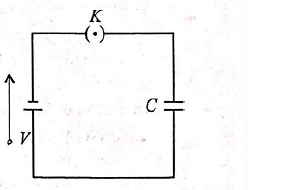
A parallel plate capacitor is connected to a battery as shown in figure. Consider two situations
image
(i) key KK is kept closed and plates of capacitors are moved apart using insulating handle
(ii) key KK is opened and plates of capacitors are moved apart using insulating handle
Which of the following statements is correct?

Detailed Solution: Question 5

When key K is kept closed, condenser C is charged to potential V. When plates of capacitors are moved apart, its capacitance, C = ϵoA/d decreases.
As potential of condenser remains same, charge Q = CV decreases. So option is correct. Once key K is closed, condenser gets charged, Q = CV.
Now, if key K is opened, battery is disconnected, no more charging can occur i.e. Q remains same.
As plates or capacitor are moved apart, its capacity C = ϵoA/d decreases.
Therefore, its potential, V = q/C increases

74 videos|346 docs|92 tests
Information about Test: The Parallel Plate Capacitor (NCERT) Page
In this test you can find the Exam questions for Test: The Parallel Plate Capacitor (NCERT) solved & explained in the simplest way possible. Besides giving Questions and answers for Test: The Parallel Plate Capacitor (NCERT), EduRev gives you an ample number of Online tests for practice
74 videos|346 docs|92 tests
Download as PDF