Humanities/Arts Exam  >  Humanities/Arts Test  >  Psychology Class 11  >  Test: Methods of Enquiry in Psychology- 1 - Humanities/Arts MCQ

Methods of Enquiry in Psychology- 1 - Free MCQ Practice Test with solutions,


MCQ Practice Test & Solutions: Test: Methods of Enquiry in Psychology- 1 (10 Questions)

You can prepare effectively for Humanities/Arts Psychology Class 11 with this dedicated MCQ Practice Test (available with solutions) on the important topic of "Test: Methods of Enquiry in Psychology- 1". These 10 questions have been designed by the experts with the latest curriculum of Humanities/Arts 2026, to help you master the concept.

Test Highlights:

  • - Format: Multiple Choice Questions (MCQ)
  • - Duration: 10 minutes
  • - Number of Questions: 10

Sign up on EduRev for free to attempt this test and track your preparation progress.

Test: Methods of Enquiry in Psychology- 1 - Question 1

Assertion (A): In experimental research, independent variables are manipulated to observe their effect on dependent variables.

Reason (R): Dependent variables are consistent and do not change regardless of the independent variable manipulation.

Detailed Solution: Question 1
- The Assertion is true because, in experimental research, researchers manipulate independent variables to investigate their impact on dependent variables.

- The Reason is false. Dependent variables are expected to change in response to the manipulation of independent variables, thus they are not consistent.

- Since the Reason does not accurately explain the Assertion, the correct answer is Option C.

Test: Methods of Enquiry in Psychology- 1 - Question 2

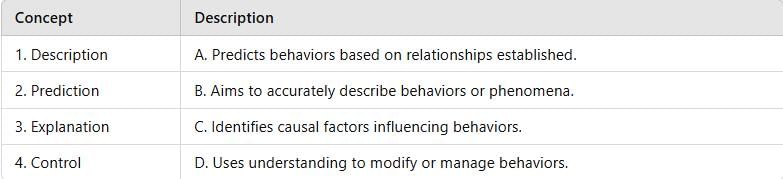
Match the following-

Detailed Solution: Question 2

  • Description (B: Aims to accurately describe behaviors or phenomena):

    • In psychological research, description refers to the careful and accurate portrayal of behaviors or phenomena, distinguishing them from others.
  • Prediction (A: Predicts behaviors based on relationships established):

    • Prediction involves forecasting future behaviors by understanding the relationships between different variables based on past observations.
  • Explanation (C: Identifies causal factors influencing behaviors):

    • Explanation is about identifying the underlying causes that influence behaviors, establishing cause-effect relationships.
  • Control (D: Uses understanding to modify or manage behaviors):

    • Control involves using knowledge gained from research to modify or influence behaviors in a desired direction, such as in therapetic settings. 

Test: Methods of Enquiry in Psychology- 1 - Question 3

Which of the following statements are true about the goals and methods of psychological enquiry?

I. The goal of prediction in psychological research is to forecast behaviors based on the accurate description and understanding of past behaviors.

II. In psychological research, control refers to the ability to describe and explain behaviors without making any changes.

Detailed Solution: Question 3

  • Statement 1 is true because prediction involves using descriptions and understanding of past behaviors to anticipate future behaviors under specific conditions.
  • Statement 2 is false because control in psychological research refers to the application of knowledge to influence or change behaviors, not just to describe or explain them.

Test: Methods of Enquiry in Psychology- 1 - Question 4

Assertion (A): Psychological research aims to describe behaviors or phenomena to distinguish them from others.

Reason (R): In psychological research, prediction is focused on forecasting likely behaviors under specific conditions based on the relationships established between different behaviors and events.

Detailed Solution: Question 4

  • Assertion (A): is true because one of the primary goals of psychological research is to accurately describe behaviors or phenomena.
  • Reason (R): is also true, as prediction is indeed focused on forecasting behaviors. However, R is not the correct explanation for A because A is about description, while R focuses on prediction.
  • Therefore, the correct answer is Option B.

Test: Methods of Enquiry in Psychology- 1 - Question 5

Arrange the steps in conducting scientific research in chronological order:

A. Collecting Data
B. Conceptualizing a Problem
C. Revising Research Conclusions
D. Drawing Conclusions

Detailed Solution: Question 5

  • Conceptualizing a Problem (Step 1):

    • This is the first step in research, where the researcher identifies and narrows down a specific problem or research question.
  • Collecting Data (Step 2):

    • After conceptualizing the problem, the researcher develops a design, selects participants, and collects data relevant to the research question.
  • Drawing Conclusions (Step 3):

    • The collected data is then analyzed to interpret findings and draw conclusions, often validating or refuting the initial hypotheses.
  • Revising Research Conclusions (Step 4):

    • Based on the analysis, the researcher revises or refines conclusions, and this iterative process may lead to the development of new theories or modifications to existing ones.

Test: Methods of Enquiry in Psychology- 1 - Question 6

Given below are four statements about the goals of psychological enquiry:

i. Description involves establishing cause-effect relationships among variables.
ii. Prediction focuses on accurately forecasting behaviors based on relationships established.
iii. Explanation aims to provide detailed records of behavior for better understanding.
iv. Control involves using research findings to modify or manage behaviors.

Which of the statements is/are true?

Detailed Solution: Question 6

The correct answer is b) ii and iv.

Explanation:

  • Statement i is incorrect: Description in psychological enquiry refers to providing an accurate account of behaviors and phenomena, not about establishing cause-effect relationships (which is the goal of explanation).
  • Statement ii is correct: Prediction involves forecasting behaviors based on established relationships between variables.
  • Statement iii is incorrect: Explanation involves identifying causes or reasons behind behaviors, not just providing records of them.
  • Statement iv is correct: Control refers to using the findings of psychological research to influence or modify behaviors.

Test: Methods of Enquiry in Psychology- 1 - Question 7

Consider the following statements about methods of enquiry in psychology:

i. Experimental Method primarily aims to describe behavior in natural settings.
ii. Observation involves controlling all variables to determine cause-effect relationships.
iii. Case Studies are used for in-depth study of unique cases to understand specific phenomena.
iv. Surveys aim to manipulate independent variables in a controlled environment.

Which of the statements is/are true?

Detailed Solution: Question 7

  • i is false; Experimental Method is for determining cause-effect relationships, not Description.
  • ii is false; Observation does not involve controlling variables; that is the role of Experiments.
  • iii is true; Case Studies are used for in-depth analysis.
  • iv is false; Surveys do not involve manipulating variables but collecting data.

Test: Methods of Enquiry in Psychology- 1 - Question 8

Research ethics represent an important component of psychological research because: 

Detailed Solution: Question 8

Research ethics bind psychologists to a set of rules or code that delineates appropriate treatment of animal and human subjects. Research ethics do not provide statistical procedures, testable hypotheses or standards for variable selection.

Test: Methods of Enquiry in Psychology- 1 - Question 9

Assertion (A): Psychological enquiry aims to describe behaviors in a detailed manner to enhance understanding.

Reason (R): Accurate descriptions of behaviors allow researchers to predict future actions based on established patterns.

Detailed Solution: Question 9

  • Assertion (A) is true because one of the main goals of psychological enquiry is to provide accurate and detailed descriptions of behaviors to facilitate better understanding.
  • Reason (R) is also true as accurate descriptions are fundamental in predicting future behaviors based on observed patterns.
  • Furthermore, Reason (R) directly explains why Assertion (A) is valid—by establishing that the purpose of detailed descriptions is to enhance predictive capabilities.

Test: Methods of Enquiry in Psychology- 1 - Question 10

You have just conducted a research study. If the responses of the participants significantly differ from what would be expected if there was no relationship among the variables in your study, then it would be appropriate for you to: 

Detailed Solution: Question 10

When the responses in a research study differ significantly from what would be expected under the assumption of no relationship among variables, it suggests that the observed effects may not be due to chance alone.

  1. Using a different method to replicate results (Option A) helps ensure the findings are not specific to one methodological approach.
  2. Obtaining a larger sample to replicate results (Option B) increases the power of the study and helps generalize the findings.
  3. Performing manipulation checks (Option C) ensures that the experimental manipulations worked as intended, validating the results.

43 videos|92 docs|18 tests
Information about Test: Methods of Enquiry in Psychology- 1 Page
In this test you can find the Exam questions for Test: Methods of Enquiry in Psychology- 1 solved & explained in the simplest way possible. Besides giving Questions and answers for Test: Methods of Enquiry in Psychology- 1, EduRev gives you an ample number of Online tests for practice
43 videos|92 docs|18 tests
Download as PDF