
Yoga- 4 - Free MCQ Practice Test with solutions, Grade 11 Physical Education
MCQ Practice Test & Solutions: Test: Yoga- 4 (20 Questions)
You can prepare effectively for Grade 11 Physical Education for Grade 11 with this dedicated MCQ Practice Test (available with solutions) on the important topic of "Test: Yoga- 4". These 20 questions have been designed by the experts with the latest curriculum of Grade 11 2026, to help you master the concept.
Test Highlights:
- - Format: Multiple Choice Questions (MCQ)
- - Duration: 20 minutes
- - Number of Questions: 20
Sign up on EduRev for free to attempt this test and track your preparation progress.

Which one of the following is not included in elements of success according to Shiva Samhita?
Match List – I with List – II and select the correct option by choosing from codes given below:
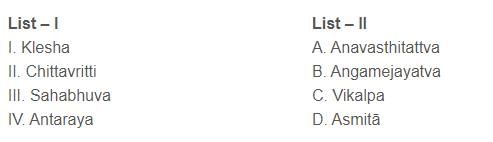 `
`
Codes:
I II III IV
`Codes:
I II III IV

Given below are two statements, an Assertion (A), and a Reason (R). Indicate your answer from the alternatives below:
Assertion (A): Human value is like an axle of a wheel and other types of value are around it.
Reason (R): The Human values are truthfulness, constructivity, sacrifice, sincerity, self control, anthusim and scientific vision.
In the context of above two statements, which one of the following is correct?
Assertion (A): Human value is like an axle of a wheel and other types of value are around it.
Reason (R): The Human values are truthfulness, constructivity, sacrifice, sincerity, self control, anthusim and scientific vision.
In the context of above two statements, which one of the following is correct?
Which hormone plays an important role in ‘fight-or-flight’ response in the body?
How many ‘Adh– aras’ are described in ‘Siddha Siddhant Paddhati’ under ‘Pinda-Vichar’?
Arrange the Pancha Kosha in sequential order, from gross to subtle. Use the codes given below:
I. Manomaya Kosha
II. Prānamaya Kosha
III. Ānandamaya Kosha
IV. Annamaya Kosha
V. Vigyānamaya Kosha
Codes:
I. Manomaya Kosha
II. Prānamaya Kosha
III. Ānandamaya Kosha
IV. Annamaya Kosha
V. Vigyānamaya Kosha
Codes:
Match the List – I with List – II and select the correct option using codes given below :
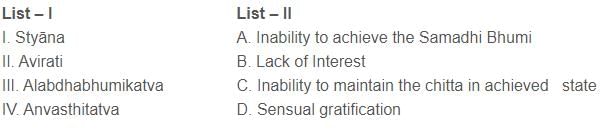
Codes:
I II III IV
Codes:
I II III IV
The positive attitude, happiness, lightedness, spiritual awakening and consciousness are the characteristics of
The following are included under Chittabhumi:
I. Moodha
II. Vikalpa
III. Vikshipta
IV. Niruddha
Use the codes given below for correct answer:
I. Moodha
II. Vikalpa
III. Vikshipta
IV. Niruddha
Use the codes given below for correct answer:
Which of the following is not included under ten principal Upanishads?
Match List-I with List-II and select the correct answer by choosing from codes given below:
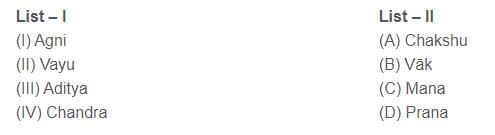
Codes:
(I) (II) (III) (IV)
Codes:
(I) (II) (III) (IV)
Detailed Solution: Question 16
Given below are two statements, an Assertion (A), and a Reason (R). Indicate your answer from the alternatives below:
Assertion (A): Matsyendrasana is the best Yoga Practice for control of Diabetes.
Reason (R): Matsyendrasana compresses the abdomen and twist the spine to stimulate the functioning of pancreas and thereby helps to control diabetes.
In the context of above two statements, which one of the following is correct?
Assertion (A): Matsyendrasana is the best Yoga Practice for control of Diabetes.
Reason (R): Matsyendrasana compresses the abdomen and twist the spine to stimulate the functioning of pancreas and thereby helps to control diabetes.
In the context of above two statements, which one of the following is correct?
Detailed Solution: Question 18
The purpose of the practice of Kriyā-yoga according to Patanjali are ________.
I. Viveka-khyāti
II. Samādhi-bhāva
III. Kaivalya-prāpti
IV. Klesha-tanūkara a
Find the correct combination according to the code:
I. Viveka-khyāti
II. Samādhi-bhāva
III. Kaivalya-prāpti
IV. Klesha-tanūkara a
Find the correct combination according to the code:
Given below are two statements, an Assertion (A), and a Reason (R). Indicate your answer from the alternatives below:
Assertion (A): By the practice of pranayama, the mind can attain the capability for Dharana.
Reason (R): Pranayam is a technique of voluntary regulation and control of breathing which enables the mind for practicing Dhārana.
In the context of above two statements, which one of the following is correct?
Assertion (A): By the practice of pranayama, the mind can attain the capability for Dharana.
Reason (R): Pranayam is a technique of voluntary regulation and control of breathing which enables the mind for practicing Dhārana.
In the context of above two statements, which one of the following is correct?
44 docs|18 tests |
