CBSE Class 3  >  Class 3 Test  >  Science Olympiad  >  Olympiad Test Level 1: Birds and Common Insects - Class 3 MCQ

Olympiad Test Level 1: Birds and Common Insects Class 3 Science MCQs


MCQ Practice Test & Solutions: Olympiad Test Level 1: Birds and Common Insects (20 Questions)

You can prepare effectively for Class 3 Science Olympiad for Class 3 with this dedicated MCQ Practice Test (available with solutions) on the important topic of "Olympiad Test Level 1: Birds and Common Insects". These 20 questions have been designed by the experts with the latest curriculum of Class 3 2026, to help you master the concept.

Test Highlights:

  • - Format: Multiple Choice Questions (MCQ)
  • - Duration: 40 minutes
  • - Number of Questions: 20

Sign up on EduRev for free to attempt this test and track your preparation progress.

Olympiad Test Level 1: Birds and Common Insects - Question 1

Which of these are flightless birds-

Detailed Solution: Question 1

Ostriches and Kiwis are flightless birds because they have small wings that can't help them fly. Instead, they are good at running or hopping around.
Sparrows, pigeons, owls, and woodpeckers can all fly.
So, the correct option is: D - Ostrich and Kiwi

Olympiad Test Level 1: Birds and Common Insects - Question 2

Which of the following statements are the characteristics of Birds?

(i) They have feathers on their body.

(ii) Their body is divided into the head, thorax and abdomen.

(iii) They have thin, light and hollow bones.

(iv) Their forelimbs get modified into fur.

Detailed Solution: Question 2

Birds have feathers on their bodies to keep them warm and help them fly.
They also have thin, light, and hollow bones which make it easier for them to fly.
Birds do not have forelimbs that turn into fur; instead, their forelimbs become wings for flying.
So, the correct Answer is; Option C - (i) and (iii)

Olympiad Test Level 1: Birds and Common Insects - Question 3

Larva of Housefly is known as

Detailed Solution: Question 3

The larva of a housefly is called a maggot. It is a small, white, worm-like creature that comes out of the egg laid by the adult fly.
A caterpillar is the larva of a butterfly, and a pupa is the stage where the larva changes into an adult.
So, the correct Answer is - Option B.- Maggot

Olympiad Test Level 1: Birds and Common Insects - Question 4

A Large or dense group of flying insects is known as.

Detailed Solution: Question 4

When many insects like bees or flies gather and fly together, we call it a "swarm." "Flocks" is used for birds, and "crowd" is for people, not insects.
So, the correct Answer is Option A - Swarm

Olympiad Test Level 1: Birds and Common Insects - Question 5

Duck is an ______ animal and it uses its ______ to probe insects in the sand and mud.

Detailed Solution: Question 5

A duck is an "aquatic" animal, which means it lives in water. It uses its "beak" to probe for insects in the sand and mud.
Ducks are great at swimming and looking for food in wet places.
So, the correct Answer is Option C - Aquatic and beak

Olympiad Test Level 1: Birds and Common Insects - Question 6

Hawk and Eagles are-

Detailed Solution: Question 6

Hawks and eagles are "carnivores," which means they eat other animals.
They hunt small animals like rabbits, fish, or birds to feed themselves.
They do not eat plants or leftover food like scavengers.
So, the correct Answer is - Option B - Carnivores

Olympiad Test Level 1: Birds and Common Insects - Question 7

Flightless bird: Penguin::Migratory bird:X

Detailed Solution: Question 7

In winter, the climatic conditions of Siberia are not suitable for birds living in these areas.
Siberian Cranes have the longest migratory period, so they are called migratory birds.

Olympiad Test Level 1: Birds and Common Insects - Question 8

Unscramble the words to find out the smallest bird in the world

Detailed Solution: Question 8

The unscrambled word is "Humming." The smallest bird in the world is the "Hummingbird." It is tiny and can hover in place by rapidly flapping its wings.
So, the correct Answer is Option C - MMUGNIH 

Olympiad Test Level 1: Birds and Common Insects - Question 9

Insects breathe with a network of tiny tubes called

Detailed Solution: Question 9

Insects breathe through a complex network of tubules called the tracheae.
Large tracheae connect to spiracles opening at the surface of the body, where air enters and carbon dioxide exits.
So, the correct answer is Option D - Tracheae

Olympiad Test Level 1: Birds and Common Insects - Question 10

Among the following Insects which have a sucking type feeding habit?

Detailed Solution: Question 10

  • The insect with a sucking feeding habit is the housefly.
  • Houseflies use a specialised mouthpart for sucking liquids.
  • This adaptation allows them to feed on liquid substances.

Olympiad Test Level 1: Birds and Common Insects - Question 11

Which among the following can fly?

Detailed Solution: Question 11

  • Ants and termites are crawling insects.
  • They do not have the ability to fly.

Olympiad Test Level 1: Birds and Common Insects - Question 12

What type of a beak is found in Ducks?

Detailed Solution: Question 12

Ducks have "broad and flat beaks." This type of beak helps them scoop up food from water, like plants and small insects.
It is perfect for their way of feeding, as they can filter food from the mud and water.
So, the correct Answer is Option D - Broad and flat beaks

Olympiad Test Level 1: Birds and Common Insects - Question 13

Choose the correct option- are the option true or false

(i) Birds have hollow bones which help to fly.

(ii) Kiwi is a flightless bird.

(iii) Eagle is a herbivorous bird.

(iv) Ducks have pointed beaks.

Detailed Solution: Question 13

(i) True – Birds have hollow bones, which are light and help them fly easily.
(ii) True – A Kiwi is a flightless bird because it cannot fly.
(iii) False – Eagles are carnivores; they eat other animals, not plants.
(iv) False – Ducks have broad and flat beaks, not pointed beaks.
So, the correct Answer is Option D - TTFF

Olympiad Test Level 1: Birds and Common Insects - Question 14

The most diverse group of animals on earth-

Detailed Solution: Question 14

Insects are the most diverse and largest group of animals on Earth.

Olympiad Test Level 1: Birds and Common Insects - Question 15

There are_____ legs in an Insect.

Detailed Solution: Question 15
nsects have six legs, also referred to as three pairs of jointed legs, all attached to their thorax. This six-legged body plan is a defining characteristic of insects, placing them in a group called hexapods, which means "six-footed".  

Olympiad Test Level 1: Birds and Common Insects - Question 16

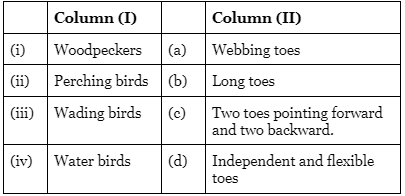
Match the Column-

Detailed Solution: Question 16

Woodpeckers have two toes painting forward and two backward.
Perching birds have independent and flexible toes.
Wading birds have long toes and water birds have webbed feet.
So, the correct Answer is Option A - (i)-c, (ii)-d, (iii) - b, (iv)-a.

Olympiad Test Level 1: Birds and Common Insects - Question 17

An insect that causes malaria-

Detailed Solution: Question 17

  • The insect responsible for spreading malaria is the female Anopheles mosquito.
  • These mosquitoes transmit the Plasmodium parasite, which causes malaria.
  • Preventing bites from these mosquitoes is key to reducing malaria risk.

Olympiad Test Level 1: Birds and Common Insects - Question 18

Largest Bird in the world–

Detailed Solution: Question 18

Largest bird in the world is Ostrich.

Olympiad Test Level 1: Birds and Common Insects - Question 19

Which among the following succumb to death after mating

Detailed Solution: Question 19

Drones are male bees which succumb to death after mating with Queen Bee.

Olympiad Test Level 1: Birds and Common Insects - Question 20

Kavi made a group of some animals shown below. But he has made a mistake. Ravi should remove which of the following from the group to correct his mistake?

Detailed Solution: Question 20

Bats are mammals because, like all mammals, they make milk for their young. Bats are not birds because they don't have feathers, they don't lay eggs, and are built very differently from birds.

33 videos|87 docs|54 tests
Information about Olympiad Test Level 1: Birds and Common Insects Page
In this test you can find the Exam questions for Olympiad Test Level 1: Birds and Common Insects solved & explained in the simplest way possible. Besides giving Questions and answers for Olympiad Test Level 1: Birds and Common Insects, EduRev gives you an ample number of Online tests for practice
33 videos|87 docs|54 tests
Download as PDF