CBSE Class 1  >  Class 1 Test  >  English Grammar for Junior Classes  >  Test: Vowels and Consonants - 1 - Class 1 MCQ

Vowels and Consonants - 1 - Free MCQ Practice Test with solutions,


MCQ Practice Test & Solutions: Test: Vowels and Consonants - 1 (10 Questions)

You can prepare effectively for Class 1 English Grammar for Junior Classes with this dedicated MCQ Practice Test (available with solutions) on the important topic of "Test: Vowels and Consonants - 1". These 10 questions have been designed by the experts with the latest curriculum of Class 1 2026, to help you master the concept.

Test Highlights:

  • - Format: Multiple Choice Questions (MCQ)
  • - Duration: 20 minutes
  • - Number of Questions: 10

Sign up on EduRev for free to attempt this test and track your preparation progress.

Test: Vowels and Consonants - 1 - Question 1

Morpheme is the 

Detailed Solution: Question 1

A morpheme is the smallest unit of meaning that can't be broken up. Eg- 'un' in the word unable.

Test: Vowels and Consonants - 1 - Question 2

There are 44 sounds in English. Out of these, how many sounds are vowels and how many are consonants respectively?

Detailed Solution: Question 2

Phoneme: It is the ‘smallest unit of sound' that distinguishes one word from another. Since sounds cannot be written, we use letters to represent or stand for the sounds.

Test: Vowels and Consonants - 1 - Question 3

A Phoneme is:

Detailed Solution: Question 3

Structure of Language: A structure is not a language component in itself but sound, symbols, and vocabulary are all components of a language. The basic components of language are phonemes, morphemes, and lexemes along with syntax and context.

Phonemes: The basis sounds of language are called phonemes. They are the smallest unit of sounds in a language. For example, the word ‘cat’ is made of three phonemes – ‘C’, ‘a’ and ‘t’.

  • All languages are made of the basic unit of sound called phonemes. Adult human beings can produce approximately 100 phonemes, and the English language is made up of about 45 phonemes.
  • Languages vary in the number of phonemes, ranging from as few as 15 to as many as 85. One reason why it is difficult for many Americans to learn foreign languages is that different phonemes are used.

Test: Vowels and Consonants - 1 - Question 4

The English language has _______ pure vowel sounds and _____ diphthongs.

Detailed Solution: Question 4

Monophthong (pure vowels) comes from the Greek word 'mono' and 'phthong' which means 'single' and 'sound' respectively. Therefore it refers to a single vowel sound which is articulated with exactly one mouth position. Eg: 'O' in the word 'hop'.Monophthongs are 12 in numbers which are: /i:/ (Beat); /ɪ/ (Bit); /e/ (Bet); /æ/ (Bat); /ʌ/ (Cut); ɑ: (Half); ɒ (Not); ɔ: (Port); ʊ (Wood); u: (You); ɜ: (Beard); ə (Butter)      
Diphthong comes from the Greek word 'di' and 'phthong' which are synonymous to the words 'twice' and 'sound' respectively. The following are its characteristics.

  • It refers to 'two sounds glide' which is articulated with a slight change in the tongue/mouth position.
  • It is a vowel sound formed by the combination of two adjacent vowels in a single syllable, in which the sound starts as one vowel and goes to another vowel.
  • Diphthongs sounds are 8 in number as explained below:

Test: Vowels and Consonants - 1 - Question 5

26 letters in English indicate______sounds for listening and speaking.

Detailed Solution: Question 5

IPA: It stands for the International Phonetic Association which was first published in 1888. Its objective is to define sounds of speech that applies to all languages. Note that:

  • There are 44 English Sounds that can be divided into two categories: Vowel and Consonant
  • Consonant Sound: In this, the flow of air is cut off, partially or completely during the production of sound. There are total 32 consonant sounds.
  • Vowel Sound: It is the sound in which the airflow is not obstructed when sound is produced. There are total 12 vowel sounds.

Hence, we conclude that 26 letters in English indicate 44 sounds for listening and speaking.

Test: Vowels and Consonants - 1 - Question 6

In speech, the smallest unit of meaning is 

Detailed Solution: Question 6

In speech, the smallest unit of meaning is 'morpheme' as it is the smallest unit of meaning that can't be broken up. Eg- 'un' in the word unable.

Morpheme is a meaningful linguistic unit of a word which:

  • can't be divided into smaller meaningful parts.
  • repeatedly convey lexical/grammatical meaning.
  • assign a particular grammatical property to a word.

Hence, it could be concluded that in speech, the smallest unit of meaning is 'morpheme'.

Test: Vowels and Consonants - 1 - Question 7

The study of 'chunks of language' which are bigger than a single sentence is:

Detailed Solution: Question 7

Language learning requires exposure to and use of language in context and language in chunks, as under normal conditions of use. This means that the ability to produce and process language and thus command of the four skills of reading, writing, listening, and speaking becomes crucial in order to use language in authentic contexts.

Test: Vowels and Consonants - 1 - Question 8

The word ‘computerization’ is composed of

Detailed Solution: Question 8

Morphology is the study of words. A morpheme is the smallest unit of a language that can carry meaning.

Test: Vowels and Consonants - 1 - Question 9

The first sound in the word ‘eat’ is transcribed as

Detailed Solution: Question 9

Phonetic symbols: These symbols are used to describe the phonemes (sounds), and also enables learners to understand and speak the language they are learning. In particular the International Phonetic Alphabet (IPA), each phonetic symbol is associated with a particular sound.

Purpose of using phonetic symbols:Language like English has limited sound to decode the words so we lack good pronunciations, phonetic symbols help in decoding words and pronouncing it correctly. Learning phonetics help in fluency and accent

Test: Vowels and Consonants - 1 - Question 10

Identify the word in which the end sound is different from the other words

Detailed Solution: Question 10
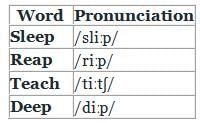
IPA: It stands for the International Phonetic Association which was first published in 1888. Its objective is to define sounds of speech that applies to all languages. It should be noted that the pronunciation of the given words are:

Hence, we conclude that teach sounds differently.

18 videos|209 docs|31 tests
Information about Test: Vowels and Consonants - 1 Page
In this test you can find the Exam questions for Test: Vowels and Consonants - 1 solved & explained in the simplest way possible. Besides giving Questions and answers for Test: Vowels and Consonants - 1, EduRev gives you an ample number of Online tests for practice
Download as PDF