CAT Exam  >  CAT Test  >  Level-wise Tests  >  Test Level 3: Quadratic Equations & Linear Equations - CAT MCQ

Test Level 3: Quadratic Equations & Linear Solved MCQs CAT


MCQ Practice Test & Solutions: Test Level 3: Quadratic Equations & Linear Equations (15 Questions)

You can prepare effectively for CAT Level-wise Tests for CAT with this dedicated MCQ Practice Test (available with solutions) on the important topic of "Test Level 3: Quadratic Equations & Linear Equations". These 15 questions have been designed by the experts with the latest curriculum of CAT 2026, to help you master the concept.

Test Highlights:

  • - Format: Multiple Choice Questions (MCQ)
  • - Duration: 30 minutes
  • - Number of Questions: 15

Sign up on EduRev for free to attempt this test and track your preparation progress.

Test Level 3: Quadratic Equations & Linear Equations - Question 1

If u + v + w + x + y = 15, then what is the maximum value of uvx + uvy + uwx + uwy?
Detailed Solution: Question 1

Given: u + v + w + x + y = 15
We need the maximum value of uvx + uvy + uwx + uwy.
(uv + uw)(x + y) = u(v + w)(x + y)
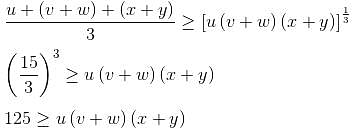
Let's use AM ≥ GM in u, (v + w), (x + y):

Hence, the maximum value of uvx + uvy + uwx + uwy is 125.

Test Level 3: Quadratic Equations & Linear Equations - Question 2

Which of the following relationships is correct, if α and β are the roots of |x|2 + |x| - 6 = 0?  

Detailed Solution: Question 2

Put |x| = y.
Given equation: y2 + y - 6 = 0
On solving, we get y = 2 or -3
i.e. |x| = 2 or -3
Modulus cannot be negative.
Therefore, |x| = 2
⇒ The roots (α and β) of the equation are 2 and -2.
Hence, α + β = 0

Test Level 3: Quadratic Equations & Linear Equations - Question 3

If the minimum value of f(x) = x2 + 2bx + 2c2 is greater than the maximum value of g(x) = -x2 - 2cx + b2, then (x being real)

Detailed Solution: Question 3

For real x, f(x) = x2 + 2bx + 2c2
= x2 + 2bx + b2 + 2c2 - b2
= (x + b)2 + 2c2 - b2 ≥ 2c2 - b2
and g(x) = -x2 - 2cx + b2
= -(x2 + 2cx + c2) + b2 + c2
= b2 + c2 - (x + c)2 ≤ b2 + c2
Hence, min. f(x) > max. g(x)
if 2c2 - b2 > b2 + c2
i.e. if c2 > 2b2

Test Level 3: Quadratic Equations & Linear Equations - Question 4

The values of a for which one root of the equation x2 - (a + 1)x + a2 + a - 8 = 0 exceeds 2 and the other is less than 2, are given by

Detailed Solution: Question 4

If the roots of the given equation are α and β, then α > 2 and β < 2.
⇒ α - 2 > 0 and β - 2 < 0
⇒(α - 2)(β - 2) < 0
⇒ αβ - 2(α + β) + 4 < 0
⇒ a2 + a - 8 - 2(a + 1) + 4 < 0
(∵ α + β = a + 1 and αβ = a2 + a - 8)
⇒ a2 - a - 6 < 0
⇒ (a - 3)(a + 2) < 0
⇒ -2 < a < 3

Test Level 3: Quadratic Equations & Linear Equations - Question 5

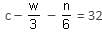
A test has 50 questions. A student scores 1 mark for a correct answer, –1/3 for a wrong answer and –1/6 for not attempting a question. If the net score of a student is 32, then the number of questions answered wrongly by that student cannot be less than
Detailed Solution: Question 5

Let c, w and n be the number of questions answered correctly, wrongly and not attempted, respectively.
∴ c + w + n = 50  … (i)

6c – 2w – n = 32 × 6 = 192 … (ii)
Adding equations (i) and (ii), we have
7c – w = 242
w = 7c – 242
Since w and c are positive numbers, the minimum value of c for which w is positive is 35.
Hence, w = 3

Test Level 3: Quadratic Equations & Linear Equations - Question 6

Which of the following conditions must p, q and r satisfy so that the following system of linear simultaneous equations has at least one solution, such that p + q + r ≠ 0?
x + 2y - 3z = p
2x + 6y - 11z = q
x - 2y + 7z = r

Detailed Solution: Question 6

Multiply the first equation by 5, second by -2 and third by -1.
5x + 10y - 15z = 5p ... (i)
-4x - 12y + 22z = - 2q ... (ii)
-x + 2y - 7z = - r ... (iii)
Adding all three equations, we get
5p - 2q - r = 0

Test Level 3: Quadratic Equations & Linear Equations - Question 7

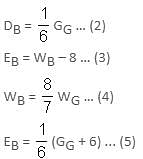
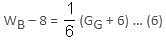
Ghosh Babu said to Banke Lal, "My wife is six years older than your daughter. Your daughter is one-sixth the age of my great-grandfather. But, your eldest son is younger than your second wife by eight years." Banke Lal replied, "My second wife is older than your only wife by one-seventh. My eldest son is one-sixth the age of what your great-grandfather would have been today, had he not died six years ago.'' What would have been the age of Ghosh Babu's great-grandfather at the time of this conversation?
Detailed Solution: Question 7

Let us suppose:
WG : Age of the wife of Ghosh Babu 
DB : Age of the daughter of Banke Lal
GG : Age of the great grandfather of Ghosh Babu
EB : Age of the eldest son of Banke Lal
WB : Age of the second wife of Banke Lal
According to the question:
WG = DB + 6 … (1)

From equations (3) and (5): 

From equations (4) and (6):

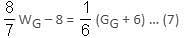
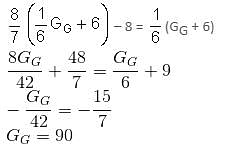
From equations (1), (2) and (7):

At the time of conversation, age of Ghosh Babu's great-grandfather would have been (GG + 6) = 90 + 6 = 96 years

Test Level 3: Quadratic Equations & Linear Equations - Question 8

Four dog dealers purchased some dogs. The first dealer purchased 1 Airedale, 3 Spaniels and 7 puppies and paid $1400; and the second purchased 1 Airedale, 4 Spaniels and 10 puppies and paid $1700. The third purchased 10 Airedales, 15 Spaniels and 25 puppies; and the fourth purchased 1 Airedale, 1 Spaniel and only 1 puppy. How much did the third and fourth dealers pay, separately?

Detailed Solution: Question 8

a + 3s + 7p = 1400 … (1)
a + 4s + 10p = 1700 … (2)
10a + 15s + 25p = ?
And a + s + p = ?
We have 2 equations and 3 unknown variables.
Subtracting equation (1) from (2), we get
s + 3p = 300
And 4 × equation (1) - 3 × equation (2) gives a - 2p = 500.
a + s + p = 800
Also, 10a - 20p = 5000
And 15s + 45p = 4500
10a + 15s + 25p = 9500

Test Level 3: Quadratic Equations & Linear Equations - Question 9

Three drunkards agreed to pool their vodka and decided to share it with the fourth drunkard (who had no vodka) at a price equal to 5 roubles a litre. The first drunkard contributed 1 litre more than the second and the second contributed 1 litre more than the third. Then, all four of them divided the vodka equally and drank it. The fourth drunkard paid money, which was divided in the ratio of each drunkard's contribution towards his portion. It was found that the first drunkard got twice as much money as the second. How much money did the second drunkard get (in roubles)?

Detailed Solution: Question 9

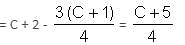
Let the contributions be C + 2, C + 1 and C.
Total vodka = 3C + 3 = 3 (C + 1)
The total vodka is divided into 4 equal parts.
Thus, each of them gets

Contribution of first drunkard towards fourth's portion 

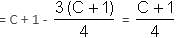
Contribution of second drunkard towards fourth's portion  

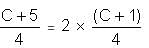
According to the question: 

C + 5 = 2C + 2
C = 3
Contribution of second drunkard towards fourth's portion = (3 + 1)/4 = 1
Now, the price equals 5 roubles a litre.
Hence, the second drunkard received 5 roubles from the fourth drunkard.

Test Level 3: Quadratic Equations & Linear Equations - Question 10

Rocky and Anthony are solving a quadratic equation. While solving, Rocky commits a mistake in the constant term and finds the roots to be 8 and 2. Anthony commits a mistake in the coefficient of X and finds the roots to be -9 and -1. Find the correct roots.

Detailed Solution: Question 10

Let the correct equation be X2 + aX + b = 0 … (1)
Roots found by Rocky are 8 and 2. As such, the equation should be X2 - (8 + 2)X + 8  2 or X2 - 10X + 16 = 0.
Since he has committed a mistake only in the constant term, coefficient of X in both would be the same, or a = -10. 
Now, roots found by Anthony are -9 and -1. As such, the equation should be X2 - (-9 - 1)X + (-9)(-1) = 0 or X2 + 10X + 9 = 0.
As he has committed mistake only in the coefficient of X, therefore constant term in equation (1) and his solution would be the same, i.e. b = 9. Hence, the correct equation is X2 - 10X + 9 = 0 or (X - 9)(X - 1) = 0.
So, the roots are 9 and 1.

Test Level 3: Quadratic Equations & Linear Equations - Question 11

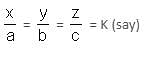
Detailed Solution: Question 11

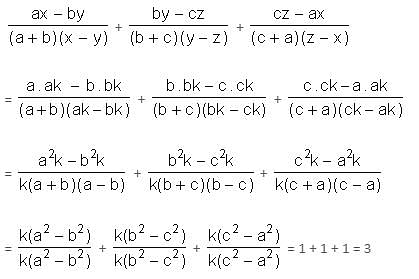
Given,


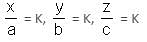
x = aK, y = bK, z = cK

Test Level 3: Quadratic Equations & Linear Equations - Question 12

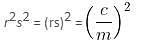
If r and s are the solutions of quadratic equation mx2 + nx + c = 0, which of the following equations can have its roots equal to r2 and s2?

Detailed Solution: Question 12

r2, s2 are the roots of the equation.
Sum of roots,
r2 + s2 = (r + s)2 - 2rs

Product of roots,

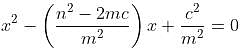
So, required equation is: 

or m2x2 - n2x + 2mcx + c2 = 0

Test Level 3: Quadratic Equations & Linear Equations - Question 13

It is known that y2 - 11y + 4k = 0 has two distinct roots. It is also known that one factor is (y - k) and k is greater than zero. What is the difference between the sum and products of the roots?

Detailed Solution: Question 13

Since (y - k) is a factor of the quadratic equation, so substitute y = k in the equation.
So the equation y2 - 11y + 4k = 0 transforms to k2 - 11k + 4k = 0
Hence, k2 = 7k and k = 7.
Now, substitute k = 7 in the equation y2 - 11y + 4k = 0
The equation becomes y2 - 11y + 28 = 0, the roots of which are 7 and 4.
Sum of the roots = 11;
Product of roots = 28
So, required difference = 28 - 11 = 17

Test Level 3: Quadratic Equations & Linear Equations - Question 14

A harvester's team had to harvest 170 hectares of a field. For the first four days, the team harvested as per the plan. After that, they started harvesting at double the rate planned for every day. So, the work was finished eight days before the planned date. How many hectares had to be harvested by the team each day as per the initial plan?

Detailed Solution: Question 14

Suppose, according to the initial plan, 'a' hectares of land were to be harvested each day and 'd' days were to be taken for the complete job.
So, ad = 170 ... (i)
Now, the equation formed for the new situation is as follows.
4a + (d - 4 - 8)2a = 170
Or, 4a + 2ad - 24a = 170 ... (ii)
Plugging in the value of ad as 170 from equation (i) into equation (ii), we get 4a + 2 × 170 - 24a = 170
Or, a = 8.5
Thus, 8.5 hectares had to be harvested by the harvesting team each day according to the initial plan.
Hence, answer option 2 is correct.

Test Level 3: Quadratic Equations & Linear Equations - Question 15

36 coins are divided among A, B, C and D, such that B takes more than A, C takes more than B and D takes more than C. If the difference in the number of coins between A and B is 1, between B and C is 9 and between C and D is 7, the number of coins with A is

Detailed Solution: Question 15

Let the numbers of coins with A, B, C and D be a, b, c and d, respectively.
Now, according to the question:
a + b + c + d = 36 … (1)
And d > c > b > a (Given)
b - a = 1 … (2)
⇒ b = a + 1
c - b = 9 … (3)
Add (2) and (3).
c - a = 10 … (4)
⇒ c = a + 10
d - c = 7 … (5)
Add (4) and (5).
d - a = 17
d = a + 17
The total numbers of coins is 36.
a + a + 1 + a + 10 + a + 17 = 36
⇒ 4a + 28 = 36
⇒ 4a = 8
⇒ a = 2

5 docs|246 tests
Information about Test Level 3: Quadratic Equations & Linear Equations Page
In this test you can find the Exam questions for Test Level 3: Quadratic Equations & Linear Equations solved & explained in the simplest way possible. Besides giving Questions and answers for Test Level 3: Quadratic Equations & Linear Equations, EduRev gives you an ample number of Online tests for practice
Download as PDF