NEET Exam  >  NEET Test  >  Chemistry Class 11  >  Test: Quantum Mechanical Model of an Atom - NEET MCQ

Quantum Mechanical Model of an Atom - Free MCQ Practice Test with solutions,


MCQ Practice Test & Solutions: Test: Quantum Mechanical Model of an Atom (15 Questions)

You can prepare effectively for NEET Chemistry Class 11 with this dedicated MCQ Practice Test (available with solutions) on the important topic of "Test: Quantum Mechanical Model of an Atom". These 15 questions have been designed by the experts with the latest curriculum of NEET 2026, to help you master the concept.

Test Highlights:

  • - Format: Multiple Choice Questions (MCQ)
  • - Duration: 15 minutes
  • - Number of Questions: 15

Sign up on EduRev for free to attempt this test and track your preparation progress.

Test: Quantum Mechanical Model of an Atom - Question 1

Direction (Q. Nos. 1-12) This section contains 12 multiple choice questions. Each question has four choices (a), (b), (c) and (d), out of which ONLY ONE option is correct.

Q. 

Radial wave functio ns (R) of different orbitals are plotted. Which is/are correct graphs?

Detailed Solution: Question 1

For 1s-orbital radial wave function (Ft) is maximum at r - 0, and falls rapidly as r increases thus, (a) correct.
For2s-orbital, radial wave function (R) is maximum at (r = 0), falls to zero and further decreases with r. There appears radial nodes. Thus (b) correct.
For2p-orbital, radial wave function is zero at r = 0, reaches maximum value (at r = a0) and then falls thus (c) is correct.

Test: Quantum Mechanical Model of an Atom - Question 2

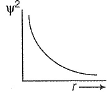
For 2s-orbital electron, radial probability density R2 as function of r (distance) is given by

Detailed Solution: Question 2

Correct Answer : b

Explanation : (a) It represents R2 vs r for 1s

(b) It represents R2 vs r for2s

(c) It represents R2 vs r for 2p

Test: Quantum Mechanical Model of an Atom - Question 3

For an electron in 2p-orbital, radial probability function 4πr2R2 as a function of r is given by

Detailed Solution: Question 3

(a) Describes radial wave function as a function of r for 1s
(b) Describes radial probability function as a function of r for 2s
(c) Describes radial wave function as a function r for 2s
(d) Describes radial probability function as a function of r for 2p

Test: Quantum Mechanical Model of an Atom - Question 4

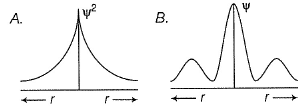
C onsider the following figures A and B indicating distribution of charge density (electron probability ) with distance r

Select the correct statement(s). 

Detailed Solution: Question 4

in case of 1s, falls as r increases thus, (A) is for 1s.
In case of 2s, is maximum in the vicinity o f the nucleus, falls to zero giving spherical nodes and then rises to second highest value. Thus, (6) is for2s

Test: Quantum Mechanical Model of an Atom - Question 5

Select the correct statement(s).

Detailed Solution: Question 5

 Thus, is d e pendent on r true


(b) and | | are dependent on r, θ and  : true
(c) Angular wave function is determined by /land m, and not by n: true

Test: Quantum Mechanical Model of an Atom - Question 6

Which orbital gives an electron, a greater probability being found close to the nucleus?

Detailed Solution: Question 6
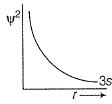
3s is spherically symmetrical and its electron density is maximum at the nucleus. It decreases with r.

Test: Quantum Mechanical Model of an Atom - Question 7

Hamiltonian operator is the sum of two energy operators. These are

Detailed Solution: Question 7

H = T + V


Test: Quantum Mechanical Model of an Atom - Question 8

Angular nodes in 4s- suborbit is equal to radial nodes in

Detailed Solution: Question 8

The number of angular nodes in an orbital is equal to the value of the azimuthal quantum number (l). For the 4s orbital, l = 0, so the number of angular nodes is 0.
The number of radial nodes is calculated using the formula: radial nodes = n – l – 1.
For 3d: n = 3, l = 2, so radial nodes = 3 – 2 – 1 = 0.
For 2p: n = 2, l = 1, so radial nodes = 2 – 1 – 1 = 0.
Thus, both 3d and 2p orbitals have 0 radial nodes, which equals the number of angular nodes in the 4s orbital.
Therefore, the correct answer is Both (A) and (B).

Test: Quantum Mechanical Model of an Atom - Question 9

at any point is proportional to

Detailed Solution: Question 9

By Born’s interpretation of the wave function, the square of the magnitude of the wave function gives probability density:

∣ψ∣2 = probability density

So ∣ψ∣2 dV is the probability of finding the particle in the small volume element dV around that point.

Hence option (a) is the correct answer.

Test: Quantum Mechanical Model of an Atom - Question 10

There is formation of in all five nodes (including terminal nodes) in a string of 12 cm. Thus, wavelength of the waves formed is 

Detailed Solution: Question 10

For n nodes in a string

Test: Quantum Mechanical Model of an Atom - Question 11

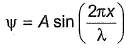
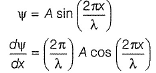
For x -axis , wave function () can be written as

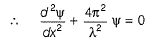
Thus, Schrodinger wave equation along x-axis can be written as : 

Detailed Solution: Question 11


Test: Quantum Mechanical Model of an Atom - Question 12

The Schrodinger wave equation for H-atom is 

where, a0 is Bohr’s radius. If radial node in 2s is at distance r0, then

Detailed Solution: Question 12



*Multiple options can be correct
Test: Quantum Mechanical Model of an Atom - Question 13

Direction (Q. Nos. 13-15) This section contains 3 multiple choice questions. Each question has four choices (a), (b), (c) and (d), out of which ONE or  MORE THANT ONE  is correct.

Q.  Which of the following properties can be described by wave function ?

Detailed Solution: Question 13

The wave function describ es properties of the orbital and the electron that occupies the orbital
(a) Type of orbital is described : true
(b) Energy of electron : true
(c) Shape of the orbital: true
(d) Probability: true

*Multiple options can be correct
Test: Quantum Mechanical Model of an Atom - Question 14

As compared to 1s electron of H-atom in ground state, which of the following properties appear(s) in the radial probability density of 2s electron of H-atom in first excited state?

Detailed Solution: Question 14
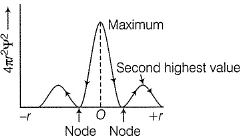
For2s-electron of H-atom (first excited state)

For 1s-electron of H-atom in ground state

At point Ar = a0 r at point Br > a0
(a) True (b) True (c) True (d) True

*Multiple options can be correct
Test: Quantum Mechanical Model of an Atom - Question 15

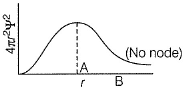
Radial probability density in the occupied orbital of a hydrogen atom in the ground state (1s) is given below
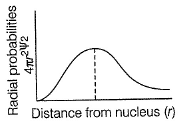
Detailed Solution: Question 15

Radial probability increases as r increase reaches a maximum value when r = a0 (Bohr’s radius) and then falls. When radial probability is very small.
Thus, (a) and (c) are true.

98 videos|243 docs|71 tests
Information about Test: Quantum Mechanical Model of an Atom Page
In this test you can find the Exam questions for Test: Quantum Mechanical Model of an Atom solved & explained in the simplest way possible. Besides giving Questions and answers for Test: Quantum Mechanical Model of an Atom, EduRev gives you an ample number of Online tests for practice
98 videos|243 docs|71 tests
Download as PDF