Regulatory Body Exams Exam  >  Regulatory Body Exams Test  >  RBI Grade B Mock Test Series & Past Year Papers 2026  >  Test: Quantitative Aptitude - 3 - Regulatory Body Exams MCQ

RBI Grade B Test: Quantitative Aptitude - 3 Free Online Test 2026


MCQ Practice Test & Solutions: Test: Quantitative Aptitude - 3 (20 Questions)

You can prepare effectively for Regulatory Body Exams RBI Grade B Mock Test Series & Past Year Papers 2026 with this dedicated MCQ Practice Test (available with solutions) on the important topic of "Test: Quantitative Aptitude - 3". These 20 questions have been designed by the experts with the latest curriculum of Regulatory Body Exams 2026, to help you master the concept.

Test Highlights:

  • - Format: Multiple Choice Questions (MCQ)
  • - Duration: 10 minutes
  • - Number of Questions: 20

Sign up on EduRev for free to attempt this test and track your preparation progress.

Test: Quantitative Aptitude - 3 - Question 1

An amount becomes Rs.7000 in 4 years at Simple interest. The same amount becomes Rs.7400 in 4 years if the rate of interest is increased by 20%. Find the rate of interest.

Detailed Solution: Question 1

Let P be the principal amount, n be the number of years and R be the rate of interest.

7000 = P + P x 4 x R/100 ⇒ 4PR/100 = 7000 – P – (I)

7400 = P + P x 1.20 x 4PR/100 ⇒ P + 1.20 x 4PR/100 = 7400 – (II)

Sub (I) in (II) ⇒ P + 1.20 x (7000 – P) = 7400

=> P = Rs.5000

(I) ⇒ 4 x 5000 x R/100 = 7000- 5000

⇒ R = 10%

Test: Quantitative Aptitude - 3 - Question 2

The average height of 12 boys in the class is 152cm and the average height is increased by 4cm when two more boys are included. Find the average height of new boys included.

Detailed Solution: Question 2

Let x be the total weight of newly included boys.

12 x 152 + x = 156 x 14

⇒ x = 360

Average height of the new boys = 360/2 = 180cm

Test: Quantitative Aptitude - 3 - Question 3

Find the two digit number such that when 20 is added to 4 times the number, the resulting number is 8 more than five times the number.

Detailed Solution: Question 3

Let the number be x.

4x + 20 = 5x + 8

⇒ x = 12

Test: Quantitative Aptitude - 3 - Question 4

A bus driver drives the bus at 24kmph from Nagercoil to Madurai. Another driver drives at 26kmph from Madurai to Nagercoil, which are 250km apart. After what time, will they cross each other, if they start at the same time?

Detailed Solution: Question 4

Total distance = 250km

Relative speed = 24 + 26 = 50kmph

Time taken to cross each other = Distance/Speed = 250/50 = 5 hours

Test: Quantitative Aptitude - 3 - Question 5

A boy running at 12m/s crosses a train which is running in opposite direction at 180kmph in 10 seconds. What is the train length?

Detailed Solution: Question 5

Speed of the train = 180 x 5/18 = 50m/s

Length of the train = Speed x Distance

= (50 + 12) x 10

= 620 m

Test: Quantitative Aptitude - 3 - Question 6

What value should come in the place of (?) in the following questions?

15% of 4000 + 25% of 8000 =? x 13

Detailed Solution: Question 6

15% of 4000 + 25% of 8000 =? * 13

⇒ 600 + 2000 = ? x  13

⇒ ? = 200

Test: Quantitative Aptitude - 3 - Question 7

What value should come in the place of (?) in the following questions?

(15 x 15 + 14 x 14 + 420)/29 =?

Detailed Solution: Question 7

(15 x 15 + 14 x 14 + 420)/29 =?

(15 x 15 + 14 x 14 + 420)/(15 + 14) =?

(a + b)2/(a + b) = (a + b)

⇒ (15 + 14)2/(15 + 14)

⇒ (15 + 14)

⇒ 29

Test: Quantitative Aptitude - 3 - Question 8

What value should come in the place of (?) in the following questions?

144 x 1728 = 12?

Detailed Solution: Question 8

144 x 1728 = 12?

⇒ 122 x 123 = 12?

⇒ ? = 2 + 3 = 5

Test: Quantitative Aptitude - 3 - Question 9

What value should come in the place of (?) in the following questions?

150 + 105/7 + 42 x 0.5 =? x 6

Detailed Solution: Question 9

150 + 105/7 + 42 x 0.5 =? x 6

⇒ 150 + 15 + 21 =? x 6

⇒ 186/6

⇒ 31

Test: Quantitative Aptitude - 3 - Question 10

What value should come in the place of (?) in the following questions?

(10 x 10 + 8 x 8 – 10 x 8)/(1000 + 512) = ?

Detailed Solution: Question 10

(10 x 10 + 8 x 8 – 10 x 8)/(1000 + 512) =?

⇒ (10 x 10 + 8 x 8 – 10 x 8)/(103 + 83) =?

(a2 + b2 – ab)/(a3 + b3) = 1/(a + b)

⇒ (10 x 10 + 8 x 8 – 10 x 8)/(103 + 83) = 1/(10 + 8)

⇒ 1/18

Test: Quantitative Aptitude - 3 - Question 11

A calculator is sold at a profit of 20% at the actual cost price. If the manufacturer makes a profit of 10%, then find the profit percent made by the seller. (approx..)

Detailed Solution: Question 11

Let CP = Rs.100

Manufacturer makes 10% profit on CP = Rs.110

Overall profit = 20% = Rs.120

Profit % made by the seller = (120 – 110)/110 x 100 ≈ 9%

Test: Quantitative Aptitude - 3 - Question 12

A and B entered into a partnership by investing Rs.15000, Rs.24000 respectively. After that A changed his investments by +20%, +25%, +30% more than the previous investments for the next consecutive years, while B changed as +16.66%, +25%, +40%. Find the profit ratio after the mentioned time period?

Detailed Solution: Question 12
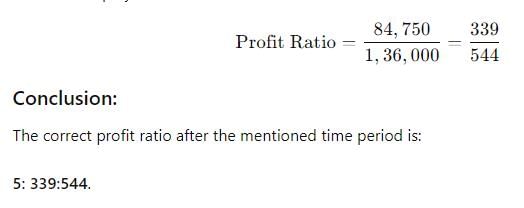
Let's break down the problem step by step to calculate the profit ratio for A and B after the mentioned time period.

Initial Investments:

  • A's initial investment: Rs. 15,000
  • B's initial investment: Rs. 24,000

Investment Changes Over the Years:

For A:

  1. First Year:
    • Investment = Rs. 15,000
  2. Second Year:
    • Increase by 20%: 15,000×1.20=Rs.18,000
  3. Third Year:
    • Increase by 25%: 18,000×1.25=Rs.22,500
  4. Fourth Year:
    • Increase by 30%: 22,500×1.30=Rs.29,250

For B:

  1. First Year:
    • Investment = Rs. 24,000
  2. Second Year:
    • Increase by 16.66%: 24,000×1.1666≈Rs.28,000
  3. Third Year:
    • Increase by 25%: 28,000×1.25=Rs.35,000
  4. Fourth Year:
    • Increase by 40%: 35,000×1.40=Rs.49,000

Profit Ratio Calculation:

The profit ratio will be the sum of their investments over the years.

  • A's Total Investment:

    15,000+18,000+22,500+29,250=Rs.84,750
  • B's Total Investment:

    24,000+28,000+35,000+49,000=Rs.1,36,000

Now, we simplify the ratio:

Test: Quantitative Aptitude - 3 - Question 13

The ratio of the length and breadth of a rectangle is 8: 7. If the radius of the circle is equal to the breadth of the rectangle whose area is 224cm2, find the area of the circle.

Detailed Solution: Question 13

Length of the rectangle = 8x and breadth of the rectangle = 7x.

8x x 7x = 224 ⇒ x = 2cm

Length of the rectangle = 16cm and breadth of the rectangle = 14cm

Radius of the circle = 14cm

Area of circle = πr2 = 616cm2

Test: Quantitative Aptitude - 3 - Question 14

P is four times as efficient as Q and R is two times as efficient as Q. What is the ratio of number of days taken by P, Q and R, when they work separately?

Detailed Solution: Question 14

Efficiency ∝ 1 / Time

  •  More efficient person takes less time
  •  Less efficient person takes more time

Given:
P is 4 times as efficient as Q → P = 4Q
R is 2 times as efficient as Q → R = 2Q

Assume: Q = 1 unit

Then:

  • P = 4 units
  • Q = 1 unit
  • R = 2 units

So,
Efficiency ratio = 4 : 1 : 2

If efficiency is given as:
a : b : c

Then time will be:
1/a : 1/b : 1/c

Days taken ⇒ P: Q: R = ¼: 1/1: ½
Simplify the ratio
Multiply everything by 4:

  • 1/4 × 4 = 1
  • 1 × 4 = 4
  • 1/2 × 4 = 2

= 1: 4: 2
Hence, option(C) is correct

Test: Quantitative Aptitude - 3 - Question 15

A boat can row at 4kmph in still water. Find the time taken by the boat to row 15km upstream and back, if the stream rate is 2kmph.

Detailed Solution: Question 15

Time taken by the boat to row 15km upstream and back

= (2 x D x Speed in still water)/((Speed in still water)2 – (Speed of stream)2)

= (2 x 15 x 4)/(42 – 22)

= 10 hours

Test: Quantitative Aptitude - 3 - Question 16

Directions: Study the following information carefully and answer the questions given below.

The below graph shows the number of managers and leads in five different companies.
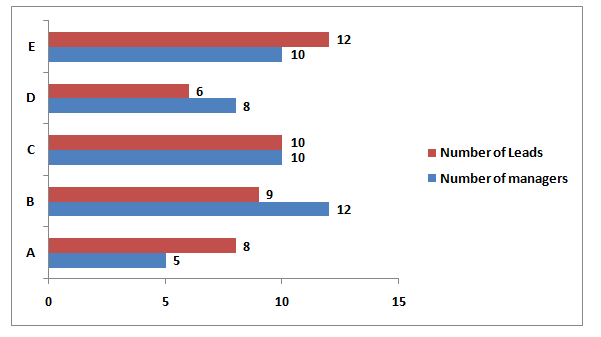
Q. Find the ratio of the number of managers in the companies C, D and E together to the number of leads in the companies A, B and C together?

Detailed Solution: Question 16

Number of managers in the companies C, D and E together = 10 + 8 + 10 = 28

Number of leads in the companies A, B and C together = 8 + 9 + 10 = 27

Required ratio = 28: 27

Test: Quantitative Aptitude - 3 - Question 17

Directions: Study the following information carefully and answer the questions given below.

The below graph shows the number of managers and leads in five different companies.
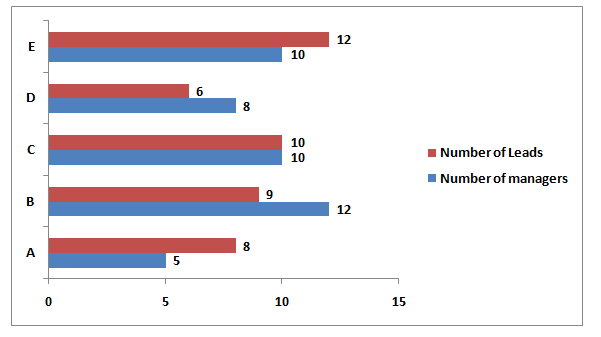
Q. What is the difference between the number of managers in the company A and E together and the number of leads in the company B and D together?

Detailed Solution: Question 17

Number of managers in the company A and E together = 5 + 10 = 15

Number of leads in the company B and D together = 9 + 6 = 15

Required difference = 0

Test: Quantitative Aptitude - 3 - Question 18

Directions: Study the following information carefully and answer the questions given below.

The below graph shows the number of managers and leads in five different companies.
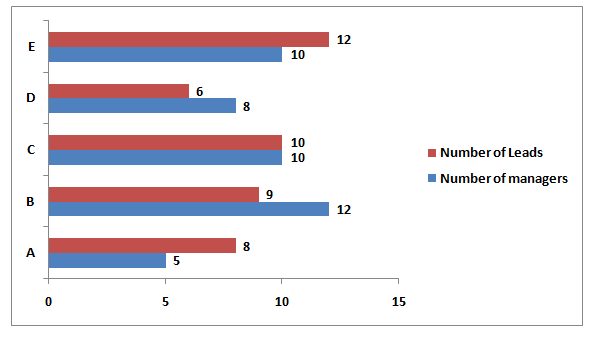
Q. If the ratio of the number of male to female managers in company B is 2: 1 and the ratio of the number of male and female leads in company D is 2: 1, then what is the difference between the number of male managers in B and the male leads in company D?

Detailed Solution: Question 18

Managers in company B = 12

Male managers = 2/3 x 12 = 8

Leads in company D = 6

Male leads = 2/3 x 6 = 4

Required difference = 8 – 4 = 4

Test: Quantitative Aptitude - 3 - Question 19

Directions: Study the following information carefully and answer the questions given below.

The below graph shows the number of managers and leads in five different companies.
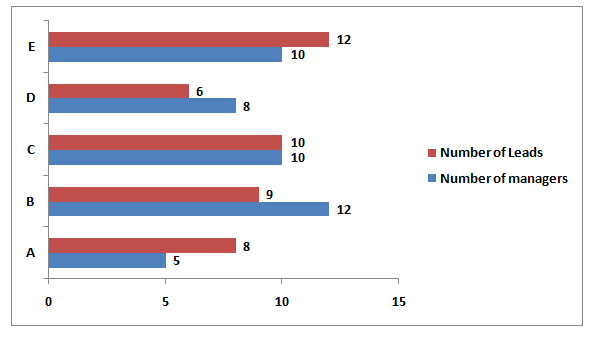
The number of leads in the company B and C together is approximately what percent of the number of managers in the company D and E together?

Detailed Solution: Question 19

Number of leads in the companies B and C together = 9 + 10 = 19

Number of managers in the companies D and E together = 8 + 10 = 18

Required % = 19/18 x  100 = 106%

Test: Quantitative Aptitude - 3 - Question 20

Directions: Study the following information carefully and answer the questions given below.

The below graph shows the number of managers and leads in five different companies.
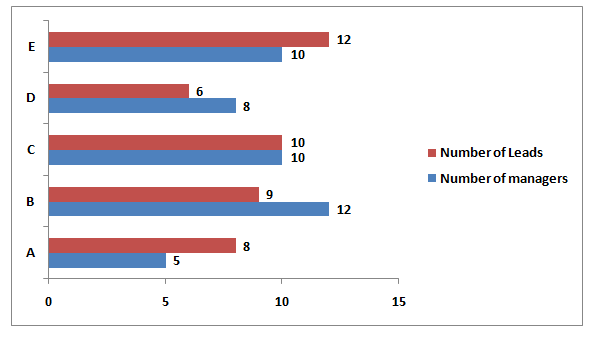
Q. If the ratio of the number of male to female leads in C is 4: 6, then find the difference between the number of female and male leads in company C.

Detailed Solution: Question 20

Number of leads in company C = 10

Number of male leads in company C = 4 and Number of female leads in C = 6

Required difference = 6 – 4 = 2

120 docs|51 tests
Information about Test: Quantitative Aptitude - 3 Page
In this test you can find the Exam questions for Test: Quantitative Aptitude - 3 solved & explained in the simplest way possible. Besides giving Questions and answers for Test: Quantitative Aptitude - 3, EduRev gives you an ample number of Online tests for practice
Download as PDF