NEET Exam  >  NEET Test  >  Chemistry Class 11  >  Test: Conformational Analysis - 1 - NEET MCQ

Conformational Analysis - 1 - Free MCQ Practice Test with solutions, NEET


MCQ Practice Test & Solutions: Test: Conformational Analysis - 1 (10 Questions)

You can prepare effectively for NEET Chemistry Class 11 with this dedicated MCQ Practice Test (available with solutions) on the important topic of "Test: Conformational Analysis - 1". These 10 questions have been designed by the experts with the latest curriculum of NEET 2026, to help you master the concept.

Test Highlights:

  • - Format: Multiple Choice Questions (MCQ)
  • - Duration: 15 minutes
  • - Number of Questions: 10

Sign up on EduRev for free to attempt this test and track your preparation progress.

Test: Conformational Analysis - 1 - Question 1

Direction (Q. Nos. 1-10) This section contains 10 multiple choice questions. Each question has four
 choices (a), (b), (c) and (d), out of which ONLY ONE option is correct.

The molecular formula C5H12 contains how many isomeric alkanes?

Detailed Solution: Question 1

The correct answer is Option C.
From the image we can see that 3 isomers are possible for pentane.

Test: Conformational Analysis - 1 - Question 2

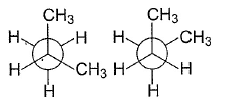
The structure below are

Test: Conformational Analysis - 1 - Question 3

Which of the following cycloalkanes exhibits the greatest molar heat of combustion per —CH2 — group?

Detailed Solution: Question 3

The correct answer is option D
Cyclopropane is a cycloalkane molecule with the molecular formula C3H6, consisting of three carbon atoms linked to each other to form a ring, with each carbon atom bearing two hydrogen atoms resulting in D3H molecular symmetry. The small size of the ring creates substantial ring strain in the structure.

Test: Conformational Analysis - 1 - Question 4

Which of the following correctly ranks the cycloalkanes in order of increasing ring strain per methylene group? 

Detailed Solution: Question 4
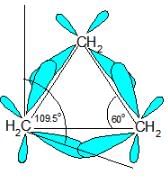
The correct answer is Option B.

The C-C-C bond angles in cyclopropane (60o) and cyclobutane (90o) are much different than the ideal bond angle of 109.5o.This bond angle causes cyclopropane and cyclobutane to have a high ring strain. However, molecules, such as cyclohexane and cyclopentane, would have a much lower ring strain because the bond angle between the carbons is much closer to 109.5o.

Test: Conformational Analysis - 1 - Question 5

Which,of the following correctly lists the conformations of cyclohexane in order of increasing potential energies?

Detailed Solution: Question 5

Correct answer is option D

Chair >Twist boat > Boat > Half-chair 

above is the stability order of
the conformed.
Stability is inversely proportional to potential energy.

Test: Conformational Analysis - 1 - Question 6

Which is not true regarding conformers of ethane?

Detailed Solution: Question 6

The correct answer is Option D.
Although conformers differ in potential energy and stability, the difference is so small that it does not allow their practical separation.

Test: Conformational Analysis - 1 - Question 7

The correct statement concerning conformers of 1,2-dichloroethane is

Detailed Solution: Question 7

Option C is correct.

The gauche conformer of 1,2-dichloroethane is lower in energy (more stable) than some other conformations and is polar, whereas the anti conformer has opposing C-Cl dipoles and is effectively non-polar (net dipole ≈ 0).

As temperature increases, the population of the higher-energy anti conformer increases. Because the anti conformer is less polar than the gauche conformer, the average (measured) dipole moment of a sample decreases with increasing temperature.

Option A is incorrect because eclipsed conformations are generally of higher potential energy than staggered (gauche or anti) conformations; a specific eclipsed form with H-Cl eclipsing is not lower than a staggered gauche form.

Option B is incorrect because the syn-periplanar (eclipsed) conformation is high in energy and therefore not the most stable.

Option D is incorrect: the two gauche rotamers of 1,2-dichloroethane are not true enantiomers. Each carbon bears two identical hydrogen atoms, and the two gauche forms are related by a proper rotation and are superposable; they do not constitute optically active enantiomers.

Test: Conformational Analysis - 1 - Question 8

Which of the following molecule exhibits conformational isomerism ?

Detailed Solution: Question 8

The correct answer is option A.
99996201712-0-0

Test: Conformational Analysis - 1 - Question 9

Which is true about conformers of 1,1,2,2-tetrachloroethane?

Which is true about conformers of 1,1,2,2-tetrachloroethane?
a) The most stable conformer has dihedral angle of 60° between all adjacent chlorine atoms
b) In the least stable conformer, two Cl-atoms are eclipsing one another while other two Cl-atoms are eclipsed to hydrogen atoms
c) In the most stable conformer, dihedral angle between hydrogen atoms is 60°
d) The most stable conformer is non-polar 

Detailed Solution: Question 9
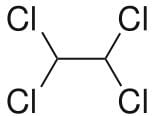
The correct answer is option D

This molecule is non-polar two Cl atoms in one carbon atom cancel the polarity other two Cl atoms on the next carbon.
Also all the Cl atoms are at max distance from each other so max. Stability due to less repulsion between Cl atoms. Dihedral angle between H and Cl is 60°

Test: Conformational Analysis - 1 - Question 10

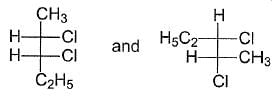
What is relationship between the following Fischer Projections?
Detailed Solution: Question 10

The Fischer Projections represent different types of stereoisomers. Here’s a breakdown of their relationships:

  • Enantiomers: These are mirror images of each other and are not superimposable.
  • Conformers: These are different spatial orientations of the same molecule, resulting from rotation around single bonds.
  • Diastereomers: These are stereoisomers that are not mirror images of one another. They have different physical properties.
  • Structural Isomers: These differ in the connectivity of their atoms, leading to different compounds.

The correct relationship for the given Fischer Projections is diastereomers.

98 videos|243 docs|71 tests
Information about Test: Conformational Analysis - 1 Page
In this test you can find the Exam questions for Test: Conformational Analysis - 1 solved & explained in the simplest way possible. Besides giving Questions and answers for Test: Conformational Analysis - 1, EduRev gives you an ample number of Online tests for practice
98 videos|243 docs|71 tests
Download as PDF