Engineering Mathematics Exam  >  Engineering Mathematics Test  >  Engineering Mathematics  >  Test: Cauchy’s Integral Theorem - 2 - Engineering Mathematics MCQ

Cauchy’s Integral Theorem - 2 - Free MCQ Practice Test with solutions,


MCQ Practice Test & Solutions: Test: Cauchy’s Integral Theorem - 2 (10 Questions)

You can prepare effectively for Engineering Mathematics Engineering Mathematics with this dedicated MCQ Practice Test (available with solutions) on the important topic of "Test: Cauchy’s Integral Theorem - 2". These 10 questions have been designed by the experts with the latest curriculum of Engineering Mathematics 2026, to help you master the concept.

Test Highlights:

  • - Format: Multiple Choice Questions (MCQ)
  • - Duration: 30 minutes
  • - Number of Questions: 10

Sign up on EduRev for free to attempt this test and track your preparation progress.

*Answer can only contain numeric values
Test: Cauchy’s Integral Theorem - 2 - Question 1

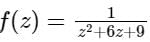
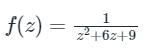
Let defined in the complex plane. The integral ∮c f(z)dz over the contour of a circle c with center at the origin and unit radius is ______.


Detailed Solution: Question 1

Concept:

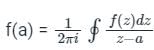
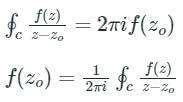
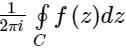
Cauchy integral formula:

If f(z) is analytic within a closed curve and if a is any point within C (contour), then

Calculation:

Given

Contour is a unit radius circle with center is the origin

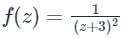
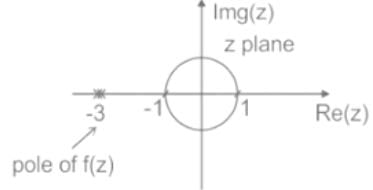
Pole of f(z) is -3, -3 and both poles are outside of  the given unit circle (it is shown in below fig.)

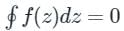
Here all-poles of f(z) outside the circle so 

Test: Cauchy’s Integral Theorem - 2 - Question 2

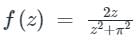
Let f(z) = if C is a counter clock wise path in the z plane such that |z - i| = 2, then the value of is____
Detailed Solution: Question 2

Concept:

Cauchy’s Theorem:

If f(z) is an analytic function and f’(z) is continuous at each point within and on a closed curve C, then


Calculation:

Given:

C:  |z - i| = 2

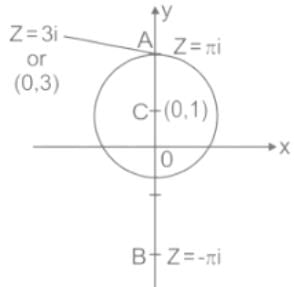
The above path is a circle with a radius of 2 and center as (0, 1). The graph of the circle is given below,


⇒ After putting the denominator as zero, the poles will be 'z = ± πi '. These pole points A and B are outside of the given circle as shown above. So, the complex function f(z) will be an analytic function for all points inside the circle.

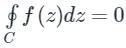
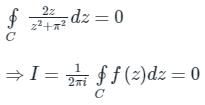
By Cauchy’s Theorem (Using equation (1))

Test: Cauchy’s Integral Theorem - 2 - Question 3

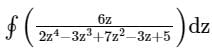
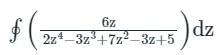
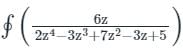
The value of the integral

evaluated over a counter-clockwise circular contour in the complex plane enclosing only the pole z = i, where i is the imaginary unit, is

Detailed Solution: Question 3
Concept:
Residue theorem: if f(z) is an analytic function in a closed curve C except at a finite number of singular points within C then 
cf(z)dz = 2πi × (sum of the residues at the singular point within curve C)
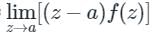
Residue for simple pole z = a:
Res f(a) =  
Calculation:

Given:

pole z = i

Check for singularity at pole z = i

f(z) = 2z4 - 3z3 + 7z2 - 3z + 5

f(i) = 2(i)4 - 3(i)3 + 7(i)2 - 3i + 5 

f(i) = 2 ×1 - 3(-i) - 7 - 3i + 5 = 0

since, f(i) = 0 ⇒ z = i  is a singular point

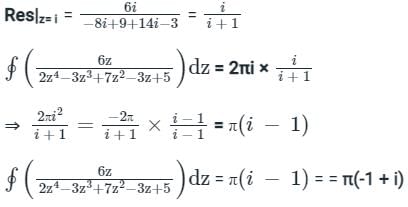
From Residue theorem:
dz = 2πi (Residue at z = i )


at z = i , Res = 0/0 form, applying L'hospital rule

Test: Cauchy’s Integral Theorem - 2 - Question 4

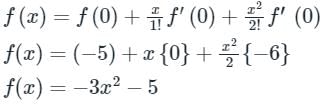
The quadratic approximation of (x) = x3 - 3x2 - 5 at the point x = 0 is

Detailed Solution: Question 4
Concept:
The Taylor's series expansion of f(x) about origin (i.e x = 0) is given by
f(x) = f(0) + x × f′(0) + x2/2! × f"(0)+.....

It is also called Maclaurin's series.
Calculation:

f(x) = x3 - 3x2-5

f(0) = 03 - 3 × 02 - 5 = - 5

f'(0) = 3x2 - 6x = 0

f"(0) = 6x - 6 = - 6

The quadratic approximation of f(x) at the point x = 0 is

Test: Cauchy’s Integral Theorem - 2 - Question 5

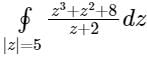
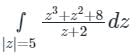
The closed loop line integral evaluated counter-clockwise, is

Detailed Solution: Question 5

Concept:
Residue Theorem: 

If f(z) is analytic in a closed curve C except at a finite number of singular points within C, then

cf(z) dz = 2πj × [sum of residues at the singular points within C]

Formula to find residue:

1. If f(z) has a simple pole at z = a, then

 Resf(α) = a⁡[(z−α)f(z)]

2. If f(z) has a pole of order n at z = a, then


Calculation:

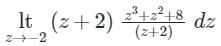
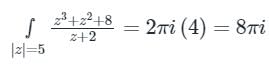
z + 2 = 0 z = -2 |z| = 2 < 5

f(x) is not analytic at z = -2

By Cauchy’s residue theorem

⁡f(x) dz = 2πi × (sum of residues)

At z = -2

Residue of f(x) = 

= -8 + 4 + 8 = 4

*Answer can only contain numeric values
Test: Cauchy’s Integral Theorem - 2 - Question 6

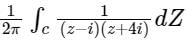
Given z = x +iy, i = √-1 C is a circle of radius 2 with the centre at the origin. If the contour C is traversed anticlockwise, then the value of the integral  is ________ (round off to one decimal place.)

Detailed Solution: Question 6

Concept:

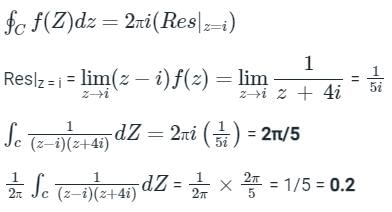
if f(z) is analytic in closed curve C except at a finite number of singular points within C then 

f(Z)dz = 2πi × [sum of residues at singular points within C]
Calculation:

Given:

Singular points: z = i, -4i

C is a circle of radius 2, only z = i will lie inside the circle

Test: Cauchy’s Integral Theorem - 2 - Question 7

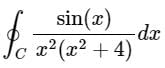
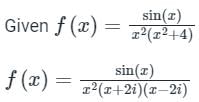
Consider the integral 

Where C is a counter-clockwise oriented circle defined as |x - i| = 2. The value of the integral is

Detailed Solution: Question 7
Concept:
Residue Theorem:

If f(z) is analytic inside and on a closed curve ‘C’ except at a finite number of singularities inside ‘C’

Then:

∮f(z) dz = 2πi (sum of residues)

Singularity: A point where the function f(z) fails to be analytic

Analysis:

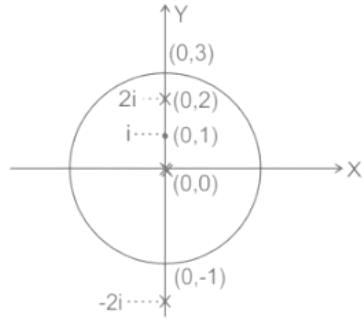
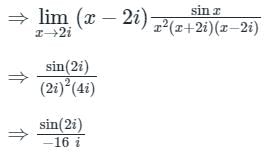
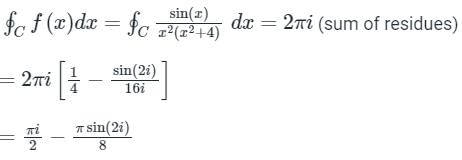
x = 0 pole of order 2
x = 2i, -2i
Given curve or region is |x - i| = 2

x = -2i lies outside |x - i| = 2
So the singular points are x = 0 & x = 2i
Residue at x = 0

 
Residue at x = 2i

Test: Cauchy’s Integral Theorem - 2 - Question 8

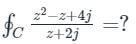
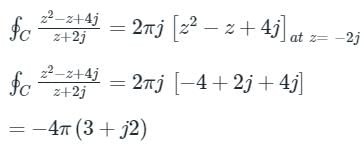
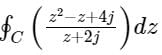
C is a closed path in the z-plane given by |z| = 3. The value of the integral is
Detailed Solution: Question 8

Concept:
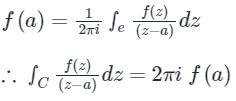
If f(z) is analytic within and on a closed curve, and if ‘a’ is any point within C then according to Cauchy Integral formula:

Application:
|z| = 3

Pole z = -2j, which lies Inside the given C i.e. |z| = 3
∴ Using the Cauchy Integral formula, we get:

Test: Cauchy’s Integral Theorem - 2 - Question 9

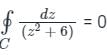
The value of , where C is the boundary of |z - i| = 1, is

Detailed Solution: Question 9

Concept:
Cauchy's theorem: If f(z) is an analytic function and f'(z) is continuous at each point within and on a closed curve C, or if the simple closed curve does not contain any singular point of f(z) then,
⁡f(z) dz = 0

Given,
The integral is where C is |z -i| = 1

Now, for point singularity consider Z2 + 6 = 0

Therefore point of singularity is a = ± √6i

For |z -i| = 1 we have,

radius r = 1,  centre c = (0,1),

a = ± √6i is out of circle,

By Cauchy's Integral Formula We have,

Test: Cauchy’s Integral Theorem - 2 - Question 10

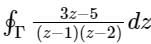
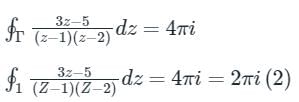
The value of along a closed path Γ is equal to (4 π i), where z = x + iy and  i = √-1. The correct path Γ is

Detailed Solution: Question 10

Concept:

Cauchy’s Integral Formula  - If f(z) is analytic within and on the closed curve C and if zo is any point inside C then

Cauchy’s Residue Theorem – If f(z) is analytic in a closed curve C except at a finite number of singular point lies inside C then,

c ⁡f(z)dz = 2πi × (sum of the residues at the singular point within curve C)

If f(z) has a simple pole at z = a then,

Calculation:

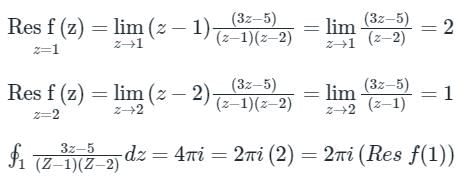
∴ Sum of residue must be equal to 2

∴ Z = 1 must lies inside C, Z = 2 lies outside C.

71 videos|135 docs|94 tests
Information about Test: Cauchy’s Integral Theorem - 2 Page
In this test you can find the Exam questions for Test: Cauchy’s Integral Theorem - 2 solved & explained in the simplest way possible. Besides giving Questions and answers for Test: Cauchy’s Integral Theorem - 2, EduRev gives you an ample number of Online tests for practice
71 videos|135 docs|94 tests
Download as PDF