Electrical Engineering (EE) Exam  >  Electrical Engineering (EE) Test  >  Electrical and Electronic Measurements  >  Test: Measurement of Low Resistance - Electrical Engineering (EE) MCQ

Measurement of Low Resistance - GATE EE Electrical and Electronic Measurements


MCQ Practice Test & Solutions: Test: Measurement of Low Resistance (10 Questions)

You can prepare effectively for Electrical Engineering (EE) Electrical and Electronic Measurements with this dedicated MCQ Practice Test (available with solutions) on the important topic of "Test: Measurement of Low Resistance". These 10 questions have been designed by the experts with the latest curriculum of Electrical Engineering (EE) 2026, to help you master the concept.

Test Highlights:

  • - Format: Multiple Choice Questions (MCQ)
  • - Duration: 30 minutes
  • - Number of Questions: 10

Sign up on EduRev for free to attempt this test and track your preparation progress.

Test: Measurement of Low Resistance - Question 1

How is the contact resistance related to the circuit while measuring a low resistance?

Detailed Solution: Question 1

The contact and lead resistances form a part of the circuit whose resistance is very high. As a result the contact and lead resistances are usually neglected compared to the high resistance value.

Test: Measurement of Low Resistance - Question 2

Which is the most popular method for measuring low resistance?

Detailed Solution: Question 2

Kelvin’s double bridge is used for the measurement of low resistances of the order of 1ῼ or less. Ammeter voltmeter method is used for the measurement of current flowing through and the voltage across the circuit.

Test: Measurement of Low Resistance - Question 3

Low resistance refers to _________

Detailed Solution: Question 3

Low resistance refers to resistance of the order of 1ῼ or less than that. Medium resistances range from above 1ῼ to a few kῼ. Any resistance value greater than a few kῼ is known as high resistance.

Test: Measurement of Low Resistance - Question 4

What is the significance of measuring low resistances?

Detailed Solution: Question 4
When measuring low resistances of the order of 1 ῼ or even less, lead and contact resistances of the order of even 0.002 ῼ cannot be neglected. High currents flow through low resistance circuits.

Test: Measurement of Low Resistance - Question 5

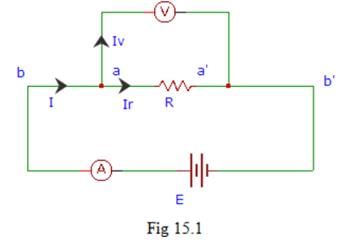
Fig 15.1 represents?

Detailed Solution: Question 5

Fig 15.1, illustrates the construction of low resistance. A is an ammeter used to measure current through the circuit, while V is the voltmeter used to measure voltage.

Test: Measurement of Low Resistance - Question 6

How is the voltage drop across a low resistance related to lead resistance?

Detailed Solution: Question 6

The voltage drop measured across a low resistance does not contain any contact and lead resistances of the components and is independent of it.

Test: Measurement of Low Resistance - Question 7

Which is not a source of error in the measurement of low resistance?

Detailed Solution: Question 7

As the current flowing through a low resistance circuit is low, the voltage drop across the terminals due to contact and lead resistances is negligible. Thermal e.m.f occurs in a circuit when its temperature increases due to high current flow.

Test: Measurement of Low Resistance - Question 8

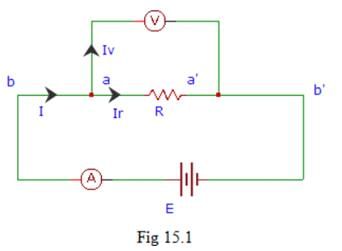
In fig 15.1, the terminals aa’ are used for _________
Detailed Solution: Question 8

The terminals aa’ are used for the measurement of the voltage drop across the resistance R. An voltmeter V is connected across the terminals aa’.

Test: Measurement of Low Resistance - Question 9

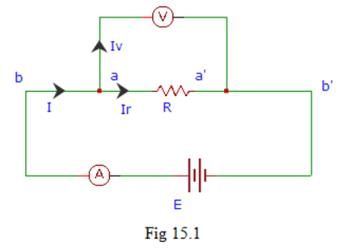
In the following figure, what is the value of I?
Detailed Solution: Question 9

By applying Kirchhoff’s current law at the node N from fig we get,
I = IV + Ir
where,
I is the total series current flowing through the circuit
Iv is the current flowing through the voltmeter
Ir is the current flowing through the resistance R.

Test: Measurement of Low Resistance - Question 10

A simple bridge circuit consists of a network of __________

Detailed Solution: Question 10

A simple bridge circuit is made of a network consisting of 4 resistance arms. Usually a galvanometer is connected between the ends of the opposite two junctions in order to measure the flow of current.

48 videos|59 docs|22 tests
Information about Test: Measurement of Low Resistance Page
In this test you can find the Exam questions for Test: Measurement of Low Resistance solved & explained in the simplest way possible. Besides giving Questions and answers for Test: Measurement of Low Resistance, EduRev gives you an ample number of Online tests for practice
Download as PDF