Electronics and Communication Engineering (ECE) Exam  >  Electronics and Communication Engineering (ECE) Test  >  Topicwise Question Bank for Electronics Engineering  >  Test: Semiconductor Memories - 2 - Electronics and Communication Engineering (ECE) MCQ

Semiconductor Memories - 2 - Free MCQ Practice Test with solutions, GATE


MCQ Practice Test & Solutions: Test: Semiconductor Memories - 2 (10 Questions)

You can prepare effectively for Electronics and Communication Engineering (ECE) Topicwise Question Bank for Electronics Engineering with this dedicated MCQ Practice Test (available with solutions) on the important topic of "Test: Semiconductor Memories - 2". These 10 questions have been designed by the experts with the latest curriculum of Electronics and Communication Engineering (ECE) 2026, to help you master the concept.

Test Highlights:

  • - Format: Multiple Choice Questions (MCQ)
  • - Duration: 30 minutes
  • - Number of Questions: 10

Sign up on EduRev for free to attempt this test and track your preparation progress.

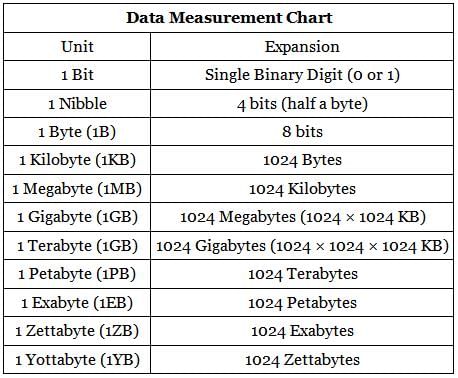
Test: Semiconductor Memories - 2 - Question 1

Which of the following is a non-volatile memory?

Detailed Solution: Question 1

The correct answer is Electrically Erasable Programmable Read-Only Memory (EEPROM)

  • EEPROM stands for Electrically Erasable Programmable Read-Only Memory.
  • It is a non-volatile memory in which the information stored Is retained even after the power goes off.
  • A special type of PROM in which the information stored in it can be erased by exposing it to an electrical charge at one byte at a time. 
  • EEPROM generally offers excellent capabilities and performance.
  • EEPROMs are constructed as arrays of floating-gate transistors.

Test: Semiconductor Memories - 2 - Question 2

Memory chip NOVRAM is

Detailed Solution: Question 2

NOVRAM (Non-Volatile Random Access Memory):

  • It is a type of memory that retains its contents when power is turned off.
  • One type of NOVRAM is SRAM that is made non-volatile by connecting it to a constant power source such as a battery.
  • Another type of NVRAM uses EEPROM chips to save its contents when power is turned off. In this case, NVRAM is composed of a combination of SRAM and EEPROM chips.

Test: Semiconductor Memories - 2 - Question 3

The address bus width of a memory of size 1024 × 8 bits is

Detailed Solution: Question 3

Concept:

The total memory can be calculated from the number of address lines and date-lines, i.e.

Total Memory = 2address lines × Data Lines

Calculation:

There are 1024 memory location

Now,

 1024 = 210

Hence, the address bus width is 10 bits.

The data bus of 8 bits will be required to write/read data at each 8-bit memory location.

Test: Semiconductor Memories - 2 - Question 4

If the computer has 32 k words, then this memory unit has _______ memory locations.

Detailed Solution: Question 4

Concept:

1 kB = 1024 bytes

One memory location of computer occupies 1 byte of memory.

So, to occupy 32 kB of memory = 32 × 1024 = 32768 bytes are required.

∵ 1 byte = 1 memory location

∴ 32 kB memory unit of computer will require 32768 memory locations.

Test: Semiconductor Memories - 2 - Question 5

A given memory chip has 14 address pins and 8 data pins. It has the following number of locations.

Detailed Solution: Question 5

Concept:

Memory Chips:

  • The number of address pins is related to the number of memory locations.
  • The data pins are typically bi-directional in read-write memories. The number of data pins is related to the size of the memory location.

Given that, 

Address pins= 14 (is related to the number of memory locations)

Data pins= 8 (It is related to the size of the memory location)

So For 'N-Bits' address pins, the number of locations that will accommodate is 2N.

So For '14-Bits' address pins, the number of locations that will accommodate is 214.

Hence the correct answer is 214.

Test: Semiconductor Memories - 2 - Question 6

Which of the following is fastest memory?

Detailed Solution: Question 6

Cache Memory :

  • Cache Memory is a special very high-speed memory.
  • It is used to speed up and synchronizing with a high-speed CPU. Cache memory is costlier than main memory or disk memory but economical than CPU registers.
  • Cache memory is an extremely fast memory type that acts as a buffer between RAM and the CPU.
  • It holds frequently requested data and instructions so that they are immediately available to the CPU when needed.
  • Cache memory is used to reduce the average time to access data from the Main memory.

Test: Semiconductor Memories - 2 - Question 7

Programmable logic array has

Detailed Solution: Question 7

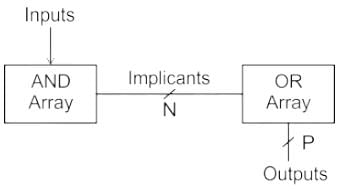
PLD’s (Programmable Logic Devices) are the circuits that contain an array of AND gates and another array of OR gates. There are three kinds of PLD’s depending upon the type of array, i.e.

  • Programmable Read-Only Memory
  • Programmable Array Logic
  • Programmable Logic Array (PLA)
  • ROM is a memory device that stores the binary information permanently.

Programmable Logic Arrays (PLA’s) implement two-level combination logic in sum-of-products (SOP) form.

PLA’s are Programmable AND array followed by Programmable OR array as shown:

PAL: Programmable AND array followed by fixed OR array

PROM:

  • It is known as programmable read-only memory
  • It includes both AND array & OR array
  • Out of these two arrays AND array is fixed and OR array is programmable.

Test: Semiconductor Memories - 2 - Question 8

PLA consists of _____.

Detailed Solution: Question 8

Programmable logic array (PLA):

It is a kind of PLD (Programmable logic device) used to implement a combinational logic circuit.

1.It has a set of programmable AND gate planes which link a set of programmable OR gate planes.

Hence option (B) is the correct answer.

2.It has 2N AND Gate for N-input variable and form or Gates it has m output.

PLA Design:

The memory IC used in a digital system is selected or enabled only for the range of address assigned to it and this process is called memory decoding.

It denotes the memory to be selected for a specific address.

Test: Semiconductor Memories - 2 - Question 9

In digital Electronics a byte is a collection of

Detailed Solution: Question 9

Test: Semiconductor Memories - 2 - Question 10

Which of the following memory types is commonly used for storing firmware in embedded systems?

Detailed Solution: Question 10

Flash memory is widely used for storing firmware in embedded systems because it is non-volatile, meaning it retains data even when power is turned off. Flash memory is faster than EEPROM and can store large amounts of data, making it ideal for firmware storage. Unlike DRAM or SRAM, which require continuous power to retain data, flash memory offers long-term storage without constant power.

195 tests
Information about Test: Semiconductor Memories - 2 Page
In this test you can find the Exam questions for Test: Semiconductor Memories - 2 solved & explained in the simplest way possible. Besides giving Questions and answers for Test: Semiconductor Memories - 2, EduRev gives you an ample number of Online tests for practice
Download as PDF