Electronics and Communication Engineering (ECE) Exam  >  Electronics and Communication Engineering (ECE) Test  >  GATE ECE (Electronics) Mock Test Series 2027  >  Test: Effects of Feedback - Electronics and Communication Engineering (ECE) MCQ

GATE ECE (Electronics) Test: Effects of Feedback Free Online Test 2026


MCQ Practice Test & Solutions: Test: Effects of Feedback (10 Questions)

You can prepare effectively for Electronics and Communication Engineering (ECE) GATE ECE (Electronics) Mock Test Series 2027 with this dedicated MCQ Practice Test (available with solutions) on the important topic of "Test: Effects of Feedback". These 10 questions have been designed by the experts with the latest curriculum of Electronics and Communication Engineering (ECE) 2026, to help you master the concept.

Test Highlights:

  • - Format: Multiple Choice Questions (MCQ)
  • - Duration: 30 minutes
  • - Number of Questions: 10

Sign up on EduRev for free to attempt this test and track your preparation progress.

Test: Effects of Feedback - Question 1

Return ratio for a circuit is 220. What is the amount of feedback, correct up to 2 decimal places?

Detailed Solution: Question 1

Return ratio is Aβ, where β=feedback factor, and A=open loop gain.
Amount of feedback is AF/A = 1 + Aβ
In decibels, amount of feedback = -20log10(1+Aβ) = -20log10(221) = -46.88 decibels.

Test: Effects of Feedback - Question 2

Consider the given diagram. Loop gain is 19. Consider closed loop gain is 50. Find the output without any feedback when input is 5.
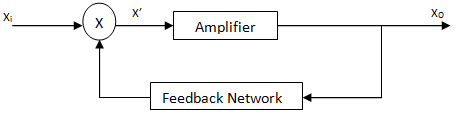
Find output without feedback when input is 5, Loop gain is 19 & closed loop gain is 50

Detailed Solution: Question 2

Feedback factor, β = 10.
AF = A/(1 + Aβ) = 50
A = 20 x 50 = 1000
Output is thus 5000.

Test: Effects of Feedback - Question 3

Find the relative change in gain with negative feedback given that return ratio is 24, and feedback factor is 3, when the change in open loop gain is 2.

Detailed Solution: Question 3

AF = A/(1+Aβ)
Aβ = 24
A = 8
Relative change in gain = dAF/AF = dA/A(1+Aβ)
dAF/AF = 2/8 x 25 = 0.01.

Test: Effects of Feedback - Question 4

Relative change of gain of feedback amplifier is 0.05. Also, loop gain is 9. Find desensitivity?

Detailed Solution: Question 4

We can simply use the ratio of 0.1 to find the answer.
Loop gain Aβ = 9
1+Aβ = 10
Desensitivity = 1/S = 1 + Aβ = 10.

Test: Effects of Feedback - Question 5

Circuit P has desensitivity 20, circuit Q has sensitivity 0.1 and circuit R has desensitivity 40. Which of the following is more stable in gain?

Detailed Solution: Question 5

Greater desensitivity indicates better stability in gain. More desensitivity means gain becomes smaller, but stable.
For circuit Q, desensitivity = 1/S = 10
Circuit R has higher desensitivity, hence most stable.

Test: Effects of Feedback - Question 6

Consider the total harmonic distortion of a closed loop system is 5%. Distortion without feedback is 10%. Calculate the sensitivity of closed loop system.

Detailed Solution: Question 6

DHF = DH/1 + Aβ
1 + Aβ = DH/DHF = 10/5 = 2
Sensitivity = 1/2 = 0.5.

Test: Effects of Feedback - Question 7

For the system shown gain with feedback is 200. Find feedback factor.
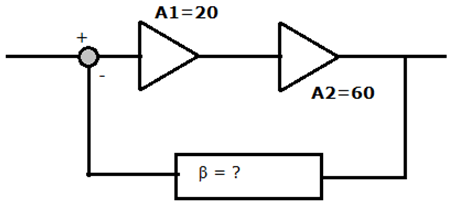
Find feedback factor for system gain with feedback 200

Detailed Solution: Question 7

AF = A/1 + Aβ
A = A1 x A2 = 1200
Thus 1 + Aβ = 1200/200 = 6
Aβ = 5
β = 5/A = 0.0041.

Test: Effects of Feedback - Question 8

Benefits of feedback:

Detailed Solution: Question 8

Closed loop system is the system with the feedback and this can be positive or negative feedback and having feedback have less dependence on parameter variation.

Test: Effects of Feedback - Question 9

Feedback control systems are:

Detailed Solution: Question 9

Feedback control system can be positive and negative but positive feedback systems less widely used as the positive feedback systems are more sensitive to parameter variations but negative feedback are less sensitive to change in G than change in H.

Test: Effects of Feedback - Question 10

Feedback can cause a system that is originally stable to become___________

Detailed Solution: Question 10

Feedback can either make a system stable if not stable previously or may be it can cause instability as it reduces the gain of the system and hence the system can become stable if unstable or vice versa.

26 docs|263 tests
Information about Test: Effects of Feedback Page
In this test you can find the Exam questions for Test: Effects of Feedback solved & explained in the simplest way possible. Besides giving Questions and answers for Test: Effects of Feedback, EduRev gives you an ample number of Online tests for practice
Download as PDF