Chemistry Exam  >  Chemistry Test  >  Organic   >  Test: Chirality - Chemistry MCQ

Chirality - Free MCQ Practice Test with solutions, Chemistry Organic


MCQ Practice Test & Solutions: Test: Chirality (10 Questions)

You can prepare effectively for Chemistry Organic Chemistry with this dedicated MCQ Practice Test (available with solutions) on the important topic of "Test: Chirality ". These 10 questions have been designed by the experts with the latest curriculum of Chemistry 2026, to help you master the concept.

Test Highlights:

  • - Format: Multiple Choice Questions (MCQ)
  • - Duration: 20 minutes
  • - Number of Questions: 10

Sign up on EduRev for free to attempt this test and track your preparation progress.

Test: Chirality - Question 1

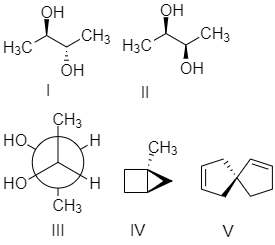
Which of the following compound(s) is/are chiral?

Detailed Solution: Question 1

To determine which compounds are chiral, consider the following:

  • A compound is chiral if it cannot be superimposed on its mirror image.
  • Chirality typically arises from the presence of a stereocentre, often a carbon atom bonded to four different groups.

I. This is the meso‐form of 2,3-butanediol (one OH is wedge, the other dash) and has an internal plane of symmetry. Achiral.

II. Here both –OH’s are on the same face (an R,R or S,S form of 2,3-butanediol). No internal mirror plane ⇒ a single enantiomer. Chiral.

III. This is the Newman projection of R,R-2,3-butanediol in a staggered conformation with no symmetry element. Again two stereocenters of the same configuration, no mirror plane ⇒ chiral.

IV. The methyl‐substituted bicyclobutane has a stereogenic carbon locked by the rigid framework. No way to invert ⇒ chiral.

V. Despite the wedge/dash, this bicyclic actually has a plane of symmetry through the spiro‐junction and is therefore achiral.

Therefore, the correct answer is II, III, IV.

Test: Chirality - Question 2

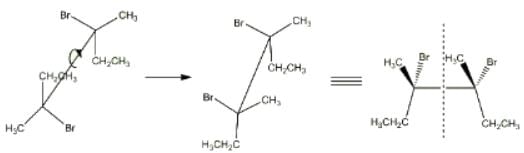
Which symmetry element makes the given compound achiral?
The symmetry element makes the given compound achiral Center of symmetry (COS)

Detailed Solution: Question 2

In order for a molecule to be achiral, it must be superimposable on its mirror image. Molecules with a center of symmetry and/or plane of symmetry meet this criterion.
The given molecule has centre of symmetry for the given figure.
For the given compound has rotation about C-C single bond is also possible, so after rotating one C while another is kept stationary, we get the structure where plane of symmetry passing through middle of the bond to get mirror images.
The plane of symmetry of the molecule is show below:

Test: Chirality - Question 3

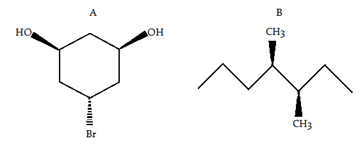
Which of the following compound(s) is/are chiral?
The following compound(s) is/are chiral is Only B

Detailed Solution: Question 3

In order for a molecule to be chiral, it must not be superimposable on its mirror image. Molecules with a plane of symmetry or a center of symmetry do not meet this criterion. Molecule A has a plane of symmetry (shown above in fuchsia), molecule B has no symmetry.

Test: Chirality - Question 4

Which symmetry element makes the given compound achiral?
The symmetry element makes the given compound achiral Plane of symmetry (POS)

Detailed Solution: Question 4

a) Plane of symmetry (POS):

  • Yes, the molecule has a plane that divides it into two mirror-image halves.

  • This plane passes vertically through:

    • The central carbon

    • The hydrogen (H) and hydroxymethyl (CH₂OH)

    • Dividing the two COOH groups equally.

Because of this plane of symmetry, the molecule becomes achiral.

b) Center of symmetry (COS):

  • Not applicable here, as all atoms don’t have equivalent counterparts at equal distances in opposite directions.

c) Axis of symmetry (AOS):

  • Present in many molecules, but this alone doesn't guarantee achirality.

d) Alternating axis of symmetry (AAOS):

  • This is rare for organic molecules, and not present here.

Correct Answer: a) Plane of symmetry (POS)

Conclusion:
The plane of symmetry makes the compound achiral despite having a chiral center.

Test: Chirality - Question 5

Which of the following is the definition of chirality?

Detailed Solution: Question 5

Chirality is not restricted to molecules. While it is common for the presence of a carbon atom in a molecule with four different substituents to be the origin of chirality of a compound, it is not a requirement for chirality.

Test: Chirality - Question 6

Which of the following compound(s) is/are achiral?
The following compound(s) is/are achiral is I in given diagram

Detailed Solution: Question 6

In order for a molecule to be chiral, it must not be superimposable on its mirror image. Molecules with a plane of symmetry or a center of symmetry do not meet this criterion. Molecule II and III are not having symmetry element, they are chiral molecule. Molecule ‘I’ is having plane of symmetry, it is an achiral atom.

Test: Chirality - Question 7

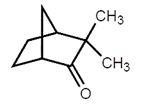
The given compound is a chiral molecule.
The given compound is a chiral molecule

Detailed Solution: Question 7

In order for a molecule to be chiral, it must not be superimposable on its mirror image. Molecules with a plane of symmetry or a center of symmetry do not meet this criterion. This molecule is not having any symmetry element, it is a chiral molecule.

Test: Chirality - Question 8

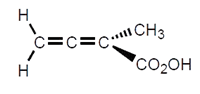
The given compound is a chiral molecule.
Molecules with a plane of symmetry or a center of symmetry do not meet the criterion

Detailed Solution: Question 8

In order for a molecule to be chiral, it must not be superimposable on its mirror image. Molecules with a plane of symmetry or a center of symmetry do not meet this criterion. This molecule is having plane of symmetry, it is an achiral molecule.

Test: Chirality - Question 9

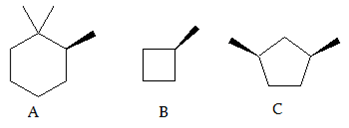
Which of the following compound(s) is/are chiral?
The following compound(s) is/are chiral is Only A

Detailed Solution: Question 9

Chiral molecules are non-superimposable on their mirror images. A good way to determine whether a molecule is chiral is to determine whether it has a plane of symmetry. A molecule with a plane of symmetry is achiral (not chiral). Molecule 1 does not have a plane of symmetry so it is chiral. Molecules 2 and 3 both have planes of symmetry, so they are not chiral.

Test: Chirality - Question 10

Which statement about a chiral compound A is incorrect?

Detailed Solution: Question 10

Follow the direction of the remaining 3 priorities from highest to lowest priority (lowest to highest number, 1<2<3). A clockwise direction is an R (rectus, Latin for right) configuration. A dextrorotary compound is often prefixed “(+)-” or “d-“

39 videos|96 docs|46 tests
Information about Test: Chirality Page
In this test you can find the Exam questions for Test: Chirality solved & explained in the simplest way possible. Besides giving Questions and answers for Test: Chirality , EduRev gives you an ample number of Online tests for practice
39 videos|96 docs|46 tests
Download as PDF