Electrical Engineering (EE) Exam  >  Electrical Engineering (EE) Test  >  Electrical Machines for Electrical Engg.  >  Induction Motor Starting & Running Conditions - Electrical Engineering (EE) MCQ

Induction Motor Starting & Running Conditions for GATE EE Electrical Machines


MCQ Practice Test & Solutions: Induction Motor Starting & Running Conditions (10 Questions)

You can prepare effectively for Electrical Engineering (EE) Electrical Machines for Electrical Engg. with this dedicated MCQ Practice Test (available with solutions) on the important topic of "Induction Motor Starting & Running Conditions". These 10 questions have been designed by the experts with the latest curriculum of Electrical Engineering (EE) 2026, to help you master the concept.

Test Highlights:

  • - Format: Multiple Choice Questions (MCQ)
  • - Duration: 30 minutes
  • - Number of Questions: 10

Sign up on EduRev for free to attempt this test and track your preparation progress.

Induction Motor Starting & Running Conditions - Question 1

If the full load speed of a 3 phase 50 Hz 6 pole induction motor is 950 rpm. What is its half load speed nearly equal to


Detailed Solution: Question 1

The synchronous speed of induction motor,

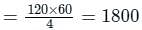
At full load, slip 
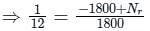
We know that slip is directly proportional to load, hence at half load slip will be 0.025
At half load rotor speed, Nr  = Ns (1 - s) = 1000 (1 - 0.025) = 975 rpm

*Answer can only contain numeric values
Induction Motor Starting & Running Conditions - Question 2

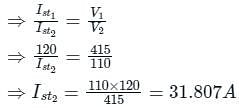
The starting line current of a 415V,3−phase, delta connected induction motor is 120A, when the rated voltage is applied to its stator winding. The starting line current at a reduced voltage of 110V, in ampere, is _________.

Detailed Solution: Question 2

At starting slip, S=1
Current Drawn α voltage

Induction Motor Starting & Running Conditions - Question 3

A 2500 V, 50 Hz delta connected induction motor has a star connected slip ring rotor with a phase transformation ratio of 3.5. At standstill, the rotor resistance and leakage reactance are 0.04 and 0.6 Ω respectively. What is the value of rotor current at 4% slip with slip rings shorted?

Detailed Solution: Question 3

Rotor phase voltage at standstill, 
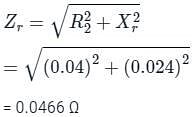
R2 = 0.04 Ω
X2 = 0.6 Ω
Xr = sX2 = 0.04 × 0.6
= 0.024 Ω
Er = sE2
= 0.04 × 714.286 V
= 28.57 V

Induction Motor Starting & Running Conditions - Question 4

A 4 pole induction machine is working as an induction generator. The generator supply frequency is 60 Hz. The rotor current frequency is 5 Hz. The mechanical speed of the rotor in RPM is

Detailed Solution: Question 4

When 3-ϕ induction machine working as an induction generator, then 
Slip (s) = 
Where, 
Ns = Synchronous speed
Nr = Rotor speed
Frequency of rotor current = s × f
Where s is the slip
f is the supply frequency
Calculation:
Given that,
Supply frequency (fs) = 60 Hz
Rotor current frequency (fr) = 5 Hz
Number of poles = 4
Synchronous speed, 

We know that,
fr = (s) fs
⇒ 5 = (s) (60)

To work as an induction generator, rotor speed should be slip speed greater than synchronous speed, therefore 

⇒ Nr = 1950 rpm

Induction Motor Starting & Running Conditions - Question 5

A 3 – phase, slip ring induction motor with delta connected rotor has an induced emf of 230 V between slip rings at standstill. Resistance and leakage reactance are 0.5 and 2.5 Ω respectively at standstill. What is the rotor current per phase at rotor developing maximum torque?

Detailed Solution: Question 5

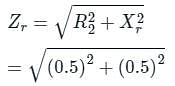
We have, R2 = 0.5 Ω, X2 = 2.5 Ω
At maximum torque, R2 = sX2  
Where s is the slip.

Impedance at maximum torque,

= 0.707 Ω          (∵ Xr = sX2)
Standstill phase voltage in rotor is
E2=230V ( ∵ Delta connection)
Now rotor induced emf is
Er=sE2=0.2×230
= 46 V
Rotor current per phase, 

*Answer can only contain numeric values
Induction Motor Starting & Running Conditions - Question 6

The rotor of a 3-phase induction motor has 0.04 Ω resistance per phase and 0.2 Ω standstill reactance per phase. An external resistance is used in the rotor circuit in order to get half of the maximum torque at starting. Neglect stator impedance. By what percentage will this external resistance change the power factor at starting?
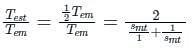
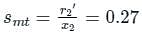
Detailed Solution: Question 6


⇒ s2mt - 4smt + 1 = 0
⇒ smt = 3.73 (or) 0.27
smt = 3.72 is not valid.
So, smt = 0.27

⇒ r'2 = 0.2 x 0.27 = 0.054Ω
External resistance that must be inserted in the rotor circuit
= r'- r2 = 0.054 - 0.04 = 0.014Ω
Without external resistance,
Power factor = 
With external resistance,
Power factor 
Percentage improvement in power factor

*Answer can only contain numeric values
Induction Motor Starting & Running Conditions - Question 7

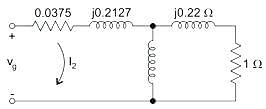
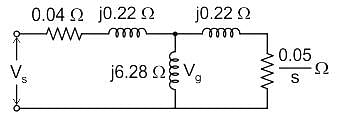
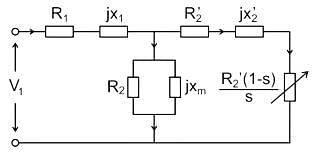
The figure shows the per-phase equivalent circuit of a two-pole three-phase induction motor operating at 50 Hz. The “air-gap” voltage, Vg across the magnetizing inductance, is 210 V rms, and the slip, is 0.05. The torque (in Nm) produced by the motor is _______.
Detailed Solution: Question 7

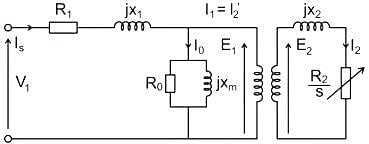
Exact Equivalent Circuit

Here, R1 is the winding resistance of the stator
X1 is the inductance of the stator winding
R0 is the core loss component
XM is the magnetizing reaction of the winding
R2/s is the power of the rotor, which includes output mechanical power and loss of rotor
Important:
If we draw the circuit with refereed to the stator then the circuit will look like

Here all the other parameters are same except R2’ is the rotor winding resistance with referred to stator winding. R2(1-s) / s is the resistance which shows the power which is mechanical power output or useful power. The power dissipated in that resistor is the useful power output or shaft power.
Explanation:

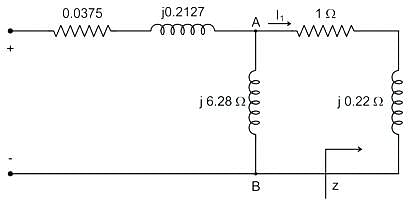
We redraw the given circuit as

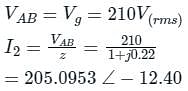
Given Vg=210V,s=0.05
Air gap voltage is the voltage across AB, i.e.

Hence, torque = 

Induction Motor Starting & Running Conditions - Question 8

Name the starter which is very common and is used for cage motor design to run normally on delta connected stator winding.

Detailed Solution: Question 8

Methods used to start a three-phase cage-type induction motor:

DOL starter:

  • The direct on line (DOL) starter method of an induction motor is simple and economical.
  • In this method, the starter is connected directly to supply voltage.
  • It also  referred as Full Voltage Starting.
  • In this method, small motors up to 5 hp rating are started to avoid the supply voltage fluctuation.

Star-delta starter:

  • The star-delta starter method of starting three-phase induction motors is very common and widely used among all the methods.
  • In this method, at stating motor in star connection and runs at delta connected stator windings.
     

Auto-transformer starter:

  • The Autotransformer is used in both the type of the connections, i.e., either star connected or delta connected.
  • The autotransformer is used to limit the starting current of the induction motor.
  • This method is used for the high rating of squirrel cage induction motors. So, this method is most suitable for a 20 hp squirrel cage induction motor.
  • The auto-transformer starter is expensive compare to the “direct on line” (DOL) starter

Induction Motor Starting & Running Conditions - Question 9

In order to______ semi-closed slots or totally closed slots are used in induction motors.

Detailed Solution: Question 9

Slots in Induction motor:

  • The speed of the induction motor is inversely proportional to the load torque. In semi-closed and closed slots, the air gap between the stator and rotor is small as compared to open slots. As the air gap is small, the requirement of magnetizing current to establish the flux in the air gap is less.
  • It results in improved power factor In order to semi-closed slots or totally closed slots are used in induction motors.
  • Among all the three types of slots, semi-closed type slots are preferred for induction machines as semi-closed slots having the partial advantages of open type and partial advantages of closed type slots.
  • Open-type slots are generally preferred for synchronous and dc machines.
  • In general, closed type slots are used in low hp motors, to control the starting current, as the leakage reactance offered by closed type slots is very high compared to other types of slots.
  • Large size induction motors use open slots so that already prepared and properly insulated coils can be easily inserted in open slots.
  • In order to improve the power factor semi-closed slots or totally closed slots are used in induction motors.

Induction Motor Starting & Running Conditions - Question 10

The starter recommended for a 20 hp squirrel cage induction motor is:

Detailed Solution: Question 10

The direct on line (DOL) starter method of an induction motor is simple and economical. In this method, the starter is connected directly to supply voltage. By this method, small motors up to 5 HP rating are started to avoid the supply voltage fluctuation.

The star-delta starter method of starting three-phase induction motors is very common and widely used among all the methods. In this method, the motor runs at delta connected stator windings. It is also used for motors of 5-15 HP rating.

The Autotransformer is used in both the type of the connections, i.e., either star connected or delta connected. The autotransformer is used to limit the starting current of the induction motor. This method is used for the high rating of squirrel cage induction motors. So, this method is most suitable for motors having ratings of more than 15 HP.

35 videos|96 docs|42 tests
Information about Induction Motor Starting & Running Conditions Page
In this test you can find the Exam questions for Induction Motor Starting & Running Conditions solved & explained in the simplest way possible. Besides giving Questions and answers for Induction Motor Starting & Running Conditions, EduRev gives you an ample number of Online tests for practice
Download as PDF