
GATE Electrical Engineering (EE) Test: Routh-Hurwitz Stability Criteria
MCQ Practice Test & Solutions: Test: Routh-Hurwitz Stability Criteria (10 Questions)
You can prepare effectively for Electrical Engineering (EE) GATE Electrical Engineering (EE) Mock Test Series 2027 with this dedicated MCQ Practice Test (available with solutions) on the important topic of "Test: Routh-Hurwitz Stability Criteria". These 10 questions have been designed by the experts with the latest curriculum of Electrical Engineering (EE) 2026, to help you master the concept.
Test Highlights:
- - Format: Multiple Choice Questions (MCQ)
- - Duration: 10 minutes
- - Number of Questions: 10
Sign up on EduRev for free to attempt this test and track your preparation progress.

The forward transfer function of a ufb system is 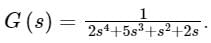 The system will be
The system will beDetailed Solution: Question 1
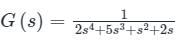
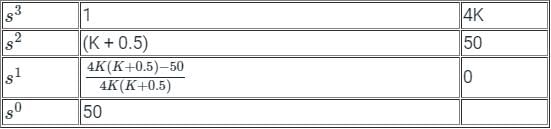
Consider the characteristic equation of a control system given by s3 + (K + 0.5)s2 + 4Ks + 50 = 0. Find the value of the frequency if the system has sustained oscillations for a given K.
Detailed Solution: Question 2

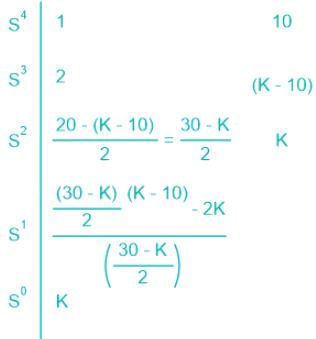
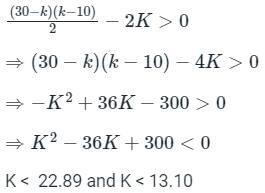
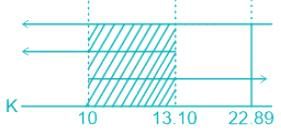
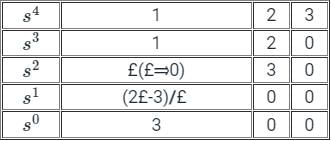
Determine the stability range of k for a feedback control system having characteristic equation -
s4 + 2s3 + 10s2 + (k − 10)s + k = 0
s4 + 2s3 + 10s2 + (k − 10)s + k = 0
Detailed Solution: Question 3
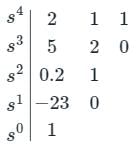
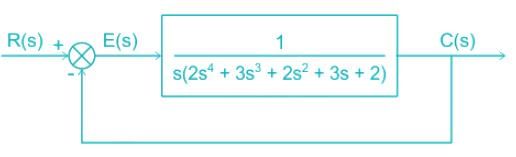
Find the number of poles in the right-half plane (RHP) for the system as shown. Is the system stable?
Detailed Solution: Question 4

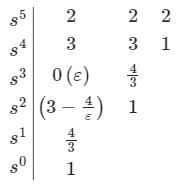
In the formation of Routh-Hurwitz array for a polynomial, all the elements of a row have zero values. This premature termination of the array indicates the presence of
- a pair of real roots with opposite sign
- complex conjugate roots on the imaginary axis
- a pair of complex conjugate roots with opposite real parts
Which of the above statements are correct?
Detailed Solution: Question 5
Which of the following is the correct comment on stability based on unknown k for the feedback system with characteristic s4 + 2ks3 + s2 + 5s + 5 = 0?
Detailed Solution: Question 6


 gives negative values.
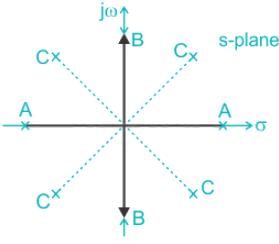
Which one of the following options correctly describes the locations of the roots of the equation s4 + s2 + 1 = 0 on the complex plane?
Detailed Solution: Question 7
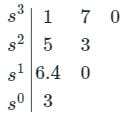
The number of roots of s3 + 5s2 + 7s + 3 = 0 in the left half of the s-plane is
Detailed Solution: Question 8
Consider the characteristic equation of a control system given by s3 + (K + 0.5)s2 + 4Ks + 50 = 0. Find the value of K for the system to have sustained oscillations.
Detailed Solution: Question 9
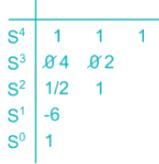
How many roots of characteristic equation P(s) = s4 + s3 + 2s2 + 2s + 3 have (+)ve real part?
Detailed Solution: Question 10
26 docs|247 tests |
