MCAT Exam  >  MCAT Test  >  Biochemistry  >  Test: Quaternary Structure of Protein - MCAT MCQ

Quaternary Structure of Protein - Free MCQ Practice Test with solutions,


MCQ Practice Test & Solutions: Test: Quaternary Structure of Protein (10 Questions)

You can prepare effectively for MCAT Biochemistry for MCAT with this dedicated MCQ Practice Test (available with solutions) on the important topic of "Test: Quaternary Structure of Protein". These 10 questions have been designed by the experts with the latest curriculum of MCAT 2026, to help you master the concept.

Test Highlights:

  • - Format: Multiple Choice Questions (MCQ)
  • - Duration: 15 minutes
  • - Number of Questions: 10

Sign up on EduRev for free to attempt this test and track your preparation progress.

Test: Quaternary Structure of Protein - Question 1

Which structure of a protein is the arrangement of protein subunits in a multi-subunit complex?

Detailed Solution: Question 1

Quaternary structure of a protein is the arrangement of protein subunits in a multi-subunit complex. Many proteins are composed of more than one polypeptide chain. These polypeptide chains fold to form a subunit of a complex protein. All subunits combine to form a complete functional protein.

Test: Quaternary Structure of Protein - Question 2

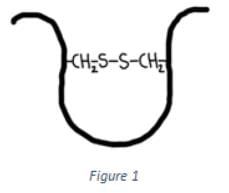
Which of the following interactions is shown in the figure below?

Detailed Solution: Question 2

The interaction shown in the above figure is a disulphide bond. Two Cysteine residues are involved in the formation of a disulfide bond. It is covalent in nature.

Test: Quaternary Structure of Protein - Question 3

Which of the following interactions is shown in the figure below?
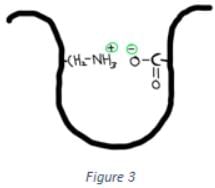
Detailed Solution: Question 3

The interaction shown in the above figure is ionic interactions. Ionic interaction is the interaction between two charged groups. If the two charged groups are oppositely charged then they will attract, while two similar charges repel each other.

Test: Quaternary Structure of Protein - Question 4

Which type of interactions are involved in the quaternary structure?

Detailed Solution: Question 4

Quaternary structure of a protein is made of a combination of any of the following interactions: i) Hydrogen bonds, ii) hydrophobic interactions, iii) disulfide bonds, iv) ionic interactions. Thus, the option containing all of the above options is correct.

Test: Quaternary Structure of Protein - Question 5

What are multi-subunit proteins called when some or all of its subunits are identical?

Detailed Solution: Question 5

Many proteins have a complex structure i.e. they have a multi-subunit structure. When some or all the sub-units of a complex protein are identical it is called oligomers.

Test: Quaternary Structure of Protein - Question 6

Find the odd one out?

Detailed Solution: Question 6

Hydrogen bond, disulfide bond, an ionic bond are the interactions that make up the quaternary structure. The peptide bond is the basis of the primary structure of a protein. Hence, the peptide bond is the odd one out.

Test: Quaternary Structure of Protein - Question 7

Which of the following is used for the reduction of disulfide bonds?

Detailed Solution: Question 7

Beta-mercaptoethanol/dithiothreitol is used forthe reduction of disulfide bonds. Urea and guanidine hydrochloride are denaturating agents, while Iodoacetate is used for acetylation of sulfhydryl groups.

Test: Quaternary Structure of Protein - Question 8

Which of the following options is not suitable for the quaternary structure of a protein?

Detailed Solution: Question 8
Generally, complex proteins that have more than one polypeptide chains adopt a quaternary structure. Thus, the option ‘single polypeptide chain’ is not suitable for the quaternary structure. All other options are suitable for the quaternary structure of a protein.

Test: Quaternary Structure of Protein - Question 9

Which of the following interactions is shown in the figure below?
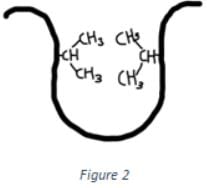
Detailed Solution: Question 9

The interaction shown in the above figure is hydrophobic interactions. Hydrophobic interactions involve interaction between two non-polar hydrophobic residues. It is non-covalent in nature.

Test: Quaternary Structure of Protein - Question 10

Which of the following interactions is shown in the figure below?
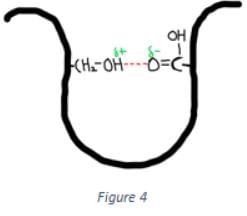
Detailed Solution: Question 10

The interaction shown in the above figure is the hydrogen bond. A hydrogen bond is the interaction between a hydrogen atom attached to an electronegative atom with another electronegative atom like oxygen in its vicinity. It is non-covalent in nature.

138 videos|22 docs|26 tests
Information about Test: Quaternary Structure of Protein Page
In this test you can find the Exam questions for Test: Quaternary Structure of Protein solved & explained in the simplest way possible. Besides giving Questions and answers for Test: Quaternary Structure of Protein, EduRev gives you an ample number of Online tests for practice
138 videos|22 docs|26 tests
Download as PDF