Computer Science Engineering (CSE) Exam  >  Computer Science Engineering (CSE) Test  >  Digital Logic  >  Test: Representation of Signed Numbers - Computer Science Engineering (CSE) MCQ

Representation of Signed Numbers - GATE CSE (CSE) Digital Logic Free MCQ


MCQ Practice Test & Solutions: Test: Representation of Signed Numbers (8 Questions)

You can prepare effectively for Computer Science Engineering (CSE) Digital Logic with this dedicated MCQ Practice Test (available with solutions) on the important topic of "Test: Representation of Signed Numbers". These 8 questions have been designed by the experts with the latest curriculum of Computer Science Engineering (CSE) 2026, to help you master the concept.

Test Highlights:

  • - Format: Multiple Choice Questions (MCQ)
  • - Duration: 30 minutes
  • - Number of Questions: 8

Sign up on EduRev for free to attempt this test and track your preparation progress.

Test: Representation of Signed Numbers - Question 1

X = 01110 and Y = 11001 are two 5-bit binary numbers represented in two’s complement format. The sum of X and Y represented in two’s complement format using 6 bits is

Detailed Solution: Question 1

To represent a given 5-bit number using 6- bits in a 2's complement representation, we simply copy the MSB bit as it is till we get the required 6 bits, i.e.
X = 01110 = 001110 
Y = 11001 =111001
Ignoring the carry, we get the addition of the two in 2's complement number as:
∴ x + y = 000111

Test: Representation of Signed Numbers - Question 2

The I's complement of the binary number (101100)2 is:

Detailed Solution: Question 2

Concept: 
1's complement of Binary: 1's complement of a Binary number is defined by the value obtained by inverting all the bit, i.e, 0 as 1 and 1 as 0.
Calculation:
The 1's complement of the given binary digit will be:
(101100) → (010011)

Additional Information
2's complement of Binary: It is the sum of 1's complement of Binary number and 1 to the least significant bit (LSB).
∴ 2's complement = 1's complement + 1 (LSB)
Shortcut Trick
Steps to writing 2’s complement to any binary number:

  • Start from right to left and search for the first ‘1’
  • Write down the bits until that first ‘1’ as it is.
  • Write down the remaining left bits with their respective complement.

Test: Representation of Signed Numbers - Question 3

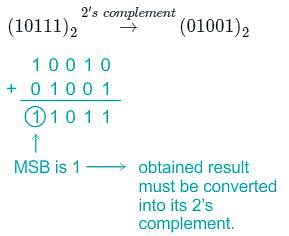
Perform the subtraction and represent your answer in 2’s complement form (10010)2 - (10111)2
Detailed Solution: Question 3

Concept:
If number is positive; MSB = 0
Then 2’s complement will be the same
If number is negative; MSB = 1
Then 2’s complement will be different from its obtained result
Calculation:
Given,
(10010)2 - (10111)2
(10010)2 + 2’s complement of (10111)2

i.e. (11011)2 = -[2’s complement of 11011]
= -[00101]
∴ (10010)2 - (10111)2 = -(00101)2

Test: Representation of Signed Numbers - Question 4

Which of the following is the smallest 4-bit negative number stored in its 2's complement representation?

Detailed Solution: Question 4

The smallest negative number is the largest binary value.
1111 is -1, 1110 is -2, 1101 is -3, etc down to 1000 which represents -8.

Important Points
Using two's complement for negative numbers:

  • Find the positive binary value for the negative number you want to represent.
  • Add a 0 to the front of the number, to indicate that it is positive
  • Invertor finds the complement of each bit in the number.
  • Add 1 to this number.

Example:
4 using two's complement numbers,

  • 4 = 100
  • Adding 0 to the front becomes 0100
  • 'inverted' becomes 1011
  • Add 1 = 1100 (-8 + 4 = -4)

Test: Representation of Signed Numbers - Question 5

X = 00110 and Y = 10011 are two binary numbers represented in 2's complement format. The sum of X and Y represented in 2's complement format using 5 bits is _____

Detailed Solution: Question 5

X = 00110
since, the MSB = 0
∴ it is a positive number.
Decimal equivalent: 0 + 1 × 22 + 1 × 21 + 0 × 20 = + 6
Y = 10011
since, the MSB = 1 
∴ it is a negative number,
We need to take the 2's complement of Y, that is.
1's complement (Y) + 1
01100 + 1
⇒ 01101
Decimal equivalent → 0 + 1 × 23 + 1 × 22 + 0 + 1 × 20 → -13
The sum of X and Y is
+6 - 13 = - 7
The 2's complement of - 7
→ 1's complement of 7 + 1
→ 1's complement of 00111 + 1
→ 11000 + 1 → 11001

Test: Representation of Signed Numbers - Question 6

The number of 1’s in the 8-bit unsigned representation of 127 in its 2’s complement form is m and that in 1’s complement form is n. What is the value of m : n?

Test: Representation of Signed Numbers - Question 7

In sign-magnitude numbers

Detailed Solution: Question 7

Signed magnitude representation uses the most significant bit (MSB) a sign bit.

  • If the sign bit is ‘0’ then the number is positive.
  • If the sign bit is ‘1’ then the number is negative.

The remaining bits represent the magnitude of the binary number.
Example:

  • 1000101 represents a negative number as the MSB bit is '1'
  • 0101001 represents a positive number as the MSB bit is '0'

Important Point:

  • 1’s complement representation: It is a representation of a binary number obtained by toggling all bits in it i.e. transforming the 0 bit to 1 and the 1 bit to 0.
  • 2’s complement representation: It is obtained by simply adding 1 to the 1’s complement of that binary number.

Test: Representation of Signed Numbers - Question 8

A register contains a 2’s complement no 10100. Find the value of a register if it is divided by 2

Detailed Solution: Question 8

Given Number is 10100
The Right shift of the content in register is same as the content divided by 2 
Apply Right Shift ⇒ 11010       
Operation right shift is equivalent to divided by 2

55 docs|15 tests
Information about Test: Representation of Signed Numbers Page
In this test you can find the Exam questions for Test: Representation of Signed Numbers solved & explained in the simplest way possible. Besides giving Questions and answers for Test: Representation of Signed Numbers, EduRev gives you an ample number of Online tests for practice
55 docs|15 tests
Download as PDF