
Bligh's Creep Theory - Free MCQ Practice Test with solutions, GATE Civil
MCQ Practice Test & Solutions: Test: Bligh's Creep Theory (10 Questions)
You can prepare effectively for Civil Engineering (CE) Irrigation Engineering with this dedicated MCQ Practice Test (available with solutions) on the important topic of "Test: Bligh's Creep Theory". These 10 questions have been designed by the experts with the latest curriculum of Civil Engineering (CE) 2026, to help you master the concept.
Test Highlights:
- - Format: Multiple Choice Questions (MCQ)
- - Duration: 30 minutes
- - Number of Questions: 10
Sign up on EduRev for free to attempt this test and track your preparation progress.

What is the value of Bligh’s coefficient for coarse-grained soil?
Detailed Solution: Question 1
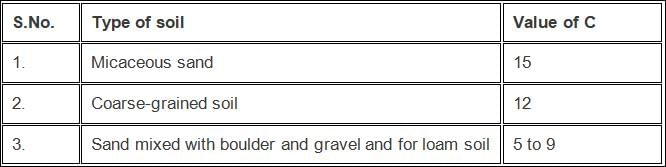
Detailed Solution: Question 2




The Bligh’s creep coefficient for light sand and mud is:
Detailed Solution: Question 3
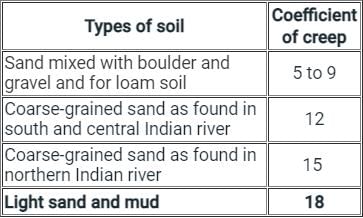
For sand mixed with boulder and gravel and for loam soil, the safe hydraulic gradient should be ___________
Detailed Solution: Question 4
Which of the following is not a limitation of creep theory?
Detailed Solution: Question 5
If the value of Bligh’s coefficient for a particular soil is equal to 12 then, what is the safe hydraulic gradient for that soil?
Detailed Solution: Question 6
Consider the following statements about Bligh’s Creep Theory.
i. Creep length is the length of path traversed by percolating water
ii. To increase the path of percolation vertical cut-off or sheet piles can be provided
iii. Loss of head per unit creep length is hydraulic gradient
iv. Bligh gave no criteria for the safety of weir against undermining
Which of the following statements are correct?
i. Creep length is the length of path traversed by percolating water
ii. To increase the path of percolation vertical cut-off or sheet piles can be provided
iii. Loss of head per unit creep length is hydraulic gradient
iv. Bligh gave no criteria for the safety of weir against undermining
Which of the following statements are correct?
Detailed Solution: Question 7
As per Bligh’s theory, thickness to be provided by taking a factor of safety equal to _______
Detailed Solution: Question 8
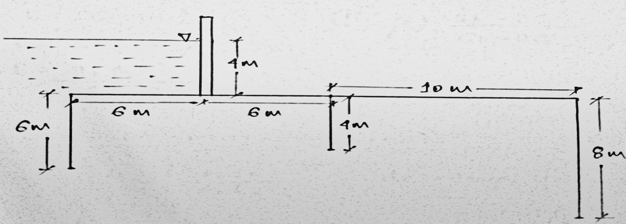
Detailed Solution: Question 9
According to Bligh, a vertical cut-off at U/s end of the floor is less useful than the one at the D/s end of the floor.
Detailed Solution: Question 10
7 videos|47 docs|31 tests |
