GMAT Exam  >  GMAT Test  >  Practice Questions  >  Test: Fractions/Ratios/Decimals - GMAT MCQ

Fractions/Ratios/Decimals - Free MCQ Practice Test with solutions, GMAT


MCQ Practice Test & Solutions: Test: Fractions/Ratios/Decimals (10 Questions)

You can prepare effectively for GMAT Practice Questions for GMAT with this dedicated MCQ Practice Test (available with solutions) on the important topic of "Test: Fractions/Ratios/Decimals". These 10 questions have been designed by the experts with the latest curriculum of GMAT 2026, to help you master the concept.

Test Highlights:

  • - Format: Multiple Choice Questions (MCQ)
  • - Duration: 20 minutes
  • - Number of Questions: 10

Sign up on EduRev for free to attempt this test and track your preparation progress.

Test: Fractions/Ratios/Decimals - Question 1

In a 200 member association consisting of men and women, exactly 20% of men and exactly 25 % women are homeowners. What is the least number of members who are homeowners?

Detailed Solution: Question 1

The proportion of women who are homeowners exceeds that of men who are homeowners. Therefore, to minimize the total number of homeowners, we should aim for the lowest possible count of women.

To achieve this, we need to ensure that the number of women is a multiple of 4 and the number of men is a multiple of 5.

Considering the objective stated in the first point and the constraint mentioned in the second point, the minimum number of women required is 20, while the corresponding number of men is 180.

Consequently, with 25% of 20 being 5 and 20% of 180 equaling 36, the minimum number of homeowners is obtained by summing these values, resulting in a total of 41 homemakers.

Test: Fractions/Ratios/Decimals - Question 2

A salad dressing requires oil, vinegar, and water in the ratio 2 : 1 : 3. If Oliver has 1 cup of oil, 1/3 cup of vinegar, and 2 cups of water, what is the maximum number of cups of dressing that he can mix?

Test: Fractions/Ratios/Decimals - Question 3

Two mixtures of X and Y have X and Y in the ratio 3:2 and 3:4. In what proportion should these two mixtures be mixed to get a new mixture in which the ration of X to Y is 5:4?

Test: Fractions/Ratios/Decimals - Question 4

In a partnership, A invests 1/6 th of the capital for 1/6 th of the time, B invests 1/3 rd of the capital for 1/3 rd of the time and C invests the rest of the capital for the whole time. Out of a profit of $4140, A’s share is:

Test: Fractions/Ratios/Decimals - Question 5

The ratio of boys to girls in the junior class is 2 to 3 respectively and the ratio of girls to boys in the senior class is 7 to 3 respectively. If there are 300 more students in the senior class than in the junior class and the combined ratio of boys to girls in both classes is 8 to 17 respectively, how many students are in the senior class?

Test: Fractions/Ratios/Decimals - Question 6

Box A contains white, blue and red balls where the ratio of the number of white balls to the number of blue balls is 1:2 and the ratio of the number of blue balls to the number of red balls is 4:3. Box B contains white balls and blue balls in the ratio 4:5. Box C contains only blue balls so that the ratio of the number of blue balls in Box C to the number of white balls in Box A is 3:2. If the total number of blue balls in all the three boxes is 45, what is the number of white balls in Box B?

Test: Fractions/Ratios/Decimals - Question 7

At a bakery, Tom normally earns x dollars per hour of the first n hours of the day. For each hour he works in excess of n hours on a given day, he is paid 1.375 times his regular rate. If Tom decides to start working over time, what is the ratio of over time hours to regular time hours required to double his daily income?

Test: Fractions/Ratios/Decimals - Question 8

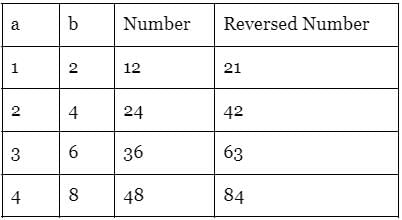
The ratio of a two digit number to a number formed by reversing its digits is 4:7. Which of the following is the sum of all the numbers of all such pairs?

Detailed Solution: Question 8
Let the two digit number be 10a + b and the number formed by reversing its digits be 10b + a.
10a + b /10b + a = 4/7
70a + 7b = 40b + 4a
66a = 33b
Therefore, a/b = 1/2
So, let us list down all possible values for a and b

Hence, the sum of all the numbers would be,
12 + 21 + 24 + 42 + 36 + 63 + 48 + 84 = 330.

Test: Fractions/Ratios/Decimals - Question 9

If n is a positive integer, how many of the ten digits from 0 through 9 could be the units digits of n3 ?

Detailed Solution: Question 9

When we cube numbers, the units digit of the cube is solely dependent on the units digit of the base number. We can observe the following pattern for the units digits of cubes:

03 = 0
13 = 1
23 = 8
33 = 7
43 = 4
53 = 5
63 = 6
73 = 3
83 = 2
93 = 9

From this pattern, we can see that each digit from 0 to 9 appears as the units digit of some cube. Therefore, all ten digits from 0 through 9 could be the units digits of n3.

Hence, the answer is E: Ten.

Test: Fractions/Ratios/Decimals - Question 10

A beaker was filled with a mixture of 40 liters of water and a liquid chemical. They are fixed in the ratio of 3 : 5, respectively. If 2 percent of the initial quantity of water and 5 percent of the initial quantity of liquid chemical evaporated each day during a 10-day period, what percent of the original amount of mixture evaporated during this period?

Detailed Solution: Question 10

Given a mixture of 40 liters consisting of water and a chemical in a ratio of 3:5, we can calculate the percentage of the original amount of mixture that evaporated during a 10-day period.

First, we solve for the individual amounts of water and chemical in the mixture using the given ratio:
Let x represent the common multiplier.
Water = 3x
Chemical = 5x

Solving the equation 3x + 5x = 40, we find x = 5.

Substituting x = 5, we find:
Water = 3 * 5 = 15 liters
Chemical = 5 * 5 = 25 liters

Over the 10-day period, water evaporates 2% each day, resulting in a total water loss of 10 * 2% = 20%.
Chemical evaporates 5% each day, resulting in a total chemical loss of 10 * 5% = 50%.

Calculating the actual amount evaporated:
Water evaporated = 15 liters * 20% = 3 liters
Chemical evaporated = 25 liters * 50% = 12.5 liters

The total amount evaporated is the sum of water and chemical evaporated:
Total evaporated = 3 liters + 12.5 liters = 15.5 liters

Finally, we calculate the percentage of the original mixture evaporated:
Percentage evaporated = (Total evaporated / Mixture total) * 100
Percentage evaporated = (15.5 liters / 40 liters) * 100 ≈ 38.75%

Therefore, the answer is C: 38.75%.

11 docs|139 tests
Information about Test: Fractions/Ratios/Decimals Page
In this test you can find the Exam questions for Test: Fractions/Ratios/Decimals solved & explained in the simplest way possible. Besides giving Questions and answers for Test: Fractions/Ratios/Decimals, EduRev gives you an ample number of Online tests for practice
Download as PDF