NEET Exam  >  NEET Test  >  Biology Class 11  >  Test: The Living World- 1 - NEET MCQ

The Living World- 1 - NEET Biology Class 11 Free MCQ Test with solutions


MCQ Practice Test & Solutions: Test: The Living World- 1 (15 Questions)

You can prepare effectively for NEET Biology Class 11 with this dedicated MCQ Practice Test (available with solutions) on the important topic of "Test: The Living World- 1". These 15 questions have been designed by the experts with the latest curriculum of NEET 2026, to help you master the concept.

Test Highlights:

  • - Format: Multiple Choice Questions (MCQ)
  • - Duration: 15 minutes
  • - Number of Questions: 15

Sign up on EduRev for free to attempt this test and track your preparation progress.

Test: The Living World- 1 - Question 1

Which statement is true regarding taxonomic categories?

Detailed Solution: Question 1

Higher taxonomic categories, like phylum, encompass a broader diversity of organisms, sharing more general characteristics compared to the more specific and closely related organisms grouped within lower categories like species and genus. This reflects the hierarchical nature of biological classification, where each ascending level represents a broader grouping based on less specific shared traits.

Topic in NCERT: Taxonomic Hierarchy

Line in NCERT: "as we go higher from species to kingdom, the number of common characteristics goes on decreasing."

Test: The Living World- 1 - Question 2

A group of closely related classes is called:

Detailed Solution: Question 2

  • Phylum is one of the major taxonomic ranks, and it represents a high-level grouping of organisms that share certain fundamental characteristics.
  • Within a phylum, organisms are further divided into classes, which are more specific and share even more closely related characteristics.

Correct answer is B.
NCERT Reference: 
Topic - Taxonomy from chapter "The Living world" of NCERT.

Topic in NCERT: Phylum

Line in NCERT: "Classes comprising animals like fishes, amphibians, reptiles, birds along with mammals constitute the next higher category called Phylum."

Test: The Living World- 1 - Question 3

The taxonomic hierarchy, from broadest to most specific, consists of the following categories:

Detailed Solution: Question 3

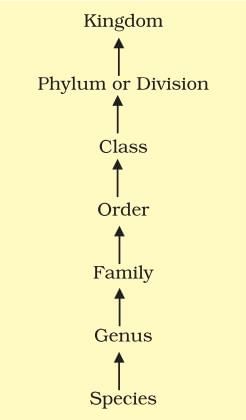
This is the correct taxonomic hierarchy from the broadest to the most specific category:

Kingdom > Phylum > Class > Order > Family > Genus > Species.

In this hierarchy, the broadest category is Kingdom, which groups organisms based on general similarities. As we move down the hierarchy, each category becomes more specific, ending with the most specific category, Species.

Hence, the Correct Answer is C
NCERT Reference: 
Topic- Taxonomic hierarchy from chapter "The Living world" of NCERT.

Topic in NCERT: Taxonomic Categories and Hierarchy
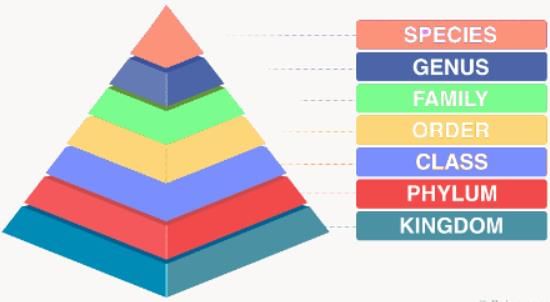
Line in NCERT: "The taxonomic categories from species to kingdom have been shown in ascending order starting with species in Figure 1.1."

Test: The Living World- 1 - Question 4

The expansion of ICZN is:

Detailed Solution: Question 4

The International Code of Zoological Nomenclature (ICZN) is in charge of producing a set of regulations for naming animals and solving nomenclatural difficulties.

Hence, the Correct Answer is B

Topic in NCERT: International Code of Zoological Nomenclature (ICZN)

Line in NCERT: "Animal taxonomists have evolved International Code of Zoological Nomenclature (ICZN)."

Test: The Living World- 1 - Question 5

Solanum, Panthera, Homo are examples of:

Detailed Solution: Question 5

Solanum, Panthera, Homo are examples of Genera.
Example:

  1. Potato Genus: Solanum; 
    Species: tuberosum
  2. Human Genus: Homo;
    Species: sapiens
  3. Lion Genus: Panthera; 
    Species: leo

Hence, the Correct Answer is C

Topic in NCERT: Genus

Line in NCERT: "the first words Mangifera, Solanum and Panthera are genera and represents another higher level of taxon or category."

Test: The Living World- 1 - Question 6

The binomial nomenclature system was introduced by:

Detailed Solution: Question 6

The binomial nomenclature system, which involves giving each species a two-part scientific name, was introduced by Carl Linnaeus, a Swedish botanist, and zoologist.

Hence, the Correct Answer is C
NCERT Reference: 
Topic- Binomial Nomenclature from chapter "The Living world" of NCERT.

Topic in NCERT: Binomial Nomenclature

Line in NCERT: Each name has two components – the Generic name and the specific epithet. This system of providing a name with two components is called Binomial nomenclature. This naming system given by Carolus Linnaeus is being practised by biologists all over the world.

Test: The Living World- 1 - Question 7

Which of the following is less general in characters as compared to genus?

Detailed Solution: Question 7
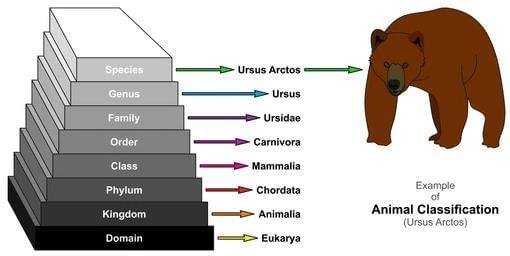
The correct hierarchy of classification of various taxons in descending order is given by:
Kingdom → Phylum → Class → Order → Family → Genus → Species

The kingdom is the highest taxon with the least similar characters shared between its various members while species is the lowest level with almost similar morphological and behavioural similarities.

Species is followed by Genus with slightly fewer similarities among its members.

Hence, the Correct Answer is A

Topic in NCERT: Genus

Line in NCERT: "Genus comprises a group of related species which has more characters in common in comparison to species of other genera."

Test: The Living World- 1 - Question 8

The scientific name of an organism is when handwritten in:

Detailed Solution: Question 8

The binomial system of nomenclature, proposed by Carolus Linnaeus, is the most accepted system of scientific naming which is practiced currently. This type of naming consists of two words taken from Latin origin.
There are four conventions that are followed while writing scientific names. They are as follows:
(i) The first word out of the two words will be the genus whereas the second word would represent the specific epithet.
(ii) The name of the genus should start with a capital letter and the name of the species should start with a small letter.
(iii) The scientific name must be italicized when printed
(iv) The scientific name must be separately underlined when it is hand written.
Example : It can be explained with the help of an example.
Panthera leo
It is the common name of the lion.
In this, the first word represents its genus- Panthera, while the second word represents the specific epithet- leo.
The scientific name has been italicized.
NCERT Reference: Topic- Nomenclature (DIVERSITY IN THE LIVING WORLD) from chapter "The Living world" of NCERT.

Topic in NCERT: Nomenclature

Line in NCERT: 1. Biological names are generally in Latin and written in italics. They are Latinised or derived from Latin irrespective of their origin. 2. The first word in a biological name represents the genus while the second component denotes the specific epithet. 3. Both the words in a biological name, when handwritten, are separately underlined, or printed in italics to indicate their Latin origin.

Test: The Living World- 1 - Question 9

The Darwin of 20th century is:

Detailed Solution: Question 9

Born on 5 July 1904, in Kempten, Germany, Ernst Mayr, the Harvard University evolutionary biologist who has been called ‘The Darwin of the 20th century’, was one of the 100 greatest scientists of all time.

Hence, the Correct Answer is B

Topic in NCERT: Introduction

Line in NCERT: Born on 5 July 1904, in Kempten, Germany, ERNST MAYR, the Harvard University evolutionary biologist who has been called ‘The Darwin of the 20th century’, was one of the 100 greatest scientists of all time.

Test: The Living World- 1 - Question 10

A taxon can be defined as _________

Detailed Solution: Question 10

  • A taxon is a taxonomic group of any ranking whereas a group of related species is the genus and a group of related families is the order.
  • Biodiversity is the number and type of organisms present on Earth.

Hence, the Correct Answer is B

Topic in NCERT: TAXONOMIC CATEGORIES

Line in NCERT: "Each rank or taxon, in fact, represents a unit of classification."

Test: The Living World- 1 - Question 11

Select the correctly written scientific name of Mango which was first described by Carolus Linnaeus.

Detailed Solution: Question 11

  • Mangifera indica is the scientific name for mango.
  • Mangifera represents the genus and indica represents the species.
  • Mangifera indica Linn. It indicates that this species was first described by Linnaeus.

Hence, the Correct Answer is D

Topic in NCERT: Binomial Nomenclature

Line in NCERT:Name of the author appears after the specific epithet, i.e., at the end of the biological name and is written in an abbreviated form, e.g., Mangifera indica Linn. It indicates that this species was first described by Linnaeus.

Test: The Living World- 1 - Question 12

What is the distinguishing factor used to categorize families among plants?

Detailed Solution: Question 12

  • The distinguishing factor used to categorize families among plants is based on their "vegetative and reproductive features."
  • Taxonomists analyze the shape and structure of leaves, stems, roots, as well as the arrangement of flowers, fruits, and seeds to group plant species with similar traits into the same family.

Hence, the Correct Answer is B
NCERT Reference: 
Topic- TAXONOMIC CATEGORIES from chapter "The Living world" of NCERT.

Topic in NCERT: Family

Line in NCERT: "Families are characterised on the basis of both vegetative and reproductive features of plant species."

Test: The Living World- 1 - Question 13

In a hierarchical system of classification of plants, which of the following taxonomic rank ends in ‘aceae’?

Detailed Solution: Question 13

  • In the hierarchical system of classification of plants, the taxonomic rank that typically ends in "aceae" is the family. 
  • A family is a higher rank in the classification system, grouping together related genera. 
  • The family name is often derived from the name of a prominent genus within that family. For example, the family Rosaceae includes the genera Rosa (roses), Malus (apples), and Prunus (cherries, plums, etc.). 
  • Similarly, the family Poaceae includes the grasses, and the family Fabaceae includes legumes.

Hence, the Correct Answer is C
NCERT Reference: 
TopicTAXONOMIC CATEGORIES from chapter "The Living world" of NCERT.

Topic in NCERT: Order

Line in NCERT: "Plant families like Convolvulaceae, Solanaceae are included in the order Polymoniales mainly based on the floral characters."

Test: The Living World- 1 - Question 14

Which family includes both lions and cats (Felis)?

Detailed Solution: Question 14

  • The family that includes both lions and domestic cats (Felis) is called Felidae, often known as the "cat family."
  • This family includes various species of big and small cats like lions, tigers, leopards, cheetahs, and also our pet cats.

Hence, the Correct Answer is B
NCERT Reference: Topic:  “Taxonomic Categories”
from Chapter  "The Living world" of NCERT.

Topic in NCERT: Family

Line in NCERT: "Among animals for example, genus Panthera, comprising lion, tiger, leopard is put along with genus, Felis (cats) in the family Felidae."

Test: The Living World- 1 - Question 15

Genus has

Detailed Solution: Question 15

To understand the concept of genus in taxonomy:

- A genus typically comprises a group of species sharing more common characteristics among themselves than with species from other genera.
- This distinction helps in classifying organisms into related groups based on similarities in traits.
- Therefore, the correct answer is B: "More common character possessing group of species than species of other genera." This choice highlights the defining feature of a genus in taxonomy.
NCERT Reference: Topic- Taxonomic Categories ( Sub Topic - Genus) from chapter "The Living world" of NCERT.

Topic in NCERT: Genus

Line in NCERT: "Genus comprises a group of related species which has more characters in common in comparison to species of other genera."

142 videos|410 docs|135 tests
Information about Test: The Living World- 1 Page
In this test you can find the Exam questions for Test: The Living World- 1 solved & explained in the simplest way possible. Besides giving Questions and answers for Test: The Living World- 1, EduRev gives you an ample number of Online tests for practice
142 videos|410 docs|135 tests
Download as PDF