CLAT Exam  >  CLAT Test  >   Mock Test Series 2027  >  Test: CLAT Mock Test - 1 - CLAT MCQ

CLAT Test: Mock Test - 1 Free Online Test 2026


Full Mock Test & Solutions: Test: CLAT Mock Test - 1 (120 Questions)

You can boost your CLAT 2026 exam preparation with this Test: CLAT Mock Test - 1 (available with detailed solutions).. This mock test has been designed with the analysis of important topics, recent trends of the exam, and previous year questions of the last 3-years. All the questions have been designed to mirror the official pattern of CLAT 2026 exam, helping you build speed, accuracy as per the actual exam.

Mock Test Highlights:

  • - Format: Multiple Choice Questions (MCQ)
  • - Duration: 120 minutes
  • - Total Questions: 120
  • - Analysis: Detailed Solutions & Performance Insights
  • - Sections covered: English Language, Legal Reasoning, Logical Reasoning, Quantitative Techniques, Current Affairs including GK

Sign up on EduRev for free and get access to these mock tests, get your All India Rank, and identify your weak areas to improve your marks & rank in the actual exam.

Test: CLAT Mock Test - 1 - Question 1

The author mentions the use of the Farmers' Almanac and Guinness Book of World Records at the James E. Foy desk primarily to:

Detailed Solution: Question 1

The mention of these sources underscores the idea that, even today, there are people who rely on human and analog sources of knowledge instead of the internet. This frames a broader contrast between traditional inquiry and modern digital access. Option (a) is inaccurate because the passage does not dismiss these older sources. Option (c) misreads the tone, which is warm, not critical. Option (d) is too narrow and not the author's primary intent. Hence (b).

Test: CLAT Mock Test - 1 - Question 2

The phrase "comforting fiction of the eternal, unchanging Earth" most likely serves to:

Detailed Solution: Question 2

The phrase “comforting fiction’" suggests that people once preferred to believe the Earth was static and eternal, and that this belief was psychologically reassuring. The revolution in geology disrupted this mental comfort. Option (a) wrongly suggests affirmation. Option (b) introduces a religious angle not explicitly addressed. Option (d) is irrelevant to the specific phrase. Hence (c).

Test: CLAT Mock Test - 1 - Question 3

Which of the following best captures the role of Marie Tharp in the development of plate tectonic theory, as depicted in the passage?

Detailed Solution: Question 3

The passage frames Tharp's seafloor maps as instrumental in overturning long-held geological assumptions and initiating the “Plate Tectonic Revolution.” Option (a) is incorrect because the theory was not widely accepted at the time. Option (b) understates her scientific significance. Option (d) is inaccurate as her work was in a completely different domain. Hence (c).

Test: CLAT Mock Test - 1 - Question 4

Vidit Kumar is a senior officer in the Municipal Corporation responsible for processing contractor payments as part of the tender process. For a recent project, contractor Vidhan Enterprises paid a fee of Rs. 3,457, which was a mandatory government requirement stipulated in the tender guidelines. However, due to an administrative error, Vidit did not forward the payment as required, and later, Vidhan Enterprises alleged in court that Vidit had accepted a bribe by misusing the fee. Can Vidit Kumar be penalized for accepting a bribe if the Rs. 3,457 fee was a mandatory government fee?

Detailed Solution: Question 4

Option (c) is correct because the passage explains that “Section 7 penalized a public servant for accepting any undue gratification beyond lawful remuneration in connection with their official functions.” In this scenario, the fee of Rs. 3,457 is a statutory payment required by government regulation; thus, its acceptance does not exceed lawful remuneration. Option (a) is incorrect because it incorrectly treats all monetary receipts as undue, ignoring the statutory requirement. Option (b) is incorrect because the issue is not about misappropriation for personal gain but whether the payment itself was undue, and here it was lawful. Option (d) is incorrect because, it incorrectly notes that the fee was an inducement.

Test: CLAT Mock Test - 1 - Question 5

Before the 2018 amendment to the Prevention of Corruption Act, contractor Vudit Kumar, an individual subject to the jurisdiction of Bombay High Court, in an effort to secure a lucrative government contract, offers a sum of Rs. 50,000 to Inspector Vidhan Singh to expedite the clearance process. Inspector Vidhan Singh categorically refuses the bribe without making any demand and records his refusal in his official log. Later, Inspector Vidhan Singh files a complaint alleging abetment of bribery. Vudit Kumar argues that since the bribe was never accepted and no demand was made by the Inspector, his offer should not be considered an offence under the legal framework. Can Vudit Kumar be prosecuted for offering a bribe under the applicable framework of the Prevention of Corruption Act?

Detailed Solution: Question 5

Option (b) is correct because the passage states that “before the 2018 amendment, merely offering a bribe without it being accepted did not constitute an offence.” The reasoning was that Section 7 PCA required proof of “acceptance of bribe or its demand” by the public official, and since there is no acceptance or demand of bribe, an offence under Section 7 could not be established. Consequently, the abetment charge under Section 12 PCA also failed. In this case, Inspector Vidhan Singh refused the bribe and made no demand; therefore, Vidit Kumar’s offer does not satisfy the elements needed to constitute an offence under the pre-2018 legal framework. Option (a) is incorrect because section 7 is an offence with respect to acceptance of bribeiy by public official.
Option (c) is incorrect because there is no evidence of any prior demand, and the offence cannot be established on mere implication. Option (d) is incorrect because the legal requirement is not that both demand and acceptance must occur. Further the question is with respect to section 12 and not section 7.

Test: CLAT Mock Test - 1 - Question 6

Vidya Gupta, a leading contractor in a large consortium bidding for a multi-million rupee infrastructure project, is under intense pressure to secure a favorable outcome due to fierce competition. During the tender process, which has already encountered significant delays and procedural irregularities, Vidya Gupta, through an intermediary, covertly offers Inspector Vidhan Singh a sum of Rs. 100,000 to expedite the processing of their tender application. Inspector Vidhan Singh, who is responsible for supervising the tender process and ensuring its integrity, categorically refuses the offer and immediately records his refusal in an internal communication. The prosecution now contends that, under PCA as amended in 2018, Vidya Gupta's act of offering the bribe is punishable irrespective of the refusal. Can Vidya Gupta be prosecuted under PCA for offering a bribe to Inspector Vidhan Singh?

Detailed Solution: Question 6

Option (a) is correct because the passage clarifies that the 2018 amendment introduced Section 8 PCA, which explicitly criminalizes any person who gives or promises to give an undue advantage to a public servant as an independent offence, separate from the abetment clause under Section 12, thereby making the mere offer of a bribe punishable regardless of whether it is accepted. In this complex scenario, Vidya Gupta’s covert offer of Rs. 100,000—even though Inspector Vidhan Singh refused it—is sufficient to establish the offence under Section 8 PCA. Option (b) is incorrect because it relies on the pre-2018 interpretation where acceptance was necessary, which is no longer applicable after the amendment. Option (c) is incorrect because Section 8 PCA does not require proof of influence on the tender process; the offence is complete on the offer alone. Option (d) is incorrect because, under the amended law, the requirement of acceptance or solicitation is expressly removed with respect to offence under section 8, thereby rendering the recorded offer itself sufficient for prosecution.

Test: CLAT Mock Test - 1 - Question 7

Assertion: Before its 2018 amendment, the Prevention of Corruption Act, 1988 did not explicitly criminalize offering a bribe as an independent offence.
Reason: Prior to the amendment, Section 12 PCA was uniformly interpreted by the courts to require that a bribe must be accepted by a public official for an offence to be constituted.

Detailed Solution: Question 7

Option (c) is correct because the passage confirms that before the 2018 amendment, the act of offering a bribe was not expressly treated as an independent offence under the PCA; it was only punishable as an abetment offence under Section 12. However, the claim that courts uniformly interpreted Section 12 PCA to require acceptance of the bribe is false, as evidenced by conflicting judgments—while the Bombay High Court held that an unaccepted bribe did not constitute an offence, the Madras High Court ruled that merely offering a bribe was punishable.

Test: CLAT Mock Test - 1 - Question 8

According to the Bombay High Court’s interpretation in Kishor Khachand Wadhwani v. State of Maharashtra (2019) regarding the pre 2018 framework of the Prevention of Corruption Act, 1988, which of the following scenarios does not constitute an offence?
I. A public servant explicitly demands a bribe and accepts it, thereby triggering prosecution under Section 7 PCA for receiving undue gratification.
II. An individual presents the bribe to a public servant as dem anded by him, but the public servant rejects to accept the bribe now.
III. An individual offers a bribe to a public servant, and even though the offer is later refused, the prosecution pursues an abetment charge under Section 12 PCA against the individual.

Detailed Solution: Question 8

According to the Bombay High Court’s interpretation in Kishor Khachand Wadhwani v. State of Maharashtra (2019), before the 2018 amendment to the Prevention of Corruption Act, 1988 (PCA)

  • The act of offering a bribe without its acceptance did not amount to an offence.

  • Section 7 PCA penalized only a public servant’s demand or acceptance of undue gratification.

  • Section 12 PCA punished abetment of such offences, but since abetment required the existence of a primary offence under Section 7, it could not stand independently if the bribe was merely offered and not accepted.

Test: CLAT Mock Test - 1 - Question 9

Which of the following statement cannot be inferred from the legal principles and facts discussed in the passage?

Detailed Solution: Question 9

Option (c) cannot be inferred because the said legal standing was that of the Bombay High Court and not Madras High Court. Madras High Court, in Ghanshyam Aggarwal v. The State (2020), took an opposing view and ruled that merely offering a bribe, even if refused, was an offence under Section 12 PCA. Option (a) is incorrect because it can be inferred as through section 12 offering of bribe was considered offence by some state and accepting is an offence under section 7 and 11. Option (b) is incorrect because it can be inferred as only after the amendment, offering has been made a standalone offence under section 12. Option (d) is incorrect because it has been directly provided in the passage.

Test: CLAT Mock Test - 1 - Question 10

Vidit Kumar is the owner of Vidit Automotives, a company that manufactures both transport and nontransport vehicles. In an effort to reduce costs for scrapping of ELVs, Vidit contemplates excluding a certain series of non-transport vehicles, not falling under the exceptions and produced under special conditions but within the category specified by the rule, arguing they cause minimal environmental harm. His proposal is however challenged. Which of the following best describes Vidit Automotives’ obligation regarding the EPR targets for scrapping ELVs?

Detailed Solution: Question 10

Option (a) is correct because the passage states that “vehicle producers have to meet annual mandatory EPR targets for scrapping ELVs, covering all transport and nontransport vehicles,” with the only exceptions being specific agricultural vehicles, and that the scrapping obligations apply based solely on age criteria (transport vehicles older than 15 years and non-transport vehicles older than 20 years). This means Vidit Automotives is obligated to include all eligible vehicles in its scrapping target without subjective exclusions. Option (b) is incorrect because the rules do not permit any exclusion based on assessments of environmental harm beyond the stated statutory exceptions. Option (c) is incorrect as the obligation clearly applies to both transport and non-transport vehicles, not just one category. Option (d) is incorrect because the rules mandate scrapping under the EPR scheme and do not provide an alternative compliance mechanism based on environmental measures.

Test: CLAT Mock Test - 1 - Question 11

Vidisha Patel is the manager of Vidya Scrap Facility, a facility registered as an RVSF in Gujarat. Recently, during an audit by State Pollution Control Boards, it was discovered that Vidya Scrap Facility had been processing a batch of ELVs without fully depolluting them. Moreover, a significant portion of recovered materials was sent to an unregistered recycler, while a fraction of hazardous waste was disposed of at a local dumping site rather than at a Common Hazardous Waste Treatment, Storage, and Disposal Facility (TSDF) as required. These deviations have raised concerns regarding the facility’s compliance with the Environment Protection (End-of-Life Vehicles) Rules, 2025. Decide which of the following best describes the likely regulatory outcome for Vidya Scrap Facility’s non-compliance with the scrapping process?

Detailed Solution: Question 11

Option (b) is correct because the passage explicitly requires that RVSFs must ensure that all recovered and segregated materials are sent only to registered recyclers, refurbishers, or co-processors, and that any non-recyclable or hazardous waste is disposed of at designated TSDFs. Further the passage provides that State Pollution Control Boards (SPCBs) oversee RVSFs and bulk consumers and SPCBs may inspect, audit, suspend, or cancel registrations for non-compliance. Therefore there can be sanction upon RVSF for non-complaince. Vidya Scrap Facility’s failure to fully depollute ELVs, its diversion of materials to an unregistered recycler, and the improper disposal of hazardous waste clearly breach these requirements. Option (a) is incorrect as voluntary remedial plans do not retroactively validate non-compliant practices. Option (c) is incorrect because the rules do not provide for a leniency threshold based on repeated violations; any significant breach can trigger sanctions. Option (d) is incorrect because subsequent registration of the recycler or temporary waste disposal does not excuse the initial non-compliance mandated by the rules.

Test: CLAT Mock Test - 1 - Question 12

Which of the following is a correct expression of the author’s opinion as stated in the passage regarding the nature of waiting?

Detailed Solution: Question 12

Option (b) is correct. The passage reflects on the difficult nature of waiting but also identifies it as an opportunity to focus on the present moment. The author discusses how the pandemic has forced a reevaluation of waiting, leading to a deeper appreciation of the present despite the stresses and griefs it brings. Option (a) is incorrect because the author does not claim that waiting is universally positive; rather, it is acknowledged as challenging. Option (c) is incorrect as the passage criticizes, rather than praises, the commercialization of annihilating waiting. Option (d) is incorrect because the author does not advocate for the eradication of waiting; instead, they discuss learning from the experience of waiting during the pandemic. Hence (b).

Test: CLAT Mock Test - 1 - Question 13

Directions: Read the following information carefully and answer the given question.

A shopkeeper has 3 different brands of t-shirts, i.e. A, B and C. He has 20 t-shirts of each brand. The total cost price of shirts of brand A is Rs. 6,000 and he made 15% profit on selling 15 such t-shirts and 12% on selling the remaining. The total profit made by selling t-shirts of brand B is 80% of the total profit made by selling all the t-shirts of brand A. The total profit that he made by selling each t-shirt of brand B is 20%. The ratio of total selling price of t-shirts of brand B and the total selling price of t-shirts of brand C is 4 : 5, respectively. The profit made by selling each t-shirt of brand C is 9/4th of the profit made by selling each t-shirt of brand B.

Q. What is the overall profit (in percent) made by the shopkeeper on selling total t-shirts of brand A and B?

Detailed Solution: Question 13

Cost price of 20 t-shirts of brand A = Rs. 6,000
Cost price of 1 t-shirt of brand A = 6,000 ÷ 20 = Rs. 300
We know that he made 15% profit on selling 15 t-shirts of brand A and 12% profit on selling 5 t-shirts of the same brand.
Total profit made by the shopkeeper on selling 20 t-shirts of brand A = (15/100 × 300 × 15) + (12/100 × 300 × 5) = 675 + 180 = Rs. 855
Now, total profit made on selling t-shirts of brand B = 80% of 855 = Rs. 684
Profit made by selling t-shirts of brand B = 20%
Let total C.P of t-shirts of brand B = Rs. x
A.T.Q,
0.2x = 684
x = 684 ÷ 0.2 = Rs. 3,420
Total S.P of t-shirts of brand B = Rs. 3,420 + 684 = Rs. 4,104
Profit made by selling t-shirts of brand C = 9/4 × 684 = Rs. 1,539
Total S.P of t-shirts of brand C = 4104/4 × 5 = Rs. 5,130

Total C.P of t-shirts of brand C = Rs. 5,130 - 1,539 = Rs. 3,591

Required percentage = 

Test: CLAT Mock Test - 1 - Question 14

Directions: Read the following information carefully and answer the given question.

There are 600 marbles in a bag. The bag contains green and blue marbles. Some of the marbles in the bag are defected. The ratio of the number of defective green to blue marbles in the bag is 3 : 5, respectively. The number of non-defective blue marbles is 140% of the number of non-defective green marbles. The number of non-defective blue marbles is 205 more than that of defective blue marbles.

What is the difference between the numbers of non-defective and defective green marbles?

Detailed Solution: Question 14
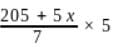
Let the number of defective green marbles be 3x and that of defective blue marbles be 5x.

We know that the number of non-defective blue marbles is 140% of the number of non-defective green marbles.
Therefore, ratio of the number of non-defective blue marbles to that of non-defective green marbles = 7 : 5
Number of non-defective blue marbles = 205 + 5x

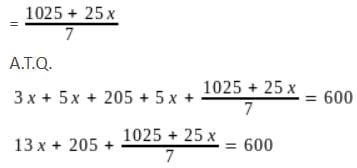
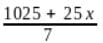
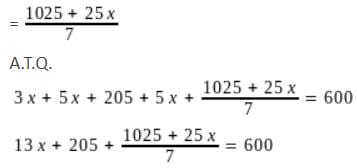
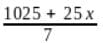
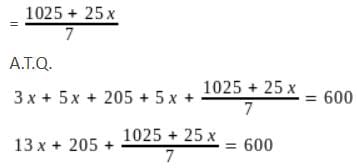
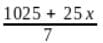
Number of non-defective green marbles = 

91x + 1435 + 1025 + 25x = 4200
116x + 2460 = 4200
116x = 4200 – 2460
116x = 1740
x = 1740 ÷ 116
x = 15

Number of defective green marbles = 3x = 45

Number of defective blue marbles = 5x = 75

Number of non-defective blue marbles = 205 + 5x
= 280

Number of non-defective green marbles = 
= 200

Required difference = 200 – 45
= 155
Hence, answer option 2 is correct.

Test: CLAT Mock Test - 1 - Question 15

Directions: Read the following information carefully and answer the given question.

There are 600 marbles in a bag. The bag contains green and blue marbles. Some of the marbles in the bag are defected. The ratio of the number of defective green to blue marbles in the bag is 3 : 5, respectively. The number of non-defective blue marbles is 140% of the number of non-defective green marbles. The number of non-defective blue marbles is 205 more than that of defective blue marbles.

Q. What is the ratio of the number of defective green marbles to the number of non-defective blue marbles?

Detailed Solution: Question 15
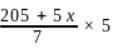
Let the number of defective green marbles be 3x and that of defective blue marbles be 5x.

We know that the number of non-defective blue marbles is 140% of the number of non-defective green marbles.
Therefore, ratio of the number of non-defective blue marbles to that of non-defective green marbles = 7 : 5
Number of non-defective blue marbles = 205 + 5x

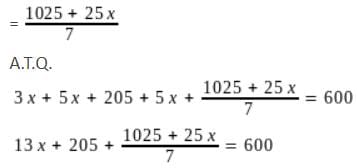
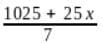
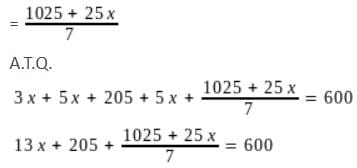
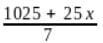
Number of non-defective green marbles = 

91x + 1435 + 1025 + 25x = 4200
116x + 2460 = 4200
116x = 4200 – 2460
116x = 1740
x = 1740 ÷ 116
x = 15

Number of defective green marbles = 3x = 45

Number of defective blue marbles = 5x = 75

Number of non-defective blue marbles = 205 + 5x
= 280

Number of non-defective green marbles = 

= 200

Required ratio = 45 : 280
= 9 : 56
Hence, answer option 2 is correct.

Test: CLAT Mock Test - 1 - Question 16

Directions: Read the following information carefully and answer the given question.

There are 600 marbles in a bag. The bag contains green and blue marbles. Some of the marbles in the bag are defected. The ratio of the number of defective green to blue marbles in the bag is 3 : 5, respectively. The number of non-defective blue marbles is 140% of the number of non-defective green marbles. The number of non-defective blue marbles is 205 more than that of defective blue marbles.

Q. What percent of green marbles are defected?

Detailed Solution: Question 16
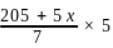
Let the number of defective green marbles be 3x and that of defective blue marbles be 5x.

We know that the number of non-defective blue marbles is 140% of the number of non-defective green marbles.
Therefore, ratio of the number of non-defective blue marbles to that of non-defective green marbles = 7 : 5
Number of non-defective blue marbles = 205 + 5x

Number of non-defective green marbles = 

91x + 1435 + 1025 + 25x = 4200
116x + 2460 = 4200
116x = 4200 – 2460
116x = 1740
x = 1740 ÷ 116
x = 15

Number of defective green marbles = 3x = 45

Number of defective blue marbles = 5x = 75

Number of non-defective blue marbles = 205 + 5x
= 280

Number of non-defective green marbles = 

= 200

Required percentage = 

Hence, answer option 2 is correct.

Test: CLAT Mock Test - 1 - Question 17

Directions: Read the following information carefully and answer the given question.

There are 600 marbles in a bag. The bag contains green and blue marbles. Some of the marbles in the bag are defected. The ratio of the number of defective green to blue marbles in the bag is 3 : 5, respectively. The number of non-defective blue marbles is 140% of the number of non-defective green marbles. The number of non-defective blue marbles is 205 more than that of defective blue marbles.

Q. What percent of the total marbles are defective blue marbles?

Detailed Solution: Question 17
Let the number of defective green marbles be 3x and that of defective blue marbles be 5x.

We know that the number of non-defective blue marbles is 140% of the number of non-defective green marbles.
Therefore, ratio of the number of non-defective blue marbles to that of non-defective green marbles = 7 : 5
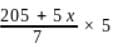
Number of non-defective blue marbles = 205 + 5x

Number of non-defective green marbles = 

91x + 1435 + 1025 + 25x = 4200
116x + 2460 = 4200
116x = 4200 – 2460
116x = 1740
x = 1740 ÷ 116
x = 15

Number of defective green marbles = 3x = 45

Number of defective blue marbles = 5x = 75

Number of non-defective blue marbles = 205 + 5x
= 280

Number of non-defective green marbles = 

= 200

Required percentage == 12.5%
Hence, answer option 1 is correct.

Test: CLAT Mock Test - 1 - Question 18

Directions: Read the following information carefully and answer the given question.

There are 600 marbles in a bag. The bag contains green and blue marbles. Some of the marbles in the bag are defected. The ratio of the number of defective green to blue marbles in the bag is 3 : 5, respectively. The number of non-defective blue marbles is 140% of the number of non-defective green marbles. The number of non-defective blue marbles is 205 more than that of defective blue marbles.

Q. If the price of each marble was Rs. 1.5, how much worth of marbles were defected?

Detailed Solution: Question 18
Let the number of defective green marbles be 3x and that of defective blue marbles be 5x.

We know that the number of non-defective blue marbles is 140% of the number of non-defective green marbles.
Therefore, ratio of the number of non-defective blue marbles to that of non-defective green marbles = 7 : 5
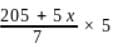
Number of non-defective blue marbles = 205 + 5x

Number of non-defective green marbles = 

91x + 1435 + 1025 + 25x = 4200
116x + 2460 = 4200
116x = 4200 – 2460
116x = 1740
x = 1740 ÷ 116
x = 15

Number of defective green marbles = 3x = 45

Number of defective blue marbles = 5x = 75

Number of non-defective blue marbles = 205 + 5x
= 280

Number of non-defective green marbles = 

= 200

Required amount = Rs. 1.5 × 120 = Rs. 180
Hence, answer option 4 is correct.

Test: CLAT Mock Test - 1 - Question 19

What amount did Chirag pay?

Detailed Solution: Question 19

The amount paid by Rahul was 12.50% of the combined amount paid by all six of them.

Rahul paid = 12.50% of 16,000 = Rs. 2,000

The amount paid by Kushal was 33.33% of the combined amount paid by the other five persons.

33.33% = 1/3

Let the other 5 persons spent = 3x

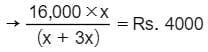
Kushal spent = x

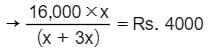
So amount spent by Kushal

The amount paid by Subhojeet was 40% less than the amount paid by Anant. The amount paid by Chirag was Rs. 2224 less than the amount paid by Anant.

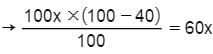
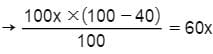
Let Anant paid → 100x

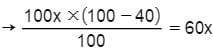
Shubhojeet paid

Chirag paid = 100x – 2,224

The amount paid by Chirag was 25% of the amount that Dhananjay paid.

Dhananjay paid

So, the combined amount paid by all six of them:

2,000 + 4,000 + 100x + 60x + 100x – 2,224 + 400x – 8,896 = 16,000

660x = 21,120

x = 32

So,

Anant paid → 100x = 100 × 32 = 3,200

Shubhojeet paid → 60x = 60 × 32 = 1,920

Chirag paid = 100x – 2,224 = 100 × 32 – 2,224 = 976

Dhananjay paid → 400x – 8,896 = 400 × 32 – 8,896 = 3,904

Test: CLAT Mock Test - 1 - Question 20

The amount paid by Rahul is what percentage of the amount paid by Anant?

Detailed Solution: Question 20

From the common explanation, we have


Hence, Option D is correct.

Common explanation :

The amount paid by Rahul was 12.50% of the combined amount paid by all six of them.

Rahul paid = 12.50% of 16,000 = Rs. 2,000

The amount paid by Kushal was 33.33% of the combined amount paid by the other five persons.
33.33% = 1/3
Let the other 5 persons spent = 3x
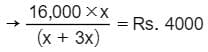
Kushal spent = x
So amount spent by Kushal

The amount paid by Subhojeet was 40% less than the amount paid by Anant. The amount paid by Chirag was Rs. 2224 less than the amount paid by Anant.

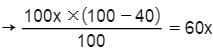
Let Anant paid → 100x

Shubhojeet paid

Chirag paid = 100x – 2,224

The amount paid by Chirag was 25% of the amount that Dhananjay paid.

Dhananjay paid

So, the combined amount paid by all six of them:

2,000 + 4,000 + 100x + 60x + 100x – 2,224 + 400x – 8,896 = 16,000

660x = 21,120

x = 32

So,

Anant paid → 100x = 100 × 32 = 3,200

Shubhojeet paid → 60x = 60 × 32 = 1,920

Chirag paid = 100x – 2,224 = 100 × 32 – 2,224 = 976

Dhananjay paid → 400x – 8,896 = 400 × 32 – 8,896 = 3,904

Test: CLAT Mock Test - 1 - Question 21

Who paid the second highest amount among the six?

Detailed Solution: Question 21

From the common explanation, we have
Dhananjay paid the second highest amount.
Hence, Option B is correct.
Common explanation :
The amount paid by Rahul was 12.50% of the combined amount paid by all six of them.
Rahul paid = 12.50% of 16,000 = Rs. 2,000
The amount paid by Kushal was 33.33% of the combined amount paid by the other five persons.
33.33% = 1/3
Let the other 5 persons spent = 3x
Kushal spent = x
So amount spent by Kushal

The amount paid by Subhojeet was 40% less than the amount paid by Anant. The amount paid by Chirag was Rs. 2224 less than the amount paid by Anant.
Let Anant paid → 100x
Shubhojeet paid

Chirag paid = 100x – 2,224

The amount paid by Chirag was 25% of the amount that Dhananjay paid.

Dhananjay paid

So, the combined amount paid by all six of them:
2,000 + 4,000 + 100x + 60x + 100x – 2,224 + 400x – 8,896 = 16,000
660x = 21,120
x = 32
So,
Anant paid → 100x = 100 × 32 = 3,200
Shubhojeet paid → 60x = 60 × 32 = 1,920
Chirag paid = 100x – 2,224 = 100 × 32 – 2,224 = 976
Dhananjay paid → 400x – 8,896 = 400 × 32 – 8,896 = 3,904

Test: CLAT Mock Test - 1 - Question 22

What is the difference between the amounts paid by Rahul and Dhananjay?

Detailed Solution: Question 22
From the common explanation, we have
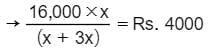
Reqd. difference = 3904 – 2000 = Rs. 1904
Hence, Option C is correct.
Common explanation :
The amount paid by Rahul was 12.50% of the combined amount paid by all six of them.
Rahul paid = 12.50% of 16,000 = Rs. 2,000

The amount paid by Kushal was 33.33% of the combined amount paid by the other five persons.
33.33% = 1/3
Let the other 5 persons spent = 3x
Kushal spent = x
So amount spent by Kushal

The amount paid by Subhojeet was 40% less than the amount paid by Anant. The amount paid by Chirag was Rs. 2224 less than the amount paid by Anant.
Let Anant paid → 100x
Shubhojeet paid

Chirag paid = 100x – 2,224
The amount paid by Chirag was 25% of the amount that Dhananjay paid.
Dhananjay paid

So, the combined amount paid by all six of them:
2,000 + 4,000 + 100x + 60x + 100x – 2,224 + 400x – 8,896 = 16,000
660x = 21,120
x = 32
So,
Anant paid → 100x = 100 × 32 = 3,200
Shubhojeet paid → 60x = 60 × 32 = 1,920
Chirag paid = 100x – 2,224 = 100 × 32 – 2,224 = 976
Dhananjay paid → 400x – 8,896 = 400 × 32 – 8,896 = 3,904

Test: CLAT Mock Test - 1 - Question 23

Which principle is highlighted by the EU’s approach to cybersecurity in the passage?

Detailed Solution: Question 23

The EU’s Cyber Resilience Directive enforces minimum cybersecurity standards, demonstrating a preventive and legally binding approach that strengthens resilience against attacks.

Test: CLAT Mock Test - 1 - Question 24

Based on the passage, why might AI and IoT integration increase cyber risks? 

Detailed Solution: Question 24

AI and IoT devices create new attack vectors and interconnected systems, making it easier for malware or hackers to exploit vulnerabilities and trigger cascading failures.

Test: CLAT Mock Test - 1 - Question 25

What can be inferred about the role of public awareness campaigns in cybersecurity? 

Detailed Solution: Question 25

Public awareness campaigns educate citizens on safe online practices, supporting technical and regulatory measures to reduce risks effectively.

Test: CLAT Mock Test - 1 - Question 26

If a country ignores employee training in cybersecurity, what is the likely consequence according to the passage’s logic? 

Detailed Solution: Question 26

Employee training is essential to strengthen defenses, and neglecting it leaves systems more vulnerable to cyberattacks.

Test: CLAT Mock Test - 1 - Question 27

What underlying risk principle does the European power grid attack illustrate? 

Detailed Solution: Question 27

The malware exploited weak systems and caused blackouts across multiple countries, showing that interconnected infrastructures amplify the impact of attacks.

Test: CLAT Mock Test - 1 - Question 28

Why might state-backed cyberattacks be particularly concerning for international cooperation? 

Detailed Solution: Question 28

Potential state sponsorship raises concerns about trust between nations and can escalate geopolitical tensions, affecting collaboration in critical sectors.

Test: CLAT Mock Test - 1 - Question 29

The high seas are defined as the waters that are ……… nautical miles from any national jurisdiction. 

Detailed Solution: Question 29

According to UNCLOS, a country’s Exclusive Economic Zone (EEZ) extends up to 200 nautical miles from its coast. Waters beyond this limit are considered high seas, beyond any national jurisdiction.

Test: CLAT Mock Test - 1 - Question 30

Which of the following is true for high seas? 

Detailed Solution: Question 30

The passage states that two-thirds of the world's oceans are international waters, meaning countries can fish, ship, and conduct research there. Only a small proportion had legal protection prior to the treaty.

View more questions
1 videos|44 docs|71 tests
Information about Test: CLAT Mock Test - 1 Page
In this test you can find the Exam questions for Test: CLAT Mock Test - 1 solved & explained in the simplest way possible. Besides giving Questions and answers for Test: CLAT Mock Test - 1, EduRev gives you an ample number of Online tests for practice
1 videos|44 docs|71 tests
Download as PDF