NEET Exam  >  NEET Test  >  Biology Class 11  >  Test: Neural Control & Coordination - 2 - NEET MCQ

Neural Control & Coordination - 2 - Free MCQ Practice Test with solutions,


MCQ Practice Test & Solutions: Test: Neural Control & Coordination - 2 (20 Questions)

You can prepare effectively for NEET Biology Class 11 with this dedicated MCQ Practice Test (available with solutions) on the important topic of "Test: Neural Control & Coordination - 2". These 20 questions have been designed by the experts with the latest curriculum of NEET 2026, to help you master the concept.

Test Highlights:

  • - Format: Multiple Choice Questions (MCQ)
  • - Duration: 20 minutes
  • - Number of Questions: 20

Sign up on EduRev for free to attempt this test and track your preparation progress.

Test: Neural Control & Coordination - 2 - Question 1

Which part of the neuron receives incoming signals from other cells?

Detailed Solution: Question 1

Dendrites are structures on neurons that receive electrical messages. These messages are the basis for neurons communicating with each other.

Topic in NCERT: NEURON AS STRUCTURAL AND FUNCTIONAL UNIT OF NEURAL SYSTEM

Line in NCERT: "Dendrites transmit impulses towards the cell body."
Test: Neural Control & Coordination - 2 - Question 2

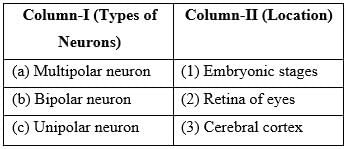
Match the following columns

Detailed Solution: Question 2

Based on the number of axon and dendrites, the neurons are divided into three types, i.e., multipolar (with one axon and two or more dendrites; found in the cerebral cortex), bipolar (with one axon and one dendrite, found in the retina of eye) and unipolar (cell body with one axon only; found usually in the embryonic stage).

Test: Neural Control & Coordination - 2 - Question 3

How do ions contribute to the resting potential of a neuron?

Detailed Solution: Question 3

The resting potential of a neuron is maintained by a high concentration of potassium ions inside and sodium ions outside the cell, facilitated by the sodium-potassium pump.

Topic in NCERT: Generation and Conduction of Nerve Impulse

Line in NCERT: "Consequently, the axoplasm inside the axon contains high concentration of K* and negatively charged proteins and low concentration of Na*. In contrast, the fluid outside the axon contains a low concentration of K*, a high concentration of Na* and thus form a concentration gradient."

Test: Neural Control & Coordination - 2 - Question 4

Which neurons transmit impulses towards the central nervous system?

Detailed Solution: Question 4

Afferent neurons, also known as sensory neurons, carry nerve impulses from sensory stimuli towards the central nervous system.

Topic in NCERT: PERIPHERAL NERVOUS SYSTEM

Line in NCERT: "The afferent nerve fibres transmit impulses from tissues/organs to the CNS and the efferent fibres transmit regulatory impulses from the CNS to the concerned peripheral tissues/organs."

Test: Neural Control & Coordination - 2 - Question 5

What type of cells are neurons in terms of their membrane potential?

Detailed Solution: Question 5

Neurons are excitable cells because their membranes can rapidly change their state in response to stimuli, shifting between polarized and depolarized states.

Topic in NCERT: Generation and Conduction of Nerve Impulse

Line in NCERT: "Neurons are excitable cells because their membranes are in a polarised state."

Test: Neural Control & Coordination - 2 - Question 6

What occurs during the depolarization phase of an action potential?

Detailed Solution: Question 6

During depolarization, sodium ions flood into the neuron, reversing the polarity of the membrane at that site.

Topic in NCERT: Transmission of Impulses

Line in NCERT: "The membrane at the site A becomes freely permeable to Na*. This leads to a rapid influx of Na* followed by the reversal of the polarity at that site, i.e., the outer surface of the membrane becomes negatively charged and the inner side becomes positively charged."

Test: Neural Control & Coordination - 2 - Question 7

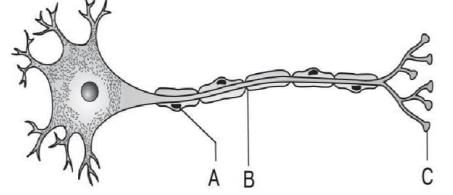
Refer to the given diagram of the structure of a neuron and identify A, B and C.
Detailed Solution: Question 7
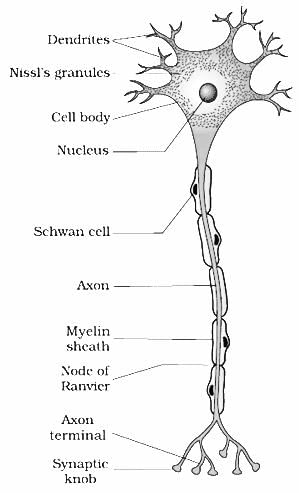

Topic in NCERT: NEURON AS STRUCTURAL AND FUNCTIONAL UNIT OF NEURAL SYSTEM
Line in NCERT: " A neuron is a microscopic structure composed of three major parts, namely, cell body, dendrites and axon."

Test: Neural Control & Coordination - 2 - Question 8

Assertion: The dendrites of neurons can receive signals from other neurons.
Reason: A multipolar neuron contains numerous axons.

Detailed Solution: Question 8

Assertion: The dendrites of neurons can receive signals from other neurons is true. They have specialized structures for this function and are crucial for the transmission of neural signals to the neuron's cell body and then to axon, axon receive signals from dendrites
Reason: A multipolar neuron contains numerous axons. This is false. A multipolar neuron typically has one axon and multiple dendrites, not numerous axons.
Thus, the correct answer is Option C.

Test: Neural Control & Coordination - 2 - Question 9

What type of synapse allows for direct flow of electrical signals between neurons?

Detailed Solution: Question 9

Electrical synapses allow electric currents to directly pass from one neuron to another, facilitating faster communication.

Topic in NCERT: Transmission of Impulses

Line in NCERT: "At electrical synapses, the membranes of pre- and post-synaptic neurons are in very close proximity. Electrical current can flow directly from one neuron into the other across these synapses."

Test: Neural Control & Coordination - 2 - Question 10

What is the main function of the autonomic nervous system?

Detailed Solution: Question 10

The autonomic nervous system regulates involuntary bodily functions, such as heart rate, digestion, and respiratory rate.

Topic in NCERT: Autonomic Neural System

Line in NCERT: "The autonomic neural system transmits impulses from the CNS to the involuntary organs and smooth muscles of the body."

Test: Neural Control & Coordination - 2 - Question 11

What is the function of Schwann cells in the peripheral nervous system?

Detailed Solution: Question 11

Schwann cells are essential for the insulation of myelinated nerve fibers in the peripheral nervous system, and they also aid in the repair of damaged nerves.

Topic in NCERT: Structure and Function of Neurons

Line in NCERT: "Unmyelinated nerve fibre is enclosed by a Schwann cell that does not form a myelin sheath around the axon."

Test: Neural Control & Coordination - 2 - Question 12

What establishes the resting potential of a neuron?

Detailed Solution: Question 12

The resting potential is established by the concentration gradient of ions across the neuron's membrane, maintained by the sodium-potassium pump.

Topic in NCERT: NEURAL CONTROL AND COORDINATION

Line in NCERT: "The electrical potential difference across the resting plasma membrane is called as the resting potential."

Test: Neural Control & Coordination - 2 - Question 13

What is the role of the limbic system in the brain?

Detailed Solution: Question 13

The limbic system is involved in various emotional responses, sexual behavior, and motivation, contributing to the psychological and behavioral aspects of the organism.

Topic in NCERT: Limbic System

Line in NCERT: "The inner parts of cerebral hemispheres and a group of associated deep structures like amygdala, hippocampus, etc., form a complex structure called the limbic lobe or limbic system. Along with the hypothalamus, it is involved in the regulation of sexual behaviour, expression of emotional reactions (e.g., excitement, pleasure, rage and fear), and motivation."

Test: Neural Control & Coordination - 2 - Question 14

What is the function of the myelin sheath in a myelinated nerve fiber?

Detailed Solution: Question 14

The myelin sheath provides electrical insulation and increases the speed at which impulses propagate along the myelinated fiber due to saltatory conduction.

Topic in NCERT: Unmyelinated Nerve Fibres

Line in NCERT: "Unmyelinated nerve fibre is enclosed by a Schwann cell that does not form a myelin sheath around the axon."

Test: Neural Control & Coordination - 2 - Question 15

What is the main role of the cerebellum in the human brain?

Detailed Solution: Question 15

The cerebellum primarily handles motor control and balance, coordinating voluntary movements such as posture, balance, coordination, and speech.

Topic in NCERT: Hindbrain

Line in NCERT: "The cerebellum integrates information received from the semicircular canals of the ear and the auditory system."

Test: Neural Control & Coordination - 2 - Question 16

Which part of the human brain is responsible for regulating thirst and hunger?

Detailed Solution: Question 16

The hypothalamus is involved in various functions of the body including the regulation of thirst and hunger.

Topic in NCERT: Forebrain

Line in NCERT: "The hypothalamus controls the body temperature, eating and drinking."

Test: Neural Control & Coordination - 2 - Question 17

What is the role of neurotransmitters in a chemical synapse?

Detailed Solution: Question 17

In chemical synapses, neurotransmitters are crucial for transmitting signals from one neuron to the next across the synaptic cleft.

Topic in NCERT: Transmission of Impulses

Line in NCERT: "Chemicals called neurotransmitters are involved in the transmission of impulses at these synapses."

Test: Neural Control & Coordination - 2 - Question 18

Five events in the transmission of nerve impulse across the synapse are given–
A. Opening of specific ion channels allows the entry of ions, a new action potential is generated in the post synaptic neuron.
B. Neurotransmitter binds to the receptor on post synaptic membrane
C. Synaptic vesicle fuses with pre-synaptic membrane, neurotransmitter releases into synaptic cleft
D. Depolarization of pre-synaptic membrane
E. Arrival of action potential at axon terminal.
In which sequence do these events occur?

Detailed Solution: Question 18

E → Arrival of action potential at axon terminal:

  • The transmission begins with an action potential (an electrical signal) traveling along the axon to the axon terminal (presynaptic membrane).

D → Depolarization of pre-synaptic membrane:

  • When the action potential reaches the axon terminal, it causes the pre-synaptic membrane to depolarize. This means the membrane potential changes, which triggers further steps.

C → Synaptic vesicle fuses with pre-synaptic membrane, neurotransmitter releases into synaptic cleft:

  • Depolarization opens voltage-gated calcium channels, allowing calcium ions (Ca++) to flow into the axon terminal. This calcium influx causes synaptic vesicles, which contain neurotransmitters, to fuse with the pre-synaptic membrane. The neurotransmitter is then released into the synaptic cleft (the space between the two neurons).

B → Neurotransmitter binds to the receptor on post-synaptic membrane:

  • The released neurotransmitter diffuses across the synaptic cleft and binds to specific receptors on the post-synaptic membrane of the next neuron (the receiving neuron).

A → Opening of specific ion channels allows the entry of ions, a new action potential is generated in the post-synaptic neuron:

  • The binding of the neurotransmitter to receptors causes ion channels in the post-synaptic membrane to open. This leads to the entry of ions (like sodium, Na+) into the post-synaptic neuron, depolarizing it and generating a new action potential, continuing the transmission of the nerve signal.

Thus, the correct sequence of events is:
E → D → C → B → A
Topic in NCERT: Transmission of Impulses
Line in NCERT: "When an impulse (action potential) arrives at the axon terminal, it stimulates the movement of the synaptic vesicles towards the membrane where they fuse with the plasma membrane and release their neurotransmitters in the synaptic cleft. The released neurotransmitters bind to their specific receptors, present on the post-synaptic membrane. This binding opens ion channels allowing the entry of ions which can generate a new potential in the post-synaptic neuron."

Test: Neural Control & Coordination - 2 - Question 19

Which structure connects the two hemispheres of the cerebrum?

Detailed Solution: Question 19

The corpus callosum is a band of nerve fibers that connects the two cerebral hemispheres, facilitating communication between them.

Topic in NCERT: Forebrain

Line in NCERT: "The hemispheres are connected by a tract of nerve fibres called corpus callosum."

Test: Neural Control & Coordination - 2 - Question 20

Which brain structure is responsible for processing visual and auditory information?

Detailed Solution: Question 20

The midbrain plays a crucial role in processing auditory and visual sensory information.

Topic in NCERT: Midbrain

Line in NCERT: "The midbrain receives and integrates visual, tactile and auditory inputs."

142 videos|410 docs|135 tests
Information about Test: Neural Control & Coordination - 2 Page
In this test you can find the Exam questions for Test: Neural Control & Coordination - 2 solved & explained in the simplest way possible. Besides giving Questions and answers for Test: Neural Control & Coordination - 2, EduRev gives you an ample number of Online tests for practice
142 videos|410 docs|135 tests
Download as PDF