NEET Exam  >  NEET Test  >  Chemistry Class 11  >  Test: Periodic Table & Trends - NEET MCQ

Periodic Table & Trends - Free MCQ Practice Test with solutions, NEET Chemistry


MCQ Practice Test & Solutions: Test: Periodic Table & Trends (22 Questions)

You can prepare effectively for NEET Chemistry Class 11 with this dedicated MCQ Practice Test (available with solutions) on the important topic of "Test: Periodic Table & Trends". These 22 questions have been designed by the experts with the latest curriculum of NEET 2026, to help you master the concept.

Test Highlights:

  • - Format: Multiple Choice Questions (MCQ)
  • - Duration: 22 minutes
  • - Number of Questions: 22

Sign up on EduRev for free to attempt this test and track your preparation progress.

Test: Periodic Table & Trends - Question 1

f block of the Periodic Table consists of

Detailed Solution: Question 1

Lanthanides, Ce(Z = 58) ñ Lu(Z = 71) and Actinoids comprises of f block elements.

Test: Periodic Table & Trends - Question 2

The elements charecterised by the filling of 4 f-orbitals, are:

Detailed Solution: Question 2

Elements characterized by the filling of 4f orbitals are known as lanthanides or lanthanoids. These elements belong to the f-block of the periodic table and include:

  • Cerium (Ce)
  • Praseodymium (Pr)
  • Neodymium (Nd)
  • Promethium (Pm)
  • Samarium (Sm)
  • Europium (Eu)
  • Gadolinium (Gd)
  • Terbium (Tb)
  • Dysprosium (Dy)
  • Holmium (Ho)
  • Erbium (Er)
  • Thulium (Tm)
  • Ytterbium (Yb)
  • Lutetium (Lu)

The term 'lanthanides' specifically refers to this series, ensuring clarity in understanding their position in the periodic table.

Test: Periodic Table & Trends - Question 3

An element belongs to Group 15 and third period of the periodic table. Its electronic configuration will be

Detailed Solution: Question 3

group is 15 so total valence electrons will be 5 while period is 3rd so n value of valence shell will be 3.

Test: Periodic Table & Trends - Question 4

It is now recognized that the ‘Modern Periodic Law’ is essentially the consequence of the

Detailed Solution: Question 4

Modern periodic law is essentially the result of periodic variation and electronic configuration.

Test: Periodic Table & Trends - Question 5

Metalloids show the properties of

Detailed Solution: Question 5

Metalloids exhibit properties that are intermediate between metals and nonmetals. They share some characteristics with metals, such as:

  • Being solid at room temperature
  • Having a metallic appearance

However, they also exhibit nonmetallic properties, including:

  • Poor electrical conductivity compared to metals

Examples of metalloids include:

  • Boron
  • Silicon
  • Germanium

These elements display this dual nature in their physical and chemical behaviours.

Test: Periodic Table & Trends - Question 6

Among the alkali metals cesium is the most reactive because

Detailed Solution: Question 6

Among the alkali metals cesium is the most reactive because the outermost electron is more loosely bound than the outermost electron of the other alkali metals.

Test: Periodic Table & Trends - Question 7

In which one of the given formulae of xenon compounds there are five σ−bonds and three π-bonds in it?


Detailed Solution: Question 7
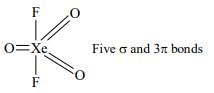
In XeF₂O₃, xenon forms a total of five sigma (σ) bonds – two bonds with fluorine atoms and three bonds with oxygen atoms. Moreover, three of the Xe–O bonds also form π bonds due to the effective overlap between xenon’s d orbitals and oxygen’s p orbitals. 

Test: Periodic Table & Trends - Question 8

In the modern periodic table

Detailed Solution: Question 8

In the modern periodic table, the horizontal rows are known as periods, and the vertical columns are referred to as groups.

This structure organises elements based on their:

  • Atomic number
  • Chemical properties

In this context:

  • Periods represent the principal quantum number.
  • Groups indicate similar valence electron configurations.

Test: Periodic Table & Trends - Question 9

Which of the following statements is false?

Detailed Solution: Question 9

Alkali metals typically form ionic bonds with non-metals like oxygen, resulting in ionic compounds such as oxides (e.g., Na2O). They do not generally form covalent bonds with oxygen.

Therefore, statement A is false because alkali metals primarily form ionic bonds when reacting with oxygen, not covalent ones.

Test: Periodic Table & Trends - Question 10

The order of Decreasing radius is

Detailed Solution: Question 10

The correct order of decreasing radius is:

  • Van der Waals' radius > Metallic radius > Covalent radius.

Explanation:

  • Van der Waals' Radius: This is the largest as it includes the distance between two atoms when they are in contact, encompassing both covalent or metallic radii and additional space due to electron clouds.
  • Metallic Radius: Smaller than Van der Waals', it measures the radius of an atom in a metallic crystal structure, where electrons are delocalised but not as tightly packed as in covalent bonds.
  • Covalent Radius: The smallest, as it measures the distance from the nucleus to the bonding electron pair shared with another atom in a covalent bond.

Thus, the correct order is Van der Waals' radius > Metallic radius > Covalent radius.

Test: Periodic Table & Trends - Question 11

For alkali metals, which one of the following trends is INCORRECT?

Detailed Solution: Question 11

Density: Li < Na < K < Rb.
The density of K is lower than that of Na. Thus, option D is incorrect. The correct trend is
Li < K < Na < Rb

Test: Periodic Table & Trends - Question 12

Dmitri Mendeleev (1834-1907) and the German chemist, Lothar Meyer (1830-1895) proposed arranging elements in

Detailed Solution: Question 12

Dmitri Mendeleev and Lothar Meyer proposed arranging elements in 1. increasing order of their atomic weights. This arrangement eventually led to the development of the periodic table of elements.

Test: Periodic Table & Trends - Question 13

According to the recommendation of International Union of Pure and Applied Chemistry (IUPAC), the groups in the modern periodic table are numbered from

Detailed Solution: Question 13

The groups in the modern periodic table are numbered from 1 to 18 according to IUPAC recommendations. This includes:

  • Group 1: Alkali metals
  • Group 18: Noble gases

Test: Periodic Table & Trends - Question 14

Ionization enthalpy increases across a period because

Detailed Solution: Question 14

as we move from left to right in a period atomic radii decreases and due to effective nuclear charge outermost electrons are held more closely to the nucleus.

Test: Periodic Table & Trends - Question 15

Choose one of the following in th increasing order of bond length

Detailed Solution: Question 15
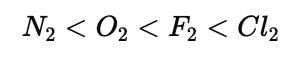
  1. N2​: Triple bond → Shortest bond length.
  2. O2: Double bond → Shorter bond length than single bonds.
  3. F2: Single bond, but shorter than Clbecause fluorine atoms are smaller.
  4. Cl2​: Single bond → Longest bond length due to larger atomic size.

Correct Order (Increasing Bond Length): 

Test: Periodic Table & Trends - Question 16

For the four successive transition elements (Cr, Mn, Fe and Co), the stability of + 2 oxidation state will be there in which of the following order? (At. nos. Cr = 24, Mn = 25, Fe = 26, Co = 27)

Detailed Solution: Question 16

The stability of an oxidation state depends on electronic configuration after ionization.

For transition metals, when forming +2 oxidation state, they lose two 4s electrons first.

  • Cr (Z = 24): Ground state = [Ar] 3d5 4s1
    Cr2+ = [Ar] 3d4 → unstable (not half-filled)

  • Mn (Z = 25): Ground state = [Ar] 3d5 4s2
    Mn2+ = [Ar] 3d5half-filled d5 (most stable)

  • Fe (Z = 26): Ground state = [Ar] 3d6 4s2
    Fe2+ = [Ar] 3d6 → fairly stable

  • Co (Z = 27): Ground state = [Ar] 3d7 4s2
    Co2+ = [Ar] 3d7 → less stable compared to Fe2+

Test: Periodic Table & Trends - Question 17

A transition metal ion exists in its highest oxidation state. It is expected to behave as

Detailed Solution: Question 17

When a transition metal ion is in highest oxidation state it tends to lower its oxidation state by gaining electrons. thus it itself reduces and oxidizes the substance from which it accepts electron. So, it acts as oxidising agent. 

Test: Periodic Table & Trends - Question 18

The sequence of ionic mobility in aqueous solution is 

Detailed Solution: Question 18

Smaller the size of cation, higher will be the hydration and its effective size will increase and hence mobility in aqueous solution will decrease. Larger size ions have more ionic mobility due to less hydration. Thus the degree of hydration of M+ ions decreases from Li+ to Cs+. Consequently the radii of the hydrated ion decreases from Li+ to Cs+. Hence the ionic conductance of these hydrated ions increases from Li+ to Cs+ 

Test: Periodic Table & Trends - Question 19

In the periodic table Electronegativity generally

Detailed Solution: Question 19

electronegativity increases on moving from left to right while decreases as we move down the group.

Test: Periodic Table & Trends - Question 20

Generally, the first ionization energy increases along a period. But there are some exceptions. One which is NOT an exception is ______.

Detailed Solution: Question 20

Sodium (Na) has a lower ionisation energy than Magnesium (Mg). The reasons for this are as follows:

  • The removal of an electron from Na requires less energy.
  • This is due to Na's lower effective nuclear charge.
  • Generally, ionisation energy increases across a period.

Therefore, this trend indicates that Na is not an exception to the rule.

Test: Periodic Table & Trends - Question 21

Which of the following will have the most negative electron gain enthalpy and which one the least negative? P, S, Cl, F.

Detailed Solution: Question 21

Cl just need one more electrons to get fully filled electronic configuration so it has most negative electron gain enthalpy while P has d3 configuration which is already stable so it cannot accept one electron extra easily so have large positive electron gain enthalpy.

Test: Periodic Table & Trends - Question 22

For Atomic numbers greater than 100 IUPAC has made recommendation that until a new element ‘s discovery is proved, and its name is officially recognized, a systematic nomenclature be derived directly from the atomic number of the element using the numerical roots for 0 and numbers 1-9. The name 'sept' in this scheme corresponds to the digit

Detailed Solution: Question 22
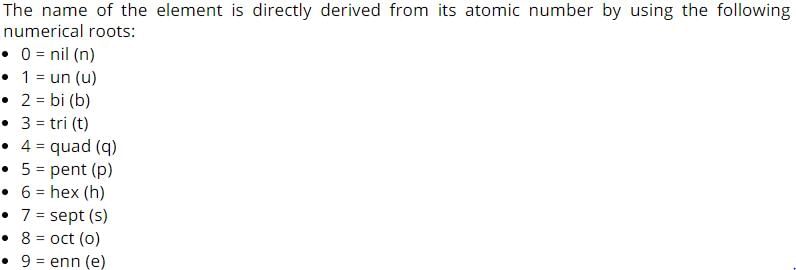
sept is for 7.

96 videos|243 docs|71 tests
Information about Test: Periodic Table & Trends Page
In this test you can find the Exam questions for Test: Periodic Table & Trends solved & explained in the simplest way possible. Besides giving Questions and answers for Test: Periodic Table & Trends, EduRev gives you an ample number of Online tests for practice
96 videos|243 docs|71 tests
Download as PDF