UPSC Exam  >  UPSC Test  >  Science & Technology CSE  >  Test: Alcohols & Carboxylic Acids - UPSC MCQ

Alcohols & Carboxylic Acids - Free MCQ Practice Test with solutions, UPSC


MCQ Practice Test & Solutions: Test: Alcohols & Carboxylic Acids (10 Questions)

You can prepare effectively for UPSC Science & Technology for UPSC CSE with this dedicated MCQ Practice Test (available with solutions) on the important topic of "Test: Alcohols & Carboxylic Acids". These 10 questions have been designed by the experts with the latest curriculum of UPSC 2026, to help you master the concept.

Test Highlights:

  • - Format: Multiple Choice Questions (MCQ)
  • - Duration: 10 minutes
  • - Number of Questions: 10

Sign up on EduRev for free to attempt this test and track your preparation progress.

Test: Alcohols & Carboxylic Acids - Question 1

Aldehydes give carboxylic acids on:

Detailed Solution: Question 1

When an aldehyde is oxidised, the product formed is a carboxylic acid.

Key points to understand this process:

  • Oxidation involves the addition of oxygen or the removal of hydrogen.
  • Aldehydes are converted to carboxylic acids through oxidation.
  • Common oxidising agents include alkaline potassium permanganate and acidified potassium dichromate.

These agents facilitate the transformation by providing the necessary conditions for the reaction.

Test: Alcohols & Carboxylic Acids - Question 2

Which gas is released when ethyl alcohol reacts with sodium?

Detailed Solution: Question 2
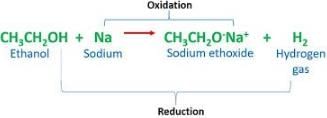
Hydrogen gas is released.

Test: Alcohols & Carboxylic Acids - Question 3

In conversion from ethanol to ethene, concentrated sulphuric acid is used as:

Detailed Solution: Question 3
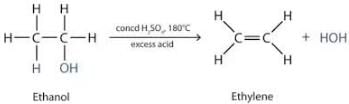
Sulphuric acid is used as a dehydrating agent because sulphuric acid has a great affinity for water. It readily removes elements of water from other compounds i.e, it acts as a dehydrating agent, it being a hygroscopic substance absorbs water from other substances without dissolving in it, so it is considered a good drying agent.

Test: Alcohols & Carboxylic Acids - Question 4

IUPAC name of CH3COOH is:

Detailed Solution: Question 4

Acetic acid, systematically named ethanoic acid, is a colourless liquid organic compound with the chemical formula 
CH3COOH .

Test: Alcohols & Carboxylic Acids - Question 5

Carboxylic acids are:

Detailed Solution: Question 5

Carboxylic acid is a weak acid as it undergoes partial or incomplete dissociation in water.

Test: Alcohols & Carboxylic Acids - Question 6

In the reaction, identify the reactant X.
CH3COOH + X  CH3COOC2H5 + H2O
Ethanoic
acid

Detailed Solution: Question 6
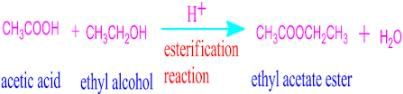
This is an esterification reaction in which a sweet smelling compound ester is formed.

Test: Alcohols & Carboxylic Acids - Question 7

The common name of ethanoic acid is:

Detailed Solution: Question 7

Ethanoic acid is commonly known as acetic acid. It is a carboxylic acid with the chemical formula CH3COOH and is widely recognised for its presence in vinegar, where it contributes to the sour taste and smell.

The other options represent different acids:

  • Formic acid (methanoic acid)
  • Propanoic acid
  • Picric acid (trinitrophenol)

Test: Alcohols & Carboxylic Acids - Question 8

What is removed from ethanol during its dehydration to ethene?

Detailed Solution: Question 8

The dehydration of ethanol to ethene involves the removal of water.

  • This process is a chemical reaction where ethanol loses a water molecule.
  • The reaction typically requires a catalyst, such as concentrated sulphuric acid.
  • During dehydration, ethanol (C2H5OH) is converted into ethene (C2H4), releasing water (H2O).

Test: Alcohols & Carboxylic Acids - Question 9

Which of the following will give a pleasant smell of ester when heated with ethyl alcohol and a small quantity of sulphuric acid?​

Detailed Solution: Question 9

Ethanoic acid reacts with ethanol in the presence of concentrated sulphuric acid as a catalyst to produce the ester, ethyl ethanoate.

Test: Alcohols & Carboxylic Acids - Question 10

Why is ethanoic acid called glacial acetic acid?

Detailed Solution: Question 10

Ethanoic acid is called glacial acetic acid because:

  • It solidifies into a solid form in cold weather, around 16.7°C (62°F).
  • This solid form resembles a glacier, giving rise to the name.

71 videos|498 docs|199 tests
Information about Test: Alcohols & Carboxylic Acids Page
In this test you can find the Exam questions for Test: Alcohols & Carboxylic Acids solved & explained in the simplest way possible. Besides giving Questions and answers for Test: Alcohols & Carboxylic Acids, EduRev gives you an ample number of Online tests for practice
Download as PDF
