CBSE Class 10  >  Class 10 Test  >  Online MCQ Tests  >  Test: Introduction to Arithmetic Progression - Class 10 MCQ

Introduction to Arithmetic Progression - Free MCQ Practice Test with solutions,


MCQ Practice Test & Solutions: Test: Introduction to Arithmetic Progression (20 Questions)

You can prepare effectively for Class 10 Online MCQ Tests for Class 10 with this dedicated MCQ Practice Test (available with solutions) on the important topic of "Test: Introduction to Arithmetic Progression". These 20 questions have been designed by the experts with the latest curriculum of Class 10 2026, to help you master the concept.

Test Highlights:

  • - Format: Multiple Choice Questions (MCQ)
  • - Duration: 20 minutes
  • - Number of Questions: 20

Sign up on EduRev for free to attempt this test and track your preparation progress.

Test: Introduction to Arithmetic Progression - Question 1

What is the 15th term of the arithmetic progression 4, 7, 10, ... ?

Detailed Solution: Question 1

The nth term of an arithmetic progression is given by an = a + (n - 1) × d. Here a = 4, d = 3 and n = 15. So a15 = 4 + (15 - 1) × 3 = 4 + 42 = 46.

Test: Introduction to Arithmetic Progression - Question 2

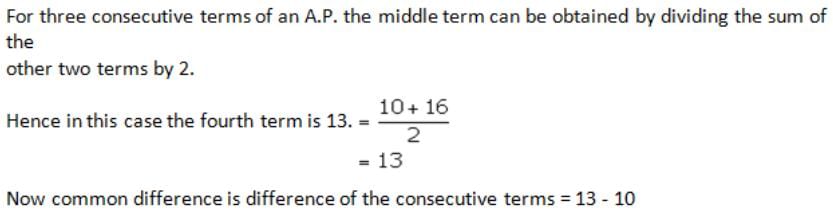
For an A.P. the third and the fifth terms are given as 10 and 16 .What is the fourth term and the common difference?​

Detailed Solution: Question 2

Test: Introduction to Arithmetic Progression - Question 3

If p, q, r, s, t are the terms of an A.P. with common difference -1 the relation between p and t is:​

Detailed Solution: Question 3

p, q, r, s, t are the terms of AP. So a=p , d= -1
To find a relation between t and p we use
l=a+(n-1)d, where l=t and n=5
t=p+(5-1)(-1)=p+4(-1)=p-4
This is because the difference is negative so it will be smaller than p.

Test: Introduction to Arithmetic Progression - Question 4

The weights of 11 students selected for a team are noted in ascending order and are in A. P. The lowest value is 45 Kg, and the middle value is 55 Kg. What is the difference between the two values placed consecutively ?

Detailed Solution: Question 4

as there are 11 students  so 6 th student would be middle one
a=45
a+(6-1)d=55
a+5d=55
45+5d=55
5d=10
d=2

Test: Introduction to Arithmetic Progression - Question 5

Is the sequence, whose general term is 5n2 + 2n + 3 an AP?​

Detailed Solution: Question 5

We have the sequence 5n2+2n+3
It will be in AP if it satisfies an-an-1=d where d is a constant.
Here, an=5n2+2n+3
And, an-1=5(n-1)2+2(n-1)+3=5(n2+1-2n)+2n-2+3
=5n2+5-10n+2n+1=5n2-8n+6
an-an-1=5n2+2n+3-(5n2-8n+6)
=5n2+2n+3-5n2+8n-6
=10n-3, which depends on a variable , so its not constant.

Test: Introduction to Arithmetic Progression - Question 6

Find the next two terms of the A.P.:- -10, -6,-2…

Detailed Solution: Question 6

We have A.P.: -10, -6,-2…
So a= -10, d=-6+10=-2+6=4
l=a+(n-1)d
For fourth term,
 = -10+(3)*4=-10+12=2
For 5th term
 = -10+4*4=6

Test: Introduction to Arithmetic Progression - Question 7

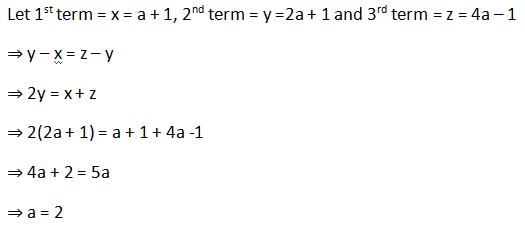
If a + 1, 2a + 1, 4a – 1 are in A.P., then value of ‘a’ is:

Detailed Solution: Question 7
Test: Introduction to Arithmetic Progression - Question 8

Give that an A.P. has term as 5 and common differences as 2. What is the A.p.?​

Detailed Solution: Question 8

A¹=5 d=2
a²=a¹+d =5+2=7
a³=a²+d =7+2 =9
a⁴=a³+d=9+2=11
A5 =a⁴+d=11+2=13
Therefore 5,7,9,11,13 is an AP.

Test: Introduction to Arithmetic Progression - Question 9

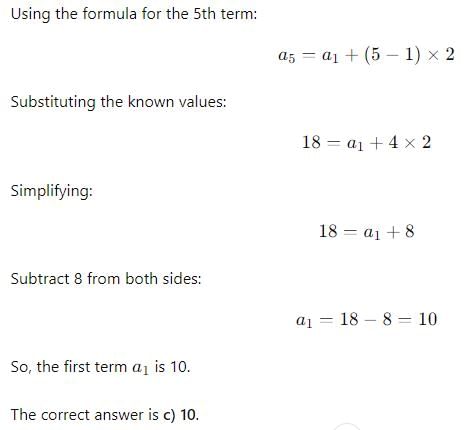
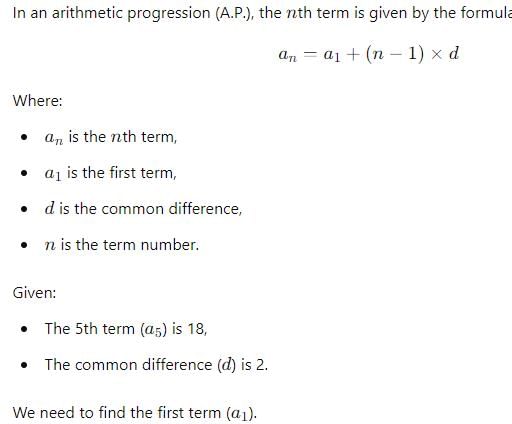
The 5th term of an A.P. is 18, the common difference is 2. What is the first term ?

Detailed Solution: Question 9
Test: Introduction to Arithmetic Progression - Question 10

Ramesh’s salary in February 2008 is Rs. 10,000. If he’s promised an increase of Rs. 1000 every year, what would be his salary in Feb 2011?​

Detailed Solution: Question 10

So this is an AP with a=10,000 , d= 1000
So after 4 years
l=a+(n-1)d=10000+(4 -1)1000=10000+3000=13000

Test: Introduction to Arithmetic Progression - Question 11

Given an A.P. few of whose terms are x, y, 2, 4, 6, 8,………. What must be the values of x and y?​

Detailed Solution: Question 11

Arithmetic progression is a sequence of numbers such that the difference of any two successive members is a constant,d
AP is x, y, 2, 4, 6, 8,…
So we have 4-2=2,6-4=2 so we have d=2
So y=2-2=0
And x=0-2=-2

Test: Introduction to Arithmetic Progression - Question 12

If p – 1, p + 3, 3p – 1 are in A.P., then p is equal to:

Detailed Solution: Question 12

We have given that 
p-1,p+3 , 3p-1 are in A.P 

we have to find p= ? 

solution :- 
we know that : 
if a,b,c are in AP 
then 2b = a + c 

here 
=> 2(p+3) = { (p-1) + ( 3p -1) } 

=> 2p +6 = 4p -2 

=> 2p = 8 

=> p = 4

Test: Introduction to Arithmetic Progression - Question 13

Which of the following is an A.P with -10 as first term and 2 as the common difference?​

Test: Introduction to Arithmetic Progression - Question 14

Amit starts his exercise regime with 25 push ups on Monday. He plans to increase 5 push ups every following Monday. How many push ups will he be doing on the 3rd Monday since he started?​

Detailed Solution: Question 14

On 1st Monday he did 25
on 2nd next he did 25+5=30 
on 3rd Monday he did 30+5=35

Test: Introduction to Arithmetic Progression - Question 15

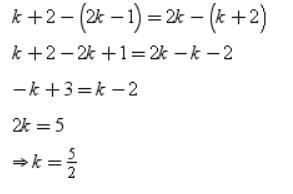
For what values of k can the following numbers form an A.P:2k-1,k+2,2k​

Detailed Solution: Question 15

If  2k-1,k+2,2k are in AP, the difference of two consecutive terms will be same.
Therefore,

Test: Introduction to Arithmetic Progression - Question 16

From an A.P. 5 consecutive terms are required to be written. The central term out of the five terms is given as 5 and it’s informed that the common difference of the A.P. is 4. Write the 5 terms in the correct sequence.​

Detailed Solution: Question 16

AP is:  a,a+d,a+2d,a+3d,a+4d
Middle term is a+2d=5
d=4
a+2d=5
a+2*4=5
a=5-8= -3
a+d= -3+4=1
a+3d= -3+3*4=-3+12=9
a+4d= -3+4*4= -3+16=13
So the terms are : -3,1,5,9,13

Test: Introduction to Arithmetic Progression - Question 17

If 4/5, a, 2 are three consecutive terms of an arithmetic progression, what is the value of a?

  • 7/5
  • 2/5
  • 9/5
  • 1/5

Detailed Solution: Question 17

In an arithmetic progression, the difference between consecutive terms is constant. Thus a minus 4/5 equals 2 minus a. That gives 2a = 2 + 4/5 = 14/5, so a = 7/5.

Test: Introduction to Arithmetic Progression - Question 18

If a - b, 0 and a + b are consecutive terms of an AP then
Test: Introduction to Arithmetic Progression - Question 19

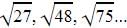
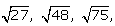
The next term of the A.P. ​ … is:

Detailed Solution: Question 19

AP is 
So a = 
So 

Test: Introduction to Arithmetic Progression - Question 20

The angles of a triangle in A.P. the smallest being half of the greatest. So what are the angles ?​

Detailed Solution: Question 20

Arithmetic progression is a sequence of numbers such that the difference of any two successive members is a constant,d. 
So let the angles be a-d , a and a+d
We are given smallest angle is half of the largest
So, a-d=1/2(a+d)
2(a-d)=a+d
2a-2d=a+d
a=3d
Using angle sum property,
(a-d)+a+(a+d)=180
3a=180
a=60
a=3d
3d=60
d=20
a-d=60-20=40
a=60
a+d=60+20=80
So , the angles are 40,60,80

459 tests
Information about Test: Introduction to Arithmetic Progression Page
In this test you can find the Exam questions for Test: Introduction to Arithmetic Progression solved & explained in the simplest way possible. Besides giving Questions and answers for Test: Introduction to Arithmetic Progression, EduRev gives you an ample number of Online tests for practice
Download as PDF