CBSE Class 9  >  Class 9 Test  >  Mathematics (Maths)   >  Test: Irrational Numbers - Class 9 MCQ

Irrational Numbers - Free MCQ Practice Test with solutions, Class 9 Maths


MCQ Practice Test & Solutions: Test: Irrational Numbers (25 Questions)

You can prepare effectively for Class 9 Mathematics (Maths) Class 9 with this dedicated MCQ Practice Test (available with solutions) on the important topic of "Test: Irrational Numbers". These 25 questions have been designed by the experts with the latest curriculum of Class 9 2026, to help you master the concept.

Test Highlights:

  • - Format: Multiple Choice Questions (MCQ)
  • - Duration: 25 minutes
  • - Number of Questions: 25

Sign up on EduRev for free to attempt this test and track your preparation progress.

Test: Irrational Numbers - Question 1

A number is irrational if and only if its decimal representation is:

Detailed Solution: Question 1

A non-terminating, non-repeating decimal is a decimal number that continues endlessly, with no group of digits repeating endlessly. Decimals of this type cannot be represented as fractions, and as a result, are irrational numbers. Pi is a non-terminating, non-repeating decimal.

Test: Irrational Numbers - Question 2

The product or quotient of a non-zero rational number with an irrational number is:

Detailed Solution: Question 2

The quotient of a non zero rational number with an irrational number will be irrational.

Test: Irrational Numbers - Question 3

A rational number between √3 and √5 is

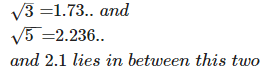
Detailed Solution: Question 3

Test: Irrational Numbers - Question 4

Which of the following statement about real numbers is false ?

Detailed Solution: Question 4

The real numbers are closed under addition and multiplication, meaning that performing these operations on any two real numbers results in another real number. They also satisfy associative, commutative, and distributive properties for these operations.

A. 'It refers to closure under addition and/or multiplication, which are true.

B. Associative law holds for multiplication, which is true.

C. Distributive law holds, which is also true.

D. The phrase 'closed with respect to commutative law of addition' incorrectly applies the concept of closure to a property (commutativity) rather than an operation. Closure pertains to operations like addition or multiplication, not laws describing their behavior.

Answer. D

Solution. Thus, the false statement is in Option D because it misapplies the term 'closure.'

Test: Irrational Numbers - Question 5

(√12 + √10 - √2) is

Detailed Solution: Question 5

The expression  involves the square roots of non-perfect squares (12, 10, and 2), which are irrational numbers.

When you add or subtract irrational numbers like these, the result is generally also an irrational number (unless there is some specific cancellation, which is not the case here).

Thus, the correct answer is:

Option 3: an irrational number

Test: Irrational Numbers - Question 6

The value obtained on simplifying (√5 + √6)2

Detailed Solution: Question 6

(a + b)2 = a2  +  b2  + 2ab
= (√5 + √6)2 
= (√5)2 + (√6)2 + 2(√5)(√6)

= 5 + 6 +2√30

= 11 + 2√30

Test: Irrational Numbers - Question 7

The decimal expansion 0.080080008000080000080000008……. is a

Detailed Solution: Question 7

The decimal expansion 0.080080008000080000080000008... is both non-terminating and non-recurring because it continues infinitely without a repeating cycle.

Test: Irrational Numbers - Question 8

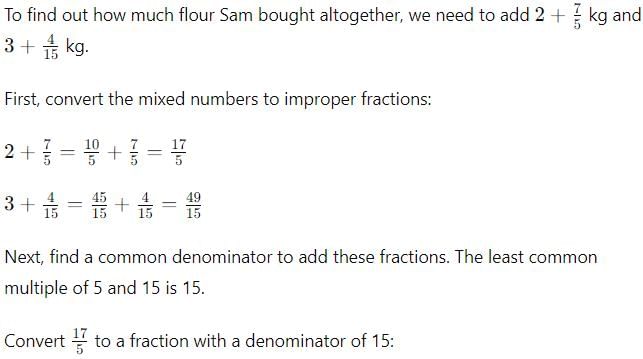
Sam bought 2+7⁄5 kg of flour in one week and 3+4⁄15 kg of flour in second week. The flour Sam bough altogether is

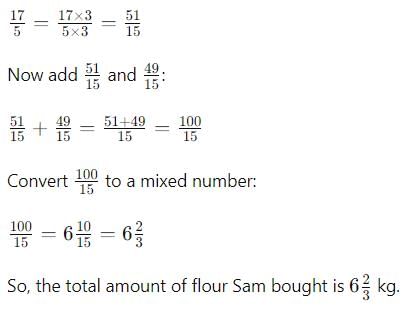
Detailed Solution: Question 8
Test: Irrational Numbers - Question 9

An irrational number between 5/7 and 7/9 is :

Detailed Solution: Question 9

There are infinitely many irrational numbers between 5/7 and 7/9.
5/7 = 0.71428571428 and 7/9 = 0.77777777777
so we have to find a number between these two numbers
(0.7507500075000.... is also an irrational number between 5/7 and 7/9;but it is not the only one;there are many others)

Test: Irrational Numbers - Question 10

Identify the irrational number among these.

Detailed Solution: Question 10

The irrational number among the options is:

√13 is classified as an irrational number because:

  • It cannot be expressed as a fraction of two integers.
  • Its decimal representation is non-repeating and non-terminating.

In contrast, the other options (9, 36, and 25) are all rational numbers because:

  • They can be expressed as fractions (e.g., 9 = 9/1).
  • They have finite decimal representations.

Test: Irrational Numbers - Question 11

On simplifying (√5 + √7)2 we get

Detailed Solution: Question 11

(√5 + √7)2 = (√5)2 + (√7)2 + 2(√5)(√7)

= 5 + 7 + 2√35

= 12 + 2√35

Test: Irrational Numbers - Question 12

The product of two numbers is -20/9. If one of the numbers is 4, find the other. 

Detailed Solution: Question 12

Solution:


  • Let the other number be x.

  • According to the given information, 4*x = -20/9.

  • So, x = -20/9 / 4 = -20/9 * 1/4 = -5/9.


  •  

Test: Irrational Numbers - Question 13

Which of the following is an irrational number ?

Detailed Solution: Question 13

2.31312345…as it has a non terminating non repeating decimal form.

Test: Irrational Numbers - Question 14

Insert one rational number between 2 and 3.​

Detailed Solution: Question 14

A rational number between 2 and 3 =  2 + 3  / 2 = 2.5

Test: Irrational Numbers - Question 15

 = _______.

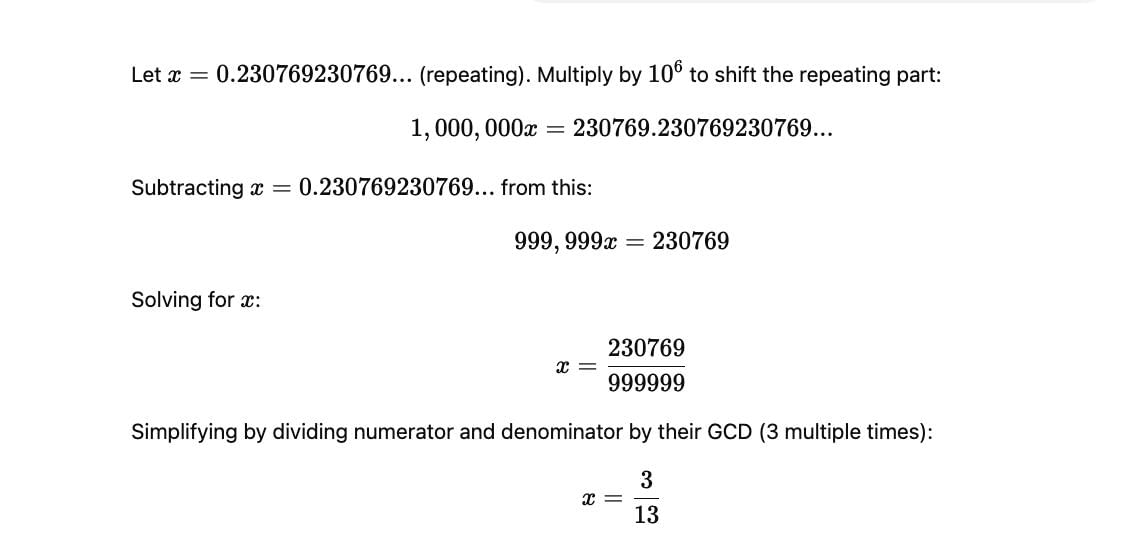
Detailed Solution: Question 15

Test: Irrational Numbers - Question 16

The ratio of the circumference of a circle to the diameter of the circle is.

Detailed Solution: Question 16

Circles are all similar, and "the circumference divided by the diameter" produces the same value regardless of their radius. This value is the ratio of the circumference of a circle to its diameter and is called π (Pi). This constant appears in the calculation of the area of a circle and is a type of an irrational number known as a transcendental number that can be expressed neither by a fraction nor by any radical sign such as a square root, nor their combination. 

Test: Irrational Numbers - Question 17

Of the given numbers
(i) √23
(ii) √256
(iii) 0.3796
(iv) 7.478478…
(v) 1.101001000100001…

Detailed Solution: Question 17

i) √23

√23 = √23/1 = p/q, but p is not an integer.

Hence √23 is an irrational number.

ii) √256

√256 = 16/1 = p/q, where p and q are integers and q ≠ 0.

Hence √225 is a rational number.

iii) 0.3796

0.3796 is a rational number because it is a terminating decimal number.

iv) 7.478478...

7.478478... is a rational number as it is a non-terminating recurring decimal i.e, the block of numbers 478 is repeating.

v) 1.101001000100001 . . . .

It is an irrational number because it is a non-terminating and non-recurring decimal.

Test: Irrational Numbers - Question 18

Which among these is the approximate value of π?

Detailed Solution: Question 18

The number π  is a mathematical constant. Originally defined as the ratio of a circle's circumference to its diameter, it now has various equivalent definitions and appears in many formulas in all areas of mathematics and physics. It is approximately equal to 3.14159. It has been represented by the Greek letter "π" since the mid-18th century, though it is also sometimes spelled out as "pi". It is also called Archimedes' constant.

Test: Irrational Numbers - Question 19

The decimal expansion 0.080080008000080000080000008….. is a

Detailed Solution: Question 19

The decimal expansion 0.080080008000080000080000008….. is a. Non-terminating, non-recurring. Non-terminating, recurring.

Test: Irrational Numbers - Question 20

How many rational numbers can you find between 5 and 6?​

Detailed Solution: Question 20

Infinitely many. You can say 5.1 is a rational number lying between 5 and 6. 5.01, 5.001, 5.0001, 5.00001 and so forth.

Test: Irrational Numbers - Question 21

Which of the following numbers is irrational?

Detailed Solution: Question 21

√8 is an irrational number because it cannot be expressed as a fraction of two integers, and its decimal form is non-terminating and non-repeating.
In contrast:

  • 0.333… is a repeating decimal, hence rational.

  • 7/2 and 5 are integers/fractions, hence rational.

Test: Irrational Numbers - Question 22

Which of the following statements is false?

Detailed Solution: Question 22

[Irrational numbers cannot be expressed in the form p/q where both p and q are integers and q ≠ 0. This form is exclusive to rational numbers, making Option B false.]

Test: Irrational Numbers - Question 23

Convert 7/25 in the form of decimals,

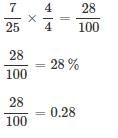
Detailed Solution: Question 23

Test: Irrational Numbers - Question 24

From the choices given below mark the co-prime numbers

Detailed Solution: Question 24

Co-prime numbers are numbers whose HCF = 1.

Test: Irrational Numbers - Question 25

Which of the following statement is true?

Detailed Solution: Question 25

The real numbers consist of both rational and irrational numbers. so the other three options are not true as the first one is not true because not only every real number is a rational number but the real number is rational and irrational both. same goes for the second one and the last option is not true because one half and the other half can be irrational or rational both.

40 videos|468 docs|55 tests
Information about Test: Irrational Numbers Page
In this test you can find the Exam questions for Test: Irrational Numbers solved & explained in the simplest way possible. Besides giving Questions and answers for Test: Irrational Numbers, EduRev gives you an ample number of Online tests for practice
40 videos|468 docs|55 tests
Download as PDF