CBSE Class 9  >  Class 9 Test  >  Mathematics (Maths)   >  20-Minute Test: Real Numbers - Class 9 MCQ

Real Numbers - Class 9 Maths Free MCQ Practice Test with solutions


MCQ Practice Test & Solutions: 20-Minute Test: Real Numbers (20 Questions)

You can prepare effectively for Class 9 Mathematics (Maths) Class 9 with this dedicated MCQ Practice Test (available with solutions) on the important topic of "20-Minute Test: Real Numbers". These 20 questions have been designed by the experts with the latest curriculum of Class 9 2026, to help you master the concept.

Test Highlights:

  • - Format: Multiple Choice Questions (MCQ)
  • - Duration: 20 minutes
  • - Number of Questions: 20

Sign up on EduRev for free to attempt this test and track your preparation progress.

20-Minute Test: Real Numbers - Question 1

 By simplifyingwe get __________

Detailed Solution: Question 1

We know that 
By applying that rule here, we get = 
= 7-5
= 2.

20-Minute Test: Real Numbers - Question 2

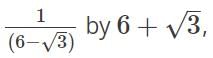
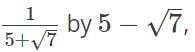
By rationalising the denominator of we get __________

Detailed Solution: Question 2

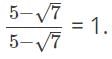
When the denominator of an expression contains a term with a square root, the process of converting it to an equivalent expression whose denominator is a rational number is called rationalising the denominator.
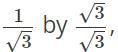
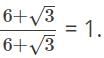
By multiplying we will get same expression since 
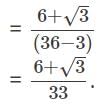
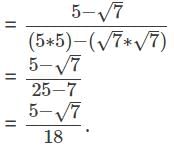
Therefore, 

20-Minute Test: Real Numbers - Question 3

By simplifying we get __________

Detailed Solution: Question 3

We know that 
By applying that rule here, we get 
since 

20-Minute Test: Real Numbers - Question 4

By simplifying (8)2/3, we get __________

Detailed Solution: Question 4

According to laws of exponents, am/n = (n√a)m.
Applying that rule here, 82/3 = (3√8)2
= 22
= 4.

20-Minute Test: Real Numbers - Question 5

Simplify 8√35 (÷) 4√5

Detailed Solution: Question 5

On simplification,

√35 = √(7x5) = √7 x √5
= 8√35 = 8 x √7 x √5
= 8 x √7 x √5
     4 x √5
=2√7

20-Minute Test: Real Numbers - Question 6

By rationalising the denominator of we get __________

Detailed Solution: Question 6

When the denominator of an expression contains a term with a square root, the process of converting it to an equivalent expression whose denominator is a rational number is called rationalising the denominator.
By multiplying we will get same expression since  
Therefore, 

20-Minute Test: Real Numbers - Question 7

By rationalising the denominator ofwe get __________

Detailed Solution: Question 7

When the denominator of an expression contains a term with a square root, the process of converting it to an equivalent expression whose denominator is a rational number is called rationalising the denominator.
By multiplying we will get same expression since 
Therefore, 

20-Minute Test: Real Numbers - Question 8

By simplifying (5)3/8, we get __________

Detailed Solution: Question 8

According to laws of exponents, am/n = (n√a)m.
Applying that rule here, 53/8= (53)1/8
= (5*5*5)1/8
= (125)1/8.

20-Minute Test: Real Numbers - Question 9

By simplifying (3)1/3 * (3)2/3, we get __________

Detailed Solution: Question 9

According to laws of exponents, am an = a(m+n)
Applying that rule here, (3)1/3 * (3)2/3 = 3(1/3+2/3)
= 3(1+2)/3
= 33/3
= 31 = 3.

20-Minute Test: Real Numbers - Question 10

By simplifying (5)3/4/(5)1/4, we get __________

Detailed Solution: Question 10

According to laws of exponents, am/an = am-n
Applying that rule here, (5)3/4/(5)1/4 = (5)(3/4-1/4)
= (5)(3-1)/4
= (5)2/4
= (5)1/2
2√5.

20-Minute Test: Real Numbers - Question 11

By simplifying (13)1/2/(13)7/2, we get __________

Detailed Solution: Question 11

According to laws of exponents, am/an = am-n
Applying that rule here, (13)1/2/(13)7/2 = 13(1/2-7/2)
= 13((1)-(7))/(2)
= 13((-6))/(2)
= 13-3.

20-Minute Test: Real Numbers - Question 12

By simplifying 23*53, we get __________

Detailed Solution: Question 12

According to laws of exponents, (am)*(bm) = (ab)m
Applying that rule here, 23*53=(2*5)3
=(10)3
= 1000.

20-Minute Test: Real Numbers - Question 13

3√6 + 4√6 is equal to:

Detailed Solution: Question 13

To add like terms with radicals, you simply add the coefficients and keep the radical part the same.
3√6​ + 4√6​=(3 + 4)√6​ = 7√6​
Answer: (b) 7√6

20-Minute Test: Real Numbers - Question 14

√6 x √27 is equal to:

Detailed Solution: Question 14

Using the property of square roots 

Now, simplify 

20-Minute Test: Real Numbers - Question 15

Every real number is

Detailed Solution: Question 15

Either you can make a fraction from two whole numbers (denominator ≠ 0), thus a rational number. Or you can't, thus irrational.

20-Minute Test: Real Numbers - Question 16

The largest number which divides 70 and 125, leaving remainders 5 and 8 respectively, is      

Detailed Solution: Question 16

Since, 5 and 8 are the remainders of 70 and 125, respectively. Thus, after subtracting these remainders from the numbers, we have the numbers 65 = (70-5),
117 = (125 – 8), which is divisible by the required number.
Now, required number = HCF of 65,117                                     [for the largest number]
For this, 117 = 65 × 1 + 52 [∵ dividend = divisior × quotient + remainder]
⇒ 65 = 52 × 1 + 13
⇒ 52 = 13 × 4 + 0
∴ HCF = 13 
Hence, 13 is the largest number which divides 70 and 125, leaving remainders 5 amnd 8.

20-Minute Test: Real Numbers - Question 17

Which of the following is equal to x3?

Detailed Solution: Question 17

Let's analyze each option:

(a) x6−x3 is not equal to x3 because it represents a subtraction of two different powers of x.
(b) x6⋅x3 is equal to x6+3=x9, which is not equal to x3.
(c) x6/x3​ is equal to x6−3=x3, which is equal to x3.
(d) (x6)3 is equal to x6×3=x18, which is not equal to x3.

    20-Minute Test: Real Numbers - Question 18

    4√5 + 5√5 is equal to:

    Detailed Solution: Question 18

    To add like terms with radicals, you simply add the coefficients and keep the radical part the same.
    4√5+5√5=(4+5)√5=9√5
    Answer: (a) 9√5

    20-Minute Test: Real Numbers - Question 19

    Simplify 

    Detailed Solution: Question 19

    Factorise the terms
    5 × √5 × 3×√5 = 5×3×5 =75

    20-Minute Test: Real Numbers - Question 20

    2√3+√3 = 

    Detailed Solution: Question 20

    Let's solve this step by step in a simple way:

    We are given:

    2√3 + √3

    Step 1: Think of √3 as a common item.
    So, we treat it like:

    2√3 + 1√3

    Step 2: Add the numbers in front of √3:

    (2 + 1)√3 = 3√3

    So, the correct answer is:

    c) 3√3

    40 videos|468 docs|55 tests
    Information about 20-Minute Test: Real Numbers Page
    In this test you can find the Exam questions for 20-Minute Test: Real Numbers solved & explained in the simplest way possible. Besides giving Questions and answers for 20-Minute Test: Real Numbers, EduRev gives you an ample number of Online tests for practice
    40 videos|468 docs|55 tests
    Download as PDF