CBSE Class 9  >  Class 9 Test  >  Online MCQ Tests  >  Test: Parallelograms Diagonal Properties - Class 9 MCQ

Parallelograms Diagonal Properties - Free MCQ Practice Test with solutions,


MCQ Practice Test & Solutions: Test: Parallelograms Diagonal Properties (5 Questions)

You can prepare effectively for Class 9 Online MCQ Tests for Class 9 with this dedicated MCQ Practice Test (available with solutions) on the important topic of "Test: Parallelograms Diagonal Properties". These 5 questions have been designed by the experts with the latest curriculum of Class 9 2026, to help you master the concept.

Test Highlights:

  • - Format: Multiple Choice Questions (MCQ)
  • - Duration: 10 minutes
  • - Number of Questions: 5

Sign up on EduRev for free to attempt this test and track your preparation progress.

Test: Parallelograms Diagonal Properties - Question 1

Which of the following statements is correct with respect to a parallelogram?
1. Diagonals bisect each other.
2. Adjacent angles are supplementary.
3. Opposite sides are equal.
4. Opposite sides are parallel​

Detailed Solution: Question 1

In a parallelogram, the following statements are correct:

  • Diagonals bisect each other, meaning they cut each other in half.
  • Adjacent angles are supplementary, which means they add up to 180 degrees.
  • Opposite sides are equal in length.
  • Opposite sides are parallel to each other.

Therefore, all the listed statements about the properties of a parallelogram are true.

Test: Parallelograms Diagonal Properties - Question 2

The diagonal of a square is 10 cm. Its area is:​

Detailed Solution: Question 2

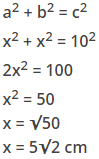
Let x = the length of a side of the square

So area of square = x2 = 50cm2

Test: Parallelograms Diagonal Properties - Question 3

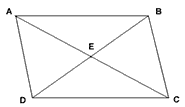
ABCD is a parallelogram E is the midpoint of _______.
Test: Parallelograms Diagonal Properties - Question 4

The diagonals of rhombus are 12 cm and 16 cm. The length of the side of rhombus is:

Detailed Solution: Question 4
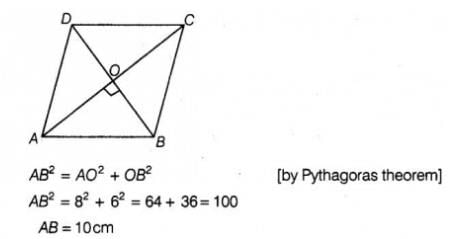
We know that, the diagonals of a rhombus are perpendicular bisector of each other.
Given,  AC = 16 cm and BD = 12 cm        [let]
∴ AO = 8cm, SO = 6cm
and  ∠AOB = 90°
In right angled ∠AOB,

Test: Parallelograms Diagonal Properties - Question 5

A diagonal of a parallelogram divides it into two congruent:

Detailed Solution: Question 5

- A diagonal of a parallelogram creates two triangles.
- These triangles are congruent because:
- A diagonal is a common side for both triangles.
- Opposite angles in a parallelogram are equal.
- Alternate interior angles are equal due to parallel sides.
- Using these equal angles and the shared side, the triangles are congruent by the ASA (Angle-Side-Angle) criterion.
- Therefore, the correct answer is C: Triangles.

5 docs|319 tests
Information about Test: Parallelograms Diagonal Properties Page
In this test you can find the Exam questions for Test: Parallelograms Diagonal Properties solved & explained in the simplest way possible. Besides giving Questions and answers for Test: Parallelograms Diagonal Properties, EduRev gives you an ample number of Online tests for practice
Download as PDF